Changing color · Easy
Stripes
To crochet stripes in rows, change color on the last pull of the last stitch of a row, so that the turning chain and the whole of the next row are the new color. Make each band an even number of rows, 2 or 4, and neither yarn needs cutting: each one is waiting at the side edge when its turn comes again. The rows on this page are single crochet (UK double crochet) in bands of 2 rows.
How to work it
Work an even number of rows

Work 2 rows in the new color, or 4. A row out and a row back bring the hook to the edge it started from, so after an even number of rows you are at the edge where the first color was left.
Cut the yarn when the rows are odd, or many

After an odd number of rows the hook is at the opposite edge from the waiting yarn. Cut that yarn, leaving a tail, and join it again at the edge where it is needed. Cut it also when a band is many rows tall: a strand carried that far up the edge is long enough to catch on things.
In the round, hide the step

Stripes worked round and round in a spiral cannot close: the end of a stripe does not meet its beginning, and a step shows at that place. To hide it, work in joined rounds and make the color change in the slip stitch that joins the round. Or finish each stripe with an invisible join, cut the yarn, and begin the next color with a standing stitch.
The stitch pattern, row by row
- Multiple
- Chain any number (3 or more).
- Starting chain
- The rows here are written for a chain of 21.
- The ch 1 at the start of a row does not count as a stitch.
- Row 1 is the right side.
- Change yarn in the last yarn over of the last stitch of the row before.
- Do not cut a yarn that rests: it waits at the edge where its next row begins and is carried loosely up that edge, over 2 rows at most.
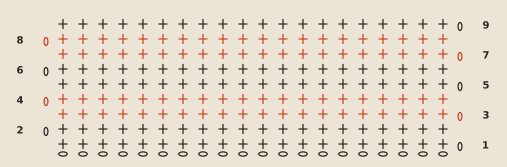
- Foundation. With A, ch 21.
- Row 1 (RS). Sc in 2nd ch from hook and in each ch across (20 sc).
- Row 2. Ch 1, turn; sc in each st across (20 sc).
- Row 3. With B, ch 1, turn; sc in each st across (20 sc).
- Row 4. Ch 1, turn; sc in each st across (20 sc).
- Row 5. With A, ch 1, turn; sc in each st across (20 sc).
Repeat rows 2 to 5 for the pattern.
What each symbol meansHow to read a chart
Abbreviations in these rows
- ch
- chain stitch
- sc
- single crochet (UK double crochet)
- RS
- right side
- st
- stitch
At a glance
- Used for
- bands of color in a blanket, a scarf or a dishcloth; stripes round a hat or a toy worked in the round
- Where the color changes
- On the last pull of the last stitch of the row before.
- Bands of 2 or 4 rows
- The waiting yarn is at the edge where it is needed. Carry it up the side.
- Bands of 1 or 3 rows
- The waiting yarn is at the other edge. Cut it and join it again.
- In the round
- A spiral leaves a step where each stripe ends. Joined rounds, or an invisible join, hide it.
- Multiple
- Any number of chains (3 or more).
- Row repeat
- Rows 2 to 5.
- Sides
- Looks much the same on both sides.
- Edges
- The side edges are straight: a row that begins with a chain that does not count begins and ends in a stitch, and that chain is not worked into.
The color change is the same in any stitch: the new color is pulled through on the last pull of the stitch before. For a stripe, that stitch is the last one of the row before, so the turning chain is already the new color.
Carrying the yarn up the side saves two tails at every change. The strand that runs up the edge is called a float. Over 2 or 4 rows it is short. Over many rows it grows long, and cutting is the safer way. The page Carrying yarn shows how the strand lies and how to catch a longer one in at the edge.
Cut ends are woven in afterwards. A striped piece with every color cut has two tails at each change, so narrow stripes of many colors mean many ends.
In the round the same change is used. The trouble is only at the place where one round ends and the next begins: in a spiral the two ends of a stripe do not meet there.
When it goes wrong
- The turning chain, or the first stitch of my stripe, is the old color.
- The change was made too late. Pull the new color through the last two loops of the last stitch of the row before, and make the turning chain with it.
- The yarn I want is at the wrong edge.
- The band below has an odd number of rows. Cut the yarn and join it at this edge, or plan the stripes in even numbers of rows.
- The edge pulls in where the yarn is carried.
- The strand up the side is too tight. Pick the yarn up more loosely, so that the strand lies flat along the rows it passes.
- A step shows where my stripes meet in the round.
- That is the jog of a spiral. Change to joined rounds for the striped part, with the color change made in the joining slip stitch, or end each stripe with an invisible join and start the next color with a standing stitch.
Left-handed
The pictures show the hook held in the right hand. For the left hand, read each picture as its mirror image.
Questions
- How do I crochet stripes without cutting the yarn?
- Make every band an even number of rows. Each yarn is then at the same side edge when it is needed again, and it is carried up that edge instead of being cut.
- Can I make stripes of one row?
- With two colors, yes, if the yarn is cut at each change. After one row the yarn you left is at the other edge, so it cannot be carried up the side.
- How do I crochet jogless stripes in the round?
- Do not work the striped part in a spiral. Join each round, and change color in the joining slip stitch; or close each stripe with an invisible join and begin the next color with a standing stitch.
- Where exactly does the color change go?
- In the last stitch before the new color: when two loops are left on the hook, the new yarn is pulled through them. For a stripe that begins with a row, that is the last stitch of the row before.