Needlepoint guide
Faded needlepoint: what can and cannot be done
Faded needlepoint cannot be dyed or sprayed back to what it was. Light has destroyed the color, and dye, paint and bleach do new harm. You can clean off dullness, restitch small areas in colors taken from the back, and stop it fading further.
On this page 10 parts
Start here
- Look at the back. Turn up a corner, or take off the backing at one edge. If the back is much brighter than the front, light has faded it. If both are equally dull, it may only be dirty.
- Touch it lightly. If threads crumble or hairs come away, stop here. Do not vacuum or wet it. It needs a textile conservator, a person trained to look after old cloth.
- Vacuum it. Dust makes every color look gray. How to clean needlepoint tells you how, through a screen and on low suction.
- Look again. Many dull pieces need no more.
- Choose one thing. Leave it as it is and move it out of the light, restitch a small area, or ask a textile conservator. An antique, anything with silk, and anything you could not bear to lose goes to the conservator: how to repair needlepoint ends with how to find one.
Faded or dirty?
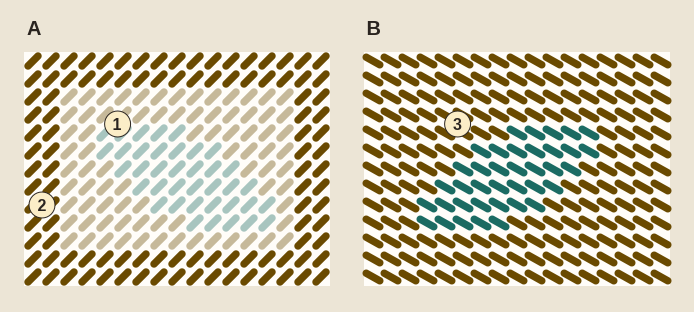
| What you see | Likely cause |
|---|---|
| Back bright, front pale | Fading |
| A clean line where a frame, a seam or a chair rail covered it | Fading |
| Pale only on the side toward a window | Fading |
| Gray or brown all over, front and back alike | Dirt, smoke or age |
| Reds gone and greens turned brown or bluish | Fading: some dyes go sooner than others |
| A dark or yellow patch with an edge | A stain, not fading |
| Threads crumble or hairs come away at a touch | Damaged fiber: stop, and do not vacuum or wet it |
Fading and weakness go together. Light that has taken the color has also made the fibers brittle, so a badly faded piece should be handled as a fragile one.
Why not dye, paint or spray it?
- Dye needs heat and acid. Wool takes dye in a simmering bath. The bath would dissolve the stiffener in the canvas, shrink the wool and let the old colors run.
- One dye colors everything. It adds its own color to every stitch, the pale background as well as the rose, and wool, silk and cotton each take it differently.
- Paint and fabric sprays sit on top. Most are transparent, so they tint what is there and cannot cover it. They stiffen the surface, fill the texture of the stitches and cannot be taken out again.
- Bleach and color removers eat fiber. Wool and silk are damaged by them.
- Vinegar and salt do not bring color back. They do not set loose dye in finished work either.
- Markers fade too. They fade unevenly, and spread into the stitches beside them if the piece is ever damp.
A conservator will not usually put color back at all. What a conservator can do is clean a piece safely, strengthen it, support what is weak, and decide with you whether a little new stitching would help.
Restitching a faded patch
This suits a sturdy piece that is not old or valuable: a pillow, a seat, a kit from a few decades back. Read how to repair needlepoint first for a worn or broken area.
- Choose the smallest area that will help. A rose center or one leaf often lifts the whole piece. A whole background seldom repays the work.
- Read the colors from the back. Lay threads beside the back, in daylight, and note the ones that match. A run of the same color from dark to light, such as four neighboring numbers, is the most useful thing to have.
- Step them down. New thread at full strength looks like a patch. Lay the thread that matched the back on the faded front, beside stitches that are staying. Then lay the next paler shade there, and the next. Stand back and half close your eyes: the right one is the strongest that does not jump out. If two shades are each a little wrong, thread one thin strand of each in the needle together.
- Match the rest. Use the same kind of thread, the same thickness and the same stitch, slanting the same way.
- Take out or cover. If the canvas beneath is sound, snip the old stitches on the front, a few at a time, and draw the pieces out from the back. If taking them out would leave the canvas weak, work over them stitch for stitch in a thread half as thick. The table below helps you choose.
- Fasten the cut ends. Where an old thread was cut, take out a few more of its stitches until the loose end is long enough to thread, and run it under stitches on the back. "Taking stitches out safely" in how to repair needlepoint has the whole of it.
- Stitch the patch. Run the end of the new thread under a few stitches on the back to begin, and again to end: see how to start and end a thread.
- Stop and look. After each color, hang the piece up and stand back.
| Take the old stitches out | Stitch over them | |
|---|---|---|
| Surface | Level with the rest | A little raised |
| Thread | The same thickness as the old | About half as thick |
| Risk | Cutting a canvas thread | Crowding the holes, and splitting the old wool |
| Use it when | The canvas is sound | The canvas is tired or the area is tiny |
A perfect match to a faded color is close to impossible, because thread is not dyed in faded colors, so stop when it no longer catches the eye.
A painted canvas that has faded before it is stitched
This one is easy, because the stitches will cover the paint. Stitch in strong colors and let the paint be only a map. Look for the first colors where light has not reached: under tape, in a fold, on the turned edge. Where a line is too faint to follow, go over it with an acrylic paint pen, or dab thinned acrylic paint on the crossings, the places where two canvas threads cross. Try the pen or paint on the margin first. Let it dry, wet it, and press a white cloth on it. If color comes off, use another: how to paint a canvas has the trial in full. Never use a ballpoint pen.
How fast does it fade?
The damage adds up: half the light for twice as long does the same harm. These are a conservation institute's figures for the years or days until a change can just be seen in colors that fade easily, and in colors of middling strength. A day is counted as eight hours of light. Lux is the measure of how much light falls on a thing.
The spans are wide because each group holds colors that differ. Nobody can tell by looking where one color falls, and it is mostly the dye that decides, not the wool. So plan by the shorter figure. Use the "fade easily" column for anything old or of unknown dye, and the other for madder reds and for thread whose maker says it stands up to light.
| Light | Where | Colors that fade easily | Middling colors |
|---|---|---|---|
| 50 lux | A dim museum room | 1 1/2 to 20 years | 20 to 700 years |
| 150 lux | A softly lit room | Half a year to 7 years | 7 to 200 years |
| 500 lux | A bright office | 7 weeks to 2 years | 2 to 70 years |
| 5,000 lux | Near a window, or close under a lamp | 5 days to 2 months | 2 months to 7 years |
| 30,000 lux | Average daylight | 1 day to 2 weeks | 2 weeks to 1 year |
Glass that blocks ultraviolet helps, and does not stop it. What helps most is less light: a wall with no sun on it, shades drawn in the bright hours, lamps off when nobody is there, and a piece shown for a season and then rested in the dark.
Which colors faded, and when they came in
| When | Dyes | How they hold in light |
|---|---|---|
| Before the 1850s | Plants and insects | Indigo blue on wool holds best; madder reds are middling; most yellows, oranges, purples and cochineal reds fade easily |
| 1845 | Picric acid, the first synthetic yellow | Poor |
| 1856 to about 1870 | Mauve, magenta and the other aniline colors, soon used for Berlin wool | Brilliant when new, poor in light and in water |
| From 1868 | Synthetic alizarin, a red to replace madder | Middling, like madder |
| From 1878 | Azo dyes, a very wide range | Varies: cheap ones fade easily |
| From about 1900 | Synthetic indigo | Good on wool, like the plant |
| Today | Dyes chosen and graded by their makers | Much better, but none is proof against sun |
Two more things an old piece can show. A green made of blue and yellow turns bluish when the yellow goes. And a black or dark brown dyed with iron rots the wool, so that the outlines of an old design fall out while the rest stands. Vintage and antique needlepoint and the history of needlepoint help to place a piece in time.
Dyeing yarn or canvas before you stitch
Dye before stitching, never after, and dye more yarn than you think you will need, because a second bath will not match.
Wool yarn, with an acid dye
Follow the maker's sheet for amounts and heat. The order is the same for all of them.
- Tie it loosely. Wind the yarn into an open skein and tie it in three or four places, slack.
- Wash and soak it. Wash in mild soap, rinse, and leave it in plain water until it is wet through.
- Mix the bath. Use a stainless or chip-free enamel pot kept for dyeing, never for food, and enough water for the yarn to move. Add the dye and the acid its sheet calls for, often white vinegar, about a quarter cup (60 ml) to a pound (450 g) of wool.
- Heat it slowly. Put in the wet yarn and bring it up to just below a simmer.
- Hold it there. Keep it hot until the water is nearly clear, commonly about half an hour. Move the yarn gently. Boiling and stirring felt it.
- Cool it in the pot.
- Rinse. Use water as warm as the yarn, until it runs clear.
- Dry it in the shade.
Wear gloves and do not breathe the powder. Cotton and linen need a different dye, and acrylic and other synthetics another again.
Tea, for an aged look
Tea gives beige to brown on cotton thread and cloth. Steep two black tea bags to each cup (240 ml) of water just off the boil for 15 minutes or more, take the bags out, put in the thread ready wetted, and leave it an hour or longer. It dries lighter than it looks wet. Rinse until the water is clear. Then give it the trial below. Tea is not a fast dye, which means that some of it can come out again: keep it off anything that will be washed, and have the piece blocked dry.
Canvas
Canvas holds a water-soluble stiffener, so a soak leaves it limp. To tint it, pin it square to a covered board and brush on thinned acrylic paint, as little as will color it, and leave it pinned until it is dry. Paint that has passed the trial in how to paint a canvas stays when the finished piece is damped for blocking. Tea may not, so use tea only on canvas that will be kept dry from then on. A colored canvas bought ready dyed is easier.
The wash-fast trial
- Lay the thread on a damp towel. Dampen a white paper towel with warm water and put a short length of the thread on it.
- Press it. Fold the towel over, press, and leave it ten minutes.
- Open it. Any color on the towel means the thread will run.
- Rinse and try again. Rinse the skein and repeat the trial, or keep that thread for a piece that will never be wetted. Finished needlepoint is usually damped and pinned square, which is called blocking, so tell whoever finishes it that the thread runs and that it must be pinned out dry, with no water and no steam. No amount of salt or vinegar will fix it.
What goes wrong
| Mistake | Why | Do this |
|---|---|---|
| A new patch glares | Thread chosen from the back alone | Choose between back and front |
| Colors ran in cleaning | Not every color was tried | Try each color with water first; blot, do not rub |
| Holes after restitching | Canvas cut with the old wool | Work over old stitches where canvas is weak |
| New yarn in two shades | Two dye baths or two dye lots | Dye or buy it all at once |
| It faded again | The light was not changed | Move it before you mend it |
Questions people ask
Can a professional re-dye needlepoint? A cleaner or upholsterer may offer to tint it. For a piece you value, ask a textile conservator first, since tinting cannot be undone.
Does a fabric protector keep the colors? It does not stop light, which is what fades them. Less light is the only protection.
Will washing brighten it? Washing removes dirt, and only that. Where the dye is gone there is nothing to brighten.
Should I turn the piece over and use the back? You can, if the back is tidy: the back of basketweave, tent stitch worked on the diagonal, is an even weave in the first colors. Ends and carried threads will show too, and the design is reversed, so letters read backward.