Needlepoint guide
How to make a needlepoint challah cover
Most needlepoint challah covers are a stitched panel, 14 by 12 inches (36 by 30 cm) or smaller, set on a lined cloth of 20 by 16 inches (51 by 41 cm). The cloth drapes and can be washed, and the needlepoint stays flat. Stitched all over, a cover is 19 by 15 inches (48 by 38 cm), 247 by 195 stitches on 13 mesh.
On this page 14 parts
What it has to do
In many Jewish homes a challah cover lies over the two braided loaves on the table until the blessing over the wine has been said. Two things make it do its work: it hangs past the bread on every side, and no bread can be seen through it.
- Ask, if it is a gift: which colors, whether it carries words and which, and whether it is for the Sabbath, for a holiday or for both.
- Measure the loaves as below.
- Choose how much to stitch from the next table.
- Choose or draw the panel. The Judaica designs here have a challah cover of 14 by 12 inches (36 by 30 cm) on 13 mesh. Any of the tallit bag panels is the same size.
Four ways to build it
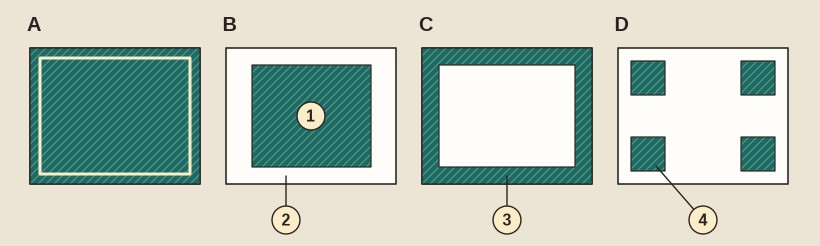
| Way | Good | Watch |
|---|---|---|
| A. All needlepoint | The whole field is yours | Stiff and heavy: it stands over the bread like a board unless you keep it supple, as below |
| B. A panel on cloth | Drapes at the edges, half the stitching or less, and the panel can come off | The panel must be square |
| C. A border | A plain middle over the bread | The middle of the canvas is cut away |
| D. One motif or four | The quickest, and the softest | Motifs need the same distance from both edges |
A strip across the middle is another way: a band of needlepoint the width of the cover and 6 inches (15 cm) deep, with suede or velvet above and below.
Measure the loaves
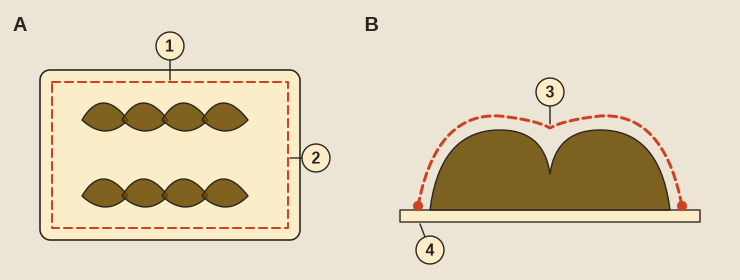
- Set out two loaves of the usual size on their board, or two rolled towels.
- Lay a tape over them the long way, from the board at one end to the board at the other (3).
- Do it again across both loaves.
- Add 2 inches (5 cm) to each. That is the finished cover.
Two long loaves lying side by side are covered by 20 by 16 inches (51 by 41 cm), the size most often sold. For two small loaves the tape may say 15 by 12 inches (38 by 30 cm).
Sizes
Mesh is the number of holes to the inch (2.5 cm). The counts are the stitching alone: add two rows all round for a turned edge, which is 4 to each count. The canvas leaves 2 inches (5 cm) bare beyond.
| Piece | Stitched size | 13 mesh | 18 mesh | Canvas to cut |
|---|---|---|---|---|
| All over, large | 19 x 15 inches (48 x 38 cm) | 247 x 195 | 342 x 270 | 23 1/2 x 19 1/2 inches (60 x 50 cm) |
| All over, medium | 16 x 14 inches (41 x 36 cm) | 208 x 182 | 288 x 252 | 20 1/2 x 18 1/2 inches (52 x 47 cm) |
| All over, small | 15 x 11 1/2 inches (38 x 29 cm) | 195 x 150 | 270 x 207 | 19 1/2 x 16 inches (50 x 41 cm) |
| Panel for a cloth of 20 x 16 inches (51 x 41 cm) | 14 x 12 inches (36 x 30 cm) | 182 x 156 | 252 x 216 | 18 1/2 x 16 1/2 inches (47 x 42 cm) |
| Small panel | 10 x 8 inches (25 x 20 cm) | 130 x 104 | 180 x 144 | 14 1/2 x 12 1/2 inches (37 x 32 cm) |
| Corner motif, each | 4 x 4 inches (10 x 10 cm) | 52 x 52 | 72 x 72 | 8 1/2 x 8 1/2 inches (22 x 22 cm) |
| Panel for a matzah cover | 12 x 12 inches (30 x 30 cm) | 156 x 156 | 216 x 216 | 16 1/2 x 16 1/2 inches (42 x 42 cm) |
| Afikoman bag, front | 10 1/2 x 8 3/4 inches (27 x 22 cm) | 137 x 114 | 189 x 158 | 15 x 13 1/2 inches (38 x 34 cm) |
The canvas size calculator does other sizes. Thread, as an estimate, in tent stitch, the small slanted stitch over one crossing: a panel of 14 by 12 inches (36 by 30 cm) with its extra rows takes about 282 yards (258 m) on 13 mesh and 385 yards (352 m) on 18, all colors together.
Plan the panel
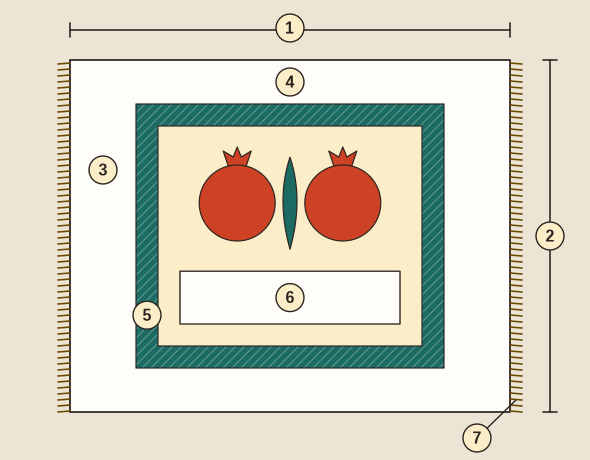
- Draw the panel on squared paper with its center lines.
- Draw the border. One inch (2.5 cm) is 13 stitches on 13 mesh.
- Keep a band for words, if there are to be any: 1 1/2 to 2 inches (4 to 5 cm) deep, 20 to 26 stitches on 13 mesh. Have the words written out by the family in the letters they use, and checked by someone who reads them, before they are charted. Centering is in how to stitch lettering.
- Place the motif above it, centered across.
- Choose colors by the table it lies on. A bright cover on a white cloth is seen first. On a patterned one, keep to two or three.
Motifs often used are pomegranates, grapes and vines, wheat, flowers, candles, the roofs of Jerusalem and a tree of life. Covers have never been of one kind: an old one in a museum shows the seal of a country.
Thread, cloth and stitches
| Use | Leave out | |
|---|---|---|
| Thread | Cotton floss or pearl cotton, or wool: colors that pass the test for running | Overdyed thread, and dark reds that bleed |
| Metallic | A little, in the middle of the design | On the folds and edges, where it frays and scratches |
| Ground | Basketweave, mosaic, brick | Open stitches, long loops, beads near the bread |
| Cloth | Linen, cotton, satin, raw silk or velvet. Washed first if it will be washed after | Cloth you can see through |
| Lining | Smooth, close cotton, which lets crumbs go | Felt and fleece, which hold them |
To keep an all-stitched cover supple: work it on 18 mesh in thin thread, or on 13 mesh in a thread that just covers. Use basketweave. Line it with thin cotton, with no interfacing (stiff cloth) between, and turn the edge instead of binding it.
Make a cover with a panel
You need the stitched panel with two extra rows all round, thin cotton to line it, a top cloth and a lining each 21 by 17 inches (53 by 43 cm), and sewing thread. The seam allowance, the strip of cloth outside a seam, is half an inch (13 mm) and is in those sizes. For fringe, have 1 yard (91 cm).
- Block the panel, if its colors pass the test there: damp it, pin it out square on a board and let it dry.
- Trim the bare canvas to half an inch (13 mm), and cut off each corner on a slant a quarter of an inch (6 mm) outside its point.
- Turn the margin to the back, corners first. Fold between the two extra rows: the inner one is the last you see in front, the outer one goes to the back. Sew the corners, and hold the margin with long stitches.
- Line the panel. Cut the thin cotton half an inch (13 mm) larger than the panel on every side, and press its edges under until it lies just inside the fold. Sew it on with slip stitch, small stitches that hide in the fold. Now it can be handled, and taken off again later.
- Lay the fringe on the right side of the top cloth, the side that will show, along the two short ends, its tape on the edge and its threads lying inward. Keep it half an inch (13 mm) clear of the corners. Baste it: hold it with long stitches that come out later.
- Lay the lining on top, right sides together, so that their good sides face each other, and pin.
- Sew all round, half an inch (13 mm) from the edge. Leave 5 inches (13 cm) open in one long side.
- Cut across the corners, turn it right side out, press it, and sew the gap closed.
- Find the middle of cloth and panel by folding each in four, and mark both with pins.
- Place the panel, center on center: 3 inches (8 cm) of cloth at each side, 2 inches (5 cm) above and below.
- Sew it on, or put it on snaps, as follows.
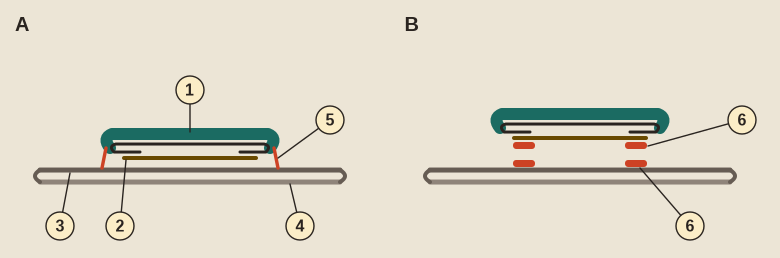
| How | When | |
|---|---|---|
| A. Sewn | Small stitches from the cloth into the folded edge of the panel, through the top cloth only | A cover that is seldom soiled, or silk or velvet that is not washed |
| B. On snaps | Eight flat sew-on snaps: one at each corner and one at the middle of each side. One half to the lining of the panel, the other to the cloth | A linen or cotton cover that goes in the wash: unsnap the panel first |
Set in instead. A panel can be let into a frame of cloth with sewn corners, like a pillow front: the strips and the steps are in how to finish a pillow. For 20 by 16 inches (51 by 41 cm) with straight corners, cut two side strips 4 by 13 inches (10 by 33 cm), then two long strips 3 by 21 inches (8 by 53 cm).
Other edges. A twisted cord round the cover, 72 inches (183 cm) and 4 inches (10 cm) for the ends, a tassel at each corner, or a cord round the panel where it meets the cloth, which hides every uneven stitch.
A border, corners or a strip
These are C and D of the first picture and the strip, for a cover of 20 by 16 inches (51 by 41 cm) on 13 mesh. Make the cloth first, steps 5 to 8 above.
A border. It is one stitched frame with a bare middle, and has no seams.
- Mark the frame on canvas 24 1/2 by 20 1/2 inches (62 by 52 cm): 260 by 208 outside, and 26 stitches, 2 inches (5 cm), wide. Its opening is 208 by 156.
- Stitch it, 21,632 stitches, with two extra rows outside and two inside.
- Block it and trim the outer margin to half an inch (13 mm).
- Cut out the middle, half an inch (13 mm) from the stitching, and snip each inner corner toward the stitching, to within two threads.
- Turn both edges between the two extra rows, and sew the margins down.
- Lay it on the cloth, its outer edge on the edge of the cover, and sew both edges down through the top cloth only.
Corners. Stitch four of 52 by 52, each with two extra rows. Turn and line each as in steps 1 to 4 above. Place them 1 1/2 inches (4 cm) from both edges, and sew them on as A or B in the table.
A strip. Stitch 260 by 78 with two extra rows all round. Cut two cloths 21 by 6 inches (53 by 15 cm). Trim the strip's margin to half an inch (13 mm). Sew a cloth to each long side, right sides together, the needlepoint on top, one row inside the edge of the stitching. Press the margins toward the cloth, from the back. Then line the whole as in steps 5 to 8, sewing one row inside the stitching at the ends of the strip.
Make an all-stitched cover
- Stitch the field and two extra rows all round, in the hand or on a scroll frame, whose two rollers take up the length.
- Block it square and trim the margin to half an inch (13 mm).
- Turn the edge, the corners first and then the sides, as in step 3 of the cover with a panel, and sew the margin down.
- Cut thin cotton half an inch (13 mm) larger all round, and slip stitch it on, a trifle loose.
- Tack the lining, which is to hold it with a tiny stitch, here and there across the middle, so that it does not bag.
- Sew on a cord or fringe by hand. A cord round 19 by 15 inches (48 by 38 cm) is 68 inches (173 cm), and 4 inches (10 cm) for the ends.
A matzah cover
At a Passover meal three matzot, flat sheets of unleavened bread, are stacked, and a cover with three pockets keeps them apart. Four layers of cloth make three pockets.
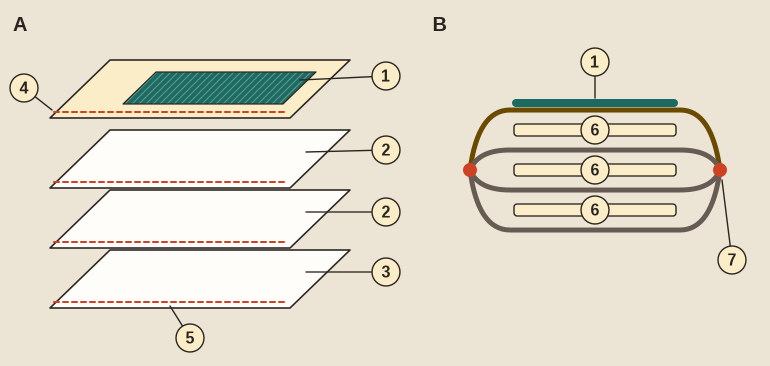
- Measure the matzah. Square sheets and large round ones differ. Add 2 inches (5 cm) each way. Covers are sold 17 to 18 inches (43 to 46 cm) square, which has room for both kinds, or 15 inches (38 cm) round.
- Cut four pieces for 17 inches (43 cm) square: each 17 inches wide and 18 inches long (43 by 46 cm).
- Hem one short edge of each: half an inch (13 mm) under, then half an inch again, and sew. These are the open side.
- Make and line the panel as above, 12 by 12 inches (30 by 30 cm), and sew it to the top piece, 2 1/2 inches (6 cm) from the hem and from where the other three edges will be.
- Stack the four, all face up, the panel on top, the four hems level on one side.
- Baste the other three sides together, a quarter of an inch (6 mm) from the edge.
- Sew on the binding, a strip of cloth or ribbon 1 1/2 inches (4 cm) wide and 54 inches (137 cm) long. Lay it face down on the face of the cover, its edge level with the raw edges, and sew a quarter of an inch (6 mm) in. Turn half an inch (13 mm) in at both ends, at the open side.
- Turn each corner. Stop a quarter of an inch (6 mm) before it. Fold the strip away from you on a slant, then back down along the next side, level with that edge, and sew on from the top of the fold.
- Fold the binding over the edges to the back, turn its raw edge under, and sew it down by hand.
- Sew three stitches over both ends of the open side, where the layers pull.
The afikoman bag holds the piece that is broken off and put aside. Stitch a front of the size in the table and make it up as a lined zip pouch, with two extra rows all round. Repeat one part of the matzah cover's design on it.
A set
A challah cover, a matzah cover and an afikoman bag, or a cover and a tallit bag, match if they share a border, two colors and one motif. Buy the thread for all of it at once, and write down the colors.
Care
- Crumbs: shake it, turn the pockets out and brush them. Crumbs draw insects, so put it away clean.
- Wine: blot at once with a white cloth, and never rub. No salt. How to clean needlepoint has the rest.
- Washing: only the cloth, with the panel off. Needlepoint stays out of the machine.
- Storing: flat, or rolled round a tube with the stitches outward. A fold across the panel stays.
What goes wrong
| What you see | Why | Cure |
|---|---|---|
| It stands up like a tent | Stiff canvas, interfacing (stiff cloth inside), thick thread | Make it a panel on cloth |
| Bread shows at the sides | The height of the loaves was left out | Add a band of cloth or a deep fringe |
| The panel is crooked | It was placed by its edges and not its middle | Unpick, fold both in four and match |
| Bare canvas at the panel's edge | The extra rows were left out | A cord round the edge |
| The cloth puckers round the panel | It was pulled tight as it was sewn | Sew again on a flat table, pinned from the middle out |
| The lining shows at the edge | Both were cut the same and pressed carelessly | Press the edge so that the top cloth rolls a hair to the back |
| A fringe thread is caught in the seam | It lay across the edge | Snip one stitch, ease it out, close the stitch |
| A motif is upside down for those who face it | Nobody said which side is the front | Turn the cover, or place a motif at each end |
Questions people ask
What size is a challah cover? About 20 by 16 inches (51 by 41 cm), or 19 1/2 by 15 1/2 (50 by 39 cm). Canvases stitched all over are 15 to 19 inches (38 to 48 cm) wide.
13 or 18 mesh? 13 for a panel, 18 for a small one or for a cover that must drape. The large panel is 28,392 stitches on 13 and 54,432 on 18.
Can a pillow design become a challah cover? Yes. One 14 by 14 inches (36 by 36 cm) goes on a cloth 20 by 18 inches (51 by 46 cm).
Does a finisher make them? Many of the people who sew up stitched canvas for others do. Ask for the sizes, the backs and the fringe they keep, whether the panel can be taken off, and how many extra rows to stitch. Cloths are compared in how to back needlepoint.