Needlepoint guide
How to make needlepoint coasters
Stitch four squares, each 4 inches (10 cm), on one piece of canvas 14 inches (36 cm) square, in stitches that lie flat, such as basketweave, with no knots or beads. Block them together (dampen the canvas and pin it out square until it is dry), cut them apart, cover each edge with the braid called binding stitch and sew felt to the back. Or slide each into a ready-made acrylic coaster.
On this page 14 parts
- What to do first
- Sizes
- One canvas for four
- Stitches that lie flat
- The steps for a set of four
- Variegated thread in a set
- Three finishes, cut through
- A bound edge with a felt back
- A turned edge with a cork back
- Coaster blanks
- Plastic canvas coasters
- Using, cleaning and keeping a set
- What goes wrong
- Questions people ask
What to do first
Choose how the coasters will be finished before you stitch: the finish sets the size.
| Finish | What you need | Extra rows on every side | Good for |
|---|---|---|---|
| Bound edge and felt | Thread for binding stitch, felt | None | A first set, sewn with no glue |
| Turned edge and cork | Cork sheet, white glue | Two, which roll over the edge | A thin, plain coaster with a back that does not take up water |
| Acrylic coaster | Boards, batting (a thin sheet of soft padding), cloth, cord, the acrylic | Four on 13 mesh, five on 18: see the sizes | Glasses that drip: the stitching never gets wet |
| Leather coaster with a sticky window | The coaster | One, to tuck under | No sewing |
| A wood or metal holder with a hollow | Thin board, the holder | One, to turn over the board | Keeping a set in one style |
| Plastic canvas | Yarn | None, and one bar of plastic (the strip between two rows of holes) | Children, and tables outdoors |
For a first set take the first row. What goes into an acrylic coaster is called an insert: two boards back to back, one covered with the needlepoint and one with cloth.
Wool and cotton are the threads to use: wool takes up the wet of a glass and dries again.
| Canvas | Wool | Cotton | Tapestry needle |
|---|---|---|---|
| 13 mesh | Tapestry wool, one strand, or Persian, two strands | Size 3 pearl cotton, one strand | 20 |
| 18 mesh | Persian, one strand | Size 5 pearl cotton, or 4 to 6 strands of floss | 22 |
The thread guide tells these threads apart. The binding stitch is worked in the same thread as the ground, the plain background. Have a sharp sewing needle and sewing thread for the felt.
Sizes
Four inches (10 cm) is the usual size, on 13 or 18 mesh. Mesh is the number of holes to the inch (2.5 cm), and the count is inches times mesh.
| Coaster | Stitched size | Stitches, 13 mesh | Stitches, 18 mesh |
|---|---|---|---|
| Small, square or round | 3 inches (7.6 cm) | 39 by 39 | 54 by 54 |
| Plain, with a bound edge | 4 inches (10 cm) | 52 by 52 | 72 by 72 |
| Plain, with a turned edge | 4 inches (10 cm) and two rows all round | 56 by 56 | 76 by 76 |
| Leather, 4 inch (10 cm) window | The window and one row all round | 54 by 54 | 74 by 74 |
| Leather, 4 1/2 inch (11.4 cm) window | The window and one row all round | 61 by 61 | 83 by 83 |
| Acrylic, 4 1/4 inches (10.8 cm) inside | 4 1/2 inches (11.4 cm) | 59 by 59 | 81 by 81 |
| Acrylic, 4 1/2 inches (11.4 cm) inside | 4 3/4 inches (12 cm) | 62 by 62 | 86 by 86 |
Measure your own. Two leather coasters that look alike may have windows of 4 and 4 1/2 inches (10 and 11.4 cm), and two acrylic ones differ as much inside. Measure the opening both ways with a ruler, and its depth. The acrylic rows allow for a cord 1/8 inch (3 mm) thick: self-finishing needlepoint has the rule.
The coaster patterns here give their stitch counts. The canvas size calculator does other sizes.
One canvas for four
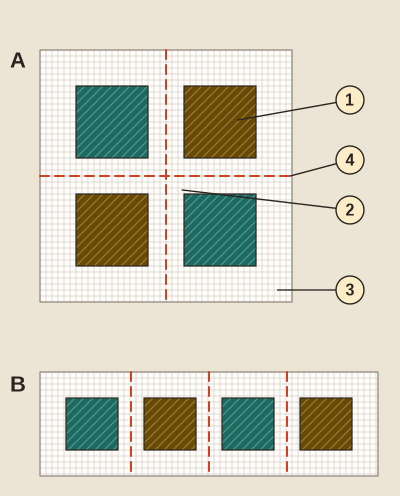
| Set of four, each 4 inches (10 cm) | Canvas to cut |
|---|---|
| Two by two | 14 by 14 inches (36 by 36 cm) |
| Four in a strip | 26 by 8 inches (66 by 20 cm) |
| Four separate pieces, to carry about | 8 by 8 inches (20 by 20 cm) each |
For a larger square, add the extra to the canvas once for each square in the row: two by two with squares of 4 1/2 inches (11.4 cm) is 15 by 15 inches (38 by 38 cm).
Leave 2 inches (5 cm) bare between two coasters and all round. Cut halfway between them and each keeps a margin of an inch (2.5 cm), enough to fold over a board.
Thread, as an estimate: one coaster of 4 inches (10 cm) in tent stitch takes about 26 yards (24 m) on 13 mesh and 36 yards (33 m) on 18. A set of four takes about 104 yards (95 m) or 144 yards (132 m), all colors together. The bound edges are extra.
Stitches that lie flat
A glass has to stand level and slide off without catching.
| Use | Leave out |
|---|---|
| Basketweave, which also stays square | Beads, French knots, loops and tufts |
| Mosaic and small Scotch | Padded or raised stitches |
| Brick and upright stitches over two or four threads | Stitches longer than four threads, which snag on a wet base |
| Continental for lines and small shapes | Open stitches with bare canvas, where drips go through |
A glass covers the middle 2 1/2 inches (6.5 cm) or so. Put a motif there to be seen when the glass is lifted, or put the pattern in the border to be seen all the time.
The steps for a set of four
- Cut the canvas for the layout you chose, and bind its edges with tape.
- Mark the top of the canvas on the tape. All four coasters keep that top, so that their stitches slant the same way.
- Find the first corner. Measure 2 inches (5 cm) in from the top edge and from the left edge. That is the only place you measure.
- Outline each square with a line of sewing thread between two canvas threads. Count canvas threads from that corner. On 13 mesh a 4 inch (10 cm) square is 52 threads and the bare strip to the next square is 26. On 18 mesh they are 72 and 36. Four squares of one count come out alike.
- Mark each center. Count half of the square in from its top and its left side, 26 on 13 mesh or 36 on 18, and take a knotted thread down through the hole where the two counts meet. Take it out when your first stitches are in.
- Stitch the four middles, one color at a time, across the whole set. Run each thread's end under stitches of its own coaster. Never carry it across to the next.
- Stitch the borders. Pull out the outline threads as you come to them.
- Fill the grounds in basketweave, and see that no outline thread is left.
- Test the colors for running. A coaster gets wet. How to block has the test. If a color runs, do not wet the piece to block it. Add the extra rows and finish it in an acrylic coaster, which keeps the stitching dry, or ask a finisher.
- Block the whole canvas square, and let it dry flat.
- Run a line of stitching by machine, or small backstitches, in the bare canvas one thread outside each coaster, for a turned edge or an insert. Skip it for a bound edge, where it would fill the fold.
- Cut them apart halfway between the squares, and finish each in one of the ways below.
Variegated thread in a set
A thread that changes color as it goes can make four coasters that match without being the same. Here is one way.
- Find the repeat: the length from where a color begins to where it begins again.
- Cut every length at the same point of the repeat, about 18 inches (45 cm) or less.
- Choose the stitch by the effect. Rows of continental make bars, basketweave makes slanting streaks, and Scotch or mosaic blocks make patches.
- Begin every coaster in the same corner with the same color, to make the four alike. To make them differ, begin each where the last one left off.
- Keep the edge plain. A border in one solid color holds the set together.
- Test it for running, every color of it.
Variegated and overdyed threads says how to keep the colors in order from one length to the next.
Three finishes, cut through
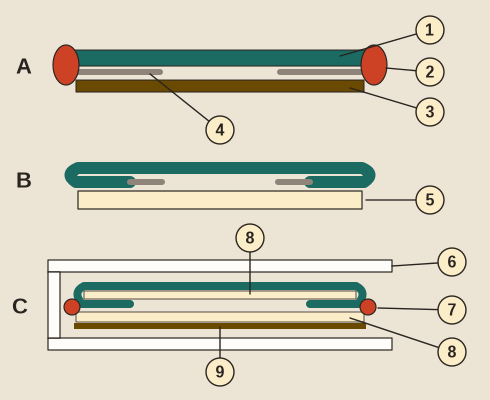
A bound edge with a felt back
- Trim the margin to half an inch (1.3 cm).
- Cut off each corner on a slant, three canvas threads from the point of the stitching.
- Start the thread. Lay the coaster face up with the first side nearest you. Run the thread under stitches on the back, and bring it up at the right-hand corner, in the last row of stitches.
- Fold the first side. Fold its two corners in on the diagonal, then the margin to the back along the first row of empty holes.
- Bind it with binding stitch, with the fold at the top and the back facing you.
- Turn the corner. Put an extra stitch or two into the last hole so that the corner is covered, fold the next side, and go on without ending the thread. How to finish a bookmark has every move round four sides.
- Catch the margin down to the backs of the stitches with small slanting stitches that do not come through to the front.
- Cut the felt two canvas threads smaller than the coaster on every side.
- Pin the felt to the back, inside the braid.
- Start the sewing thread. Knot it, and bring the needle up from under the felt, close to its edge, so that the knot is hidden.
- Sew round. Pick up one or two threads of the folded canvas margin just inside the braid, then come up through the edge of the felt about 1/8 inch (3 mm) farther on. Repeat all the way round. The needle goes under margin threads only: it does not go over the braid or through to the front.
A turned edge with a cork back
This one needs the two extra rows. Choose cork about 1/8 inch (3 mm) thick.
- Trim the margin to half an inch (1.3 cm).
- Cut off each corner on a slant, three canvas threads from the point of the stitching.
- Fold the point in at each corner, then the two sides over it, so that one row of stitching shows on the edge and one lies behind. The two folds meet in a slanting line, a miter.
- Sew the miters and the margin down at the back with small stitches.
- Cut the cork with a craft knife and a metal ruler, 1/8 inch (3 mm) smaller than the coaster across and down. That is 1/16 inch (1.5 mm) at each side. Round its corners a little.
- Glue it. Spread white craft glue that dries clear thinly on the cork, not on the needlepoint, and keep it off the outer edge.
- Weight it. Lay the coaster cork down on plain paper, put a flat book on it, and leave it until it is dry.
Glue is for good: the back does not come off again. Felt can be glued in the same way.
A round coaster
A round has a turned edge, and felt or cork on the back. Binding stitch does not turn a small circle well.
- Draw it on graph paper, one square for each stitch. For a 3 inch (7.6 cm) round draw a circle 43 squares across for 13 mesh or 58 for 18: that is the 39 or 54 of the table and two rows more all round. Fill every square whose middle lies inside the line.
- Stitch it as stitches for circles and curves says, the widest row first. No square is outlined.
- Test and block it as above.
- Trim the margin to 1/4 inch (6 mm), and snip it every half inch (1.3 cm), to within two threads of the stitching, so that it folds flat.
- Turn the edge, so that one row of stitching shows on the edge and one lies behind, and sew the margin down at the back.
- Back it. Felt or cork is cut 1/8 inch (3 mm) smaller across than the round.
- Cover the rim, if you like, with a twisted cord sewn on by hand. It hides the steps of the curve.
Coaster blanks
- Acrylic. The needlepoint is laced over a board, a second board is covered in cloth, and a cord goes round the two. The insert slides in at the open side and comes out to be changed with the season. The steps are in self-finishing needlepoint.
- Leather with a window. Trim, peel, press and tuck: the steps for leather are there too. The stitching is open to the glass.
- Wood or metal with a hollow. Measure the hollow across and down, and how deep it is. Cut a piece of thin card that drops in and out freely, and take off the thickness of the folded canvas, about 1/16 inch (1.5 mm) on each side. Cut mat board to that size, fold the margin over it and lace it, which means to run strong thread back and forth across the back from margin to margin, as for a frame. It should sit level with the rim or just below it. If the holder has a disc of glass or clear plastic, it goes on top. Leave out the glue if you may want to change the piece.
Plastic canvas coasters
Cut a square of plastic canvas with one bar more on every side than your stitches need. On plastic with 7 holes to the inch (2.5 cm) a coaster of 28 by 28 stitches is 4 inches (10 cm), and one ordinary sheet gives six. Work it in worsted yarn with a size 16 needle, then whip stitch all four edges with the same yarn, two or three stitches in each corner. There is no margin to fold and nothing to block. Plastic canvas has the cutting and the counts.
Using, cleaning and keeping a set
- After a wet glass, blot the coaster with a white cloth and lay it flat to dry. Do not stack it damp.
- A spill of wine or coffee is blotted at once, never rubbed. How to clean needlepoint has spots and stains. Cork, leather and board backs must not be soaked, and nothing here goes in a washing machine.
- A curled coaster is laid face down on a towel under a heavy book.
- Keep the set flat with plain white tissue between, tied with a ribbon or in a shallow box. Acrylic ones stand in a holder.
What goes wrong
| Problem | Cure |
|---|---|
| The glass rocks | A knot or a raised stitch. Run thread ends under stitches, and keep the stitches flat |
| One coaster is larger than the rest | It was measured and not counted. Count the rows, and add a row to the others before they are cut apart |
| Canvas shows through a bound edge | The thread is too thin for the mesh. Pick the binding out and work it with a thicker thread or one strand more. The fold stays on the first row of empty holes |
| Canvas shows at a corner | Put another stitch or two through the last hole |
| Canvas shows along a turned edge | The fold lies outside the stitching. Fold again so that one row of stitches lies on the edge |
| The felt stands out past the edge | Cut it two canvas threads smaller all round |
| A corner is thick | Too much canvas is folded in. Open it and cut the point off, three threads from the stitching |
| The insert will not go in | The cord or the batting is too thick. Use a thinner cord, then take out the batting |
| Color has come off on the table | The thread was not color fast. Put the piece in an acrylic coaster and keep it dry |
Questions people ask
What can I use as a backing? Felt, thin cork, synthetic suede or leather. How to back needlepoint compares the cloths. Felt and suede need no hem.
Do coasters need padding? No. Padding makes a glass tip. Inside acrylic one thin layer of batting is fine, because the glass stands on the plastic.
13 or 18 mesh? 13 for a first set: 2,704 stitches in each 4 inch (10 cm) square. On 18 it is 5,184, with room for fine detail and letters.
Should the edge be bound before or after the felt? Before. The felt covers the folded margin. Other edges are in edge stitches.
Can one large design be cut into four? Not after stitching: a cut through stitches lets them run. Plan four squares with a gap between from the start.