Crochet guide
How to crochet a butterfly
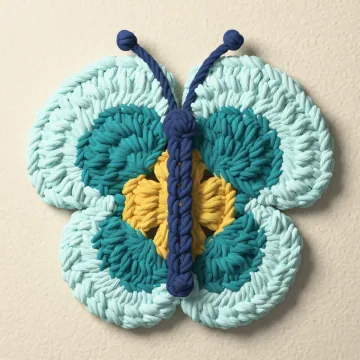
Two small butterflies, each in one piece. The flat one has four wings worked in the four spaces of a small square, and lies flat on a hat, a blanket or a card. The folded one is a ruffled round of eight petals, folded in half and tied round the middle with a strand of yarn, whose ends are the feelers.
On this page 7 parts

| Flat butterfly | Folded butterfly | |
|---|---|---|
| Worked | Three rounds | Two rounds, then a fold |
| Shape | Flat, four wings | Full, with the wings in two layers |
| Width in medium yarn, about | 3¾ in (10 cm) | 3 in (8 cm) |
| Body | A short chain, sewn on | A strand of yarn, tied round |
| Good for | Appliques, cards, blankets | Clips, magnets, garlands, gifts |
Before you start
You need: medium yarn (weight 4) in three colors for the wings and one for the body, a 5 mm (H-8) hook, a yarn needle and scissors. For the flat one the estimates are 3 yd (3 m) of A, 6 yd (6 m) of B, 8 yd (8 m) of C and 3 yd (3 m) of D for the body.
Know first: the chain, the slip stitch, single crochet (double crochet in United Kingdom terms), half double crochet (UK half treble), double crochet (UK treble) and treble crochet (UK double treble). In the lines they are ch, sl st, sc, hdc, dc and tr; st is a stitch, sk means skip, Rnd is a round and RS the right side. A ch-2 sp is the hole under 2 chains: the hook goes into the hole. Chain space shows it.
The front faces you in every round and the rounds run counterclockwise. A chain 1 that begins a round is not counted as a stitch. A left-handed maker works clockwise: read each picture as its mirror image.
The flat butterfly
These are the rounds of our one-piece butterfly. The chart shows all three. In it a T with no bar is a half double crochet, with one bar a double crochet, with two a treble; a plus is a single crochet, an oval a chain, a dot a slip stitch. Reading charts has more.

1. Make the ring
With A, make a magic ring, or chain 4 and slip stitch in the first chain. The chain that holds a magic ring is the first of the 3 chains that begin round 1.
2. Work round 1
Work four groups of 3 double crochet into the ring with 2 chains after each. The first group begins with chain 3, which stands for a double crochet. Pull the ring shut and slip stitch in the top of the chain 3. If you know the granny square, this is its first round.

Rnd 1 (RS): Ch 3 (counts as dc), 2 dc in ring, ch 2, [3 dc in ring, ch 2] 3 times, sl st in top of ch-3 to join (12 dc, 4 ch-2 sps).
Count: 4 groups and 4 spaces. Each space becomes a wing. Fasten off A. After this round it measures about 1½ in (4 cm) across.
3. Work round 2, the wings
Join B in any space. Each wing is one fan in one space. Then skip a stitch, work a single crochet in the middle stitch of the group, and skip a stitch: that short stitch is the dip between two wings. The first two fans have treble in the middle and are the upper wings. The last two have double crochet only and are the lower wings.

Rnd 2: Join B with sl st in any ch-2 sp, ch 1, (hdc, dc, 5 tr, dc, hdc) in same sp, sk next st, sc in next st, sk next st, (hdc, dc, 5 tr, dc, hdc) in next ch-2 sp, sk next st, sc in next st, sk next st, (hdc, 5 dc, hdc) in next ch-2 sp, sk next st, sc in next st, sk next st, (hdc, 5 dc, hdc) in next ch-2 sp, sk next st, sc in next st, sk next st, sl st in first hdc to join (8 hdc, 14 dc, 10 tr, 4 sc).
Count: two wings of 9 stitches, two of 7, and 4 single crochet between.
4. Work round 3, the edge
Fasten off B and join C in the first half double crochet. Go round each wing with one stitch in its first stitch, two in each of the next, and one in its last. Slip stitch in every single crochet, so that the dips stay deep.
Rnd 3: Join C with sl st in first hdc, ch 1, hdc in same st, 2 dc in each of next 7 sts, hdc in next st, sl st in next sc, hdc in next st, 2 dc in each of next 7 sts, hdc in next st, sl st in next sc, hdc in next st, 2 hdc in each of next 5 sts, hdc in next st, sl st in next sc, hdc in next st, 2 hdc in each of next 5 sts, hdc in next st, sl st in next sc, sl st in first hdc to join (28 hdc, 28 dc).
Count: 56 stitches: 16 round each upper wing and 12 round each lower one. Fasten off and weave in the ends.
5. Make the body and the feelers
With D, leaving a 12 in (30 cm) tail to sew with, chain 7 and fasten off. Lay the chain on the middle line, from the dip between the lower wings to the dip between the upper ones, and sew it down along both its edges.

Draw a 14 in (36 cm) length of D under the last chain at the top and tie its ends in a double knot: the knot is the head. Knot each end 1¼ in (3.2 cm) from the head and cut it just beyond the knot. The knot keeps the end from fraying. Yarn feelers droop; the pattern stiffens them with fabric glue.
Dampen the butterfly, pin the wings to shape and let it dry (blocking).
The folded butterfly
Two colors or one. Our estimate is about 12 yd (11 m) of medium yarn, and a 14 in (36 cm) strand of another color for the tie.
1. Work round 1
Make the ring as for the flat one. Eight double crochet with 2 chains between them make eight spaces. Then pull the ring shut and slip stitch. The chain 5 stands for the first double crochet and the first 2 chains, so the slip stitch goes into the third of the 5.
Foundation: Make a magic ring.
Rnd 1 (RS): Ch 5 (counts as dc and ch-2), [dc in ring, ch 2] 7 times, sl st in 3rd ch of ch-5 to join (8 dc, 8 ch-2 sps).
Count: 8 spaces. For a second color, fasten off here.
2. Work round 2
Slip stitch into the next space and fill each of the eight with a petal: 3 double crochet, 2 chains, 3 double crochet. The edge waves, because there are more stitches than a flat round has room for. That is right: it makes the wings full. With a second color, join it with a slip stitch in any space and begin the line at "ch 3".
Rnd 2: Sl st in next ch-2 sp, ch 3 (counts as dc), (2 dc, ch 2, 3 dc) in same sp, [(3 dc, ch 2, 3 dc) in next ch-2 sp] 7 times, sl st in top of ch-3 to join (48 dc, 8 ch-2 sps).
Count: 8 petals of 6 double crochet.

Fasten off and weave in the ends.
3. Fold it
Lay it right side up and turn it like a wheel until a gap between two petals points straight left and another straight right. Four petals are above that line and four below. The numbers in the picture only tell the petals apart.
The fold is not on the line but just under it, below the small circle that marks the middle. Bend the upper part, petals 1 to 4, over to the back along the fold.

Now the fold is at the top, and petals 5 to 8 hang in front of 4, 3, 2 and 1. Because the fold was below the line, the layer behind is a little deeper, and its edge shows under the front one.

4. Tie it
The strand goes down and up, like the dashed line in the last picture, never from side to side. Leave 4 in (10 cm) of it above the fold. Bring the rest down the front to the dip between petals 6 and 7, under both layers, and up the back to the fold. Go round three times. Draw it tight, so that the middle gathers and the wings spread.
Tie the two ends in a double knot at the top. They are the feelers: knot each about 1¼ in (3 cm) from the tie and cut it just beyond the knot.

Open the layers with your fingers. To keep the tie from slipping, catch it with a stitch or two at the back.
Make it larger or smaller
The rounds stay the same, and the yarn and the hook change the size. The first column is the pattern's own sizes. The second is worked out from them, in the same proportion.
| Yarn and hook | Flat, about | Folded, about |
|---|---|---|
| Fine (2), 3.25 mm | 2½ in (6 cm) | 2 in (5 cm) |
| Light (3), 4 mm | 3 in (8 cm) | 2½ in (6 cm) |
| Medium (4), 5 mm | 3¾ in (10 cm) | 3 in (8 cm) |
| Bulky (5), 6.5 mm | 4¾ in (12 cm) | 3¾ in (10 cm) |
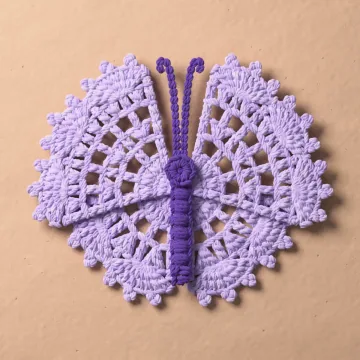
In thread and a steel hook it comes out smaller still: see our thread lace butterfly.
Change it
- One color: do not cut the yarn. In the flat one, slip stitch in the next 2 stitches and into the space, and begin round 2 there.
- A wider body: work the chain back in slip stitch before you sew it on, or tie a thicker yarn.
- A third round on the folded one: one single crochet in every stitch and 2 in every space make a firm edge, in another color if you like. More than that ruffles it further.
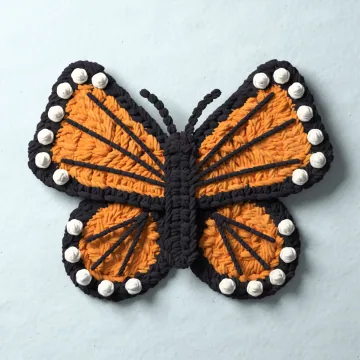
- A stuffed butterfly: our bright butterfly has a body in the round and four flat wings. The monarch has wings in its own colors.
- What to do with one: sew it to a hat or a blanket by its body alone, so that the wings stay free, or fix it to a clip, a magnet or a card. Sewing and attaching has the stitches. More are on the butterflies page.
If it goes wrong
| What you see | Why | What to do |
|---|---|---|
| The two large wings lie corner to corner | The wings are in another order | Two large ones first, side by side, then two small ones |
| A space has no wing | A group was worked past | Pull back. Four spaces, one wing in each |
| The wings run together | The single crochet or the slip stitch between them is missing | Put it in the middle stitch of the group |
| The flat one curls | Small pieces do | Dampen it, pin it out and let it dry |
| The folded one is thin | Fewer than eight petals, or a fold along one edge | Count 8, and fold through the middle of the ring |
| It falls open | The tie is loose | Wind it tightly, knot it, and catch it with a stitch |
| The feelers fray | There is no knot | A knot at each end, then trim |
| The feelers droop | Yarn is soft | Stiffen them, or sew them down |
Common questions
Which butterfly is the plainer one? The folded one: two rounds of double crochet and chains, closed with slip stitches.
Is this the butterfly stitch? No. Butterfly stitch is a pattern of long strands caught together in a fabric.
Can I join butterflies into a blanket? Sew them on a finished one. For blankets with butterflies in the fabric see butterfly blankets.