Shell stitch
A shell is a group of stitches worked into one stitch so that their tops fan out. The usual shell is five stitches of double crochet (UK treble), with a single crochet (UK double crochet) two stitches away at each side to hold it down. In the next row the shells stand on those single crochets, so the rows interlock. Those two stitches are all you need to know first.
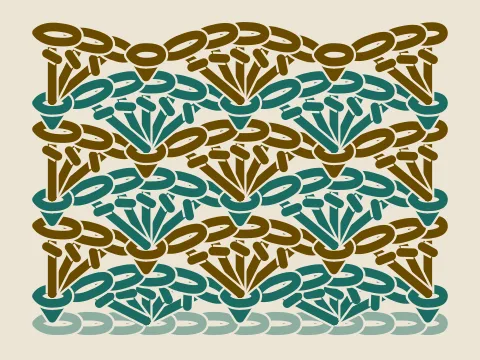
- Skip a stitch. One double crochet in the next.
- A second in that same stitch.
- Three more in it: five fan out from one stitch.
- Skip a stitch and fasten the shell with single crochet.
- Five stitches in one: a shell.
How to work it
Never held a hook? How to crochet. Red is what is new. Left-handed? Read each picture as its mirror image.
Single crochet, then skip two

To try it, chain 20, which gives three shells. Work a single crochet in the second chain from the hook. Then skip the next two chains: the shell needs their room. (In a later row you skip two stitches.)
Five double crochets in one place

Work a double crochet into the chain after the two you skipped. Then work four more double crochets into the very same chain. Each one starts in the same place, so the five lean apart as they go in.
Skip two more and hold the shell down

Skip the next two chains and work a single crochet into the one after them. That single crochet pulls the last side of the shell down flat. One shell is made. Skip two, work a shell, skip two and work a single crochet again, to the end of the row. A single crochet goes into the last chain.
Start the second row with half a shell

Chain 3, which stands for the first double crochet of the new row, and turn the work. There is room for only half a shell here: work two more double crochets into the edge stitch, the single crochet that the three chains stand on.
The stitch pattern, row by row
- Multiple
- Chain a multiple of 6 plus 2 (20 or more).
- Starting chain
- The rows here are written for a chain of 20, which is 3 times the multiple of 6, plus 2.
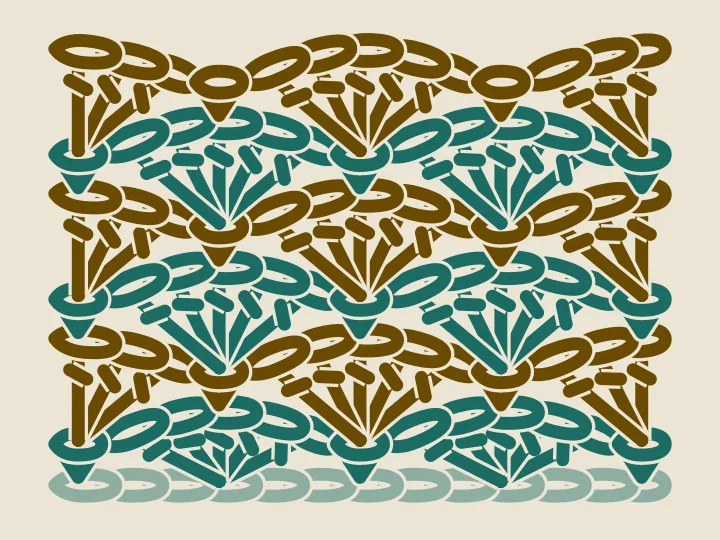
- The ch 3 at the start of a row counts as a dc. The last stitch of the next row is worked into the top of it.
- The ch 1 at the start of a row does not count as a stitch.
- Row 1 is the right side.
- Stitches in parentheses, or several of one stitch, are all worked into the one place named after them.
- Foundation. Ch 20.
- Row 1 (RS). Sc in 2nd ch from hook, [sk next 2 chs, 5 dc in next ch, sk next 2 chs, sc in next ch] 3 times (4 sc, 15 dc).
- Row 2. Ch 3 (counts as dc), turn; 2 dc in same st, [sk next 2 sts, sc in next st, sk next 2 sts, 5 dc in next st] 2 times, sk next 2 sts, sc in next st, sk next 2 sts, 3 dc in last st (16 dc, 3 sc).
- Row 3. Ch 1, turn; sc in first st, [sk next 2 sts, 5 dc in next st, sk next 2 sts, sc in next st] 2 times, sk next 2 sts, 5 dc in next st, sk next 2 sts, sc in top of turning ch (4 sc, 15 dc).
Repeat rows 2 and 3 for the pattern.
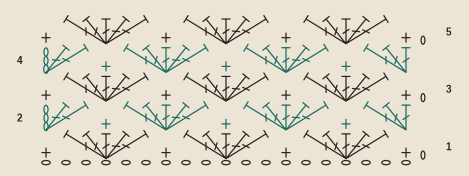
What each symbol meansHow to read a chart
Abbreviations in these rows
- ch
- chain stitch
- sc
- single crochet (UK double crochet)
- dc
- double crochet (UK treble)
- RS
- right side
- sk
- skip
- st
- stitch
The half shells are what keep the sides straight. A shell takes up more room than the one stitch it stands in, which is why two stitches are left unworked on each side of it. At the edge of the work there is nothing to leave unworked on the outer side, so every second row begins and ends with half a shell.
Count a row by its shells and its single crochets. A row that starts with a single crochet ends with one, and has a whole shell between each pair. A row that starts with a half shell ends with a half shell, and has one whole shell fewer.
The same shell makes an edging. Work one row or round of shells into the edge of a finished piece, a single crochet between each, and stop there.
When it goes wrong
- My sides slope in or out.
- Check the ends of the rows. A row that starts with chain 3 needs two more double crochets in the first stitch and three in the last. A row that starts with chain 1 needs a single crochet in the first stitch and one in the top of the turning chain.
- My shells do not sit between the shells below.
- Each shell goes into a single crochet, and each single crochet goes into the middle double crochet of a shell, the third of its five. If a shell has landed on a shell, count the two skipped stitches at each side of it again.
- I have stitches left over, or too few, at the end of a row.
- Count back along the row: five double crochets in every shell, and two skipped stitches at each side of every shell. One shell of four or six, or one stitch skipped where there should be two, moves everything after it.
Left-handed
The pictures show the hook held in the right hand. Press Left-handed, under the moving drawing, and every picture here turns for the left hand. In the words, read left for right.
Patterns that use it
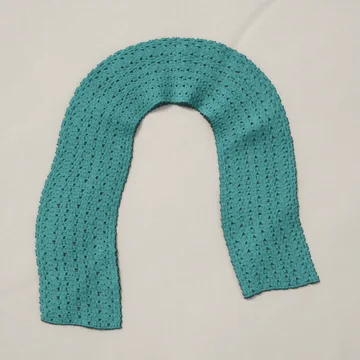
Open shell stitch scarf
Easy 7 3/4 × 60 in medium yarn
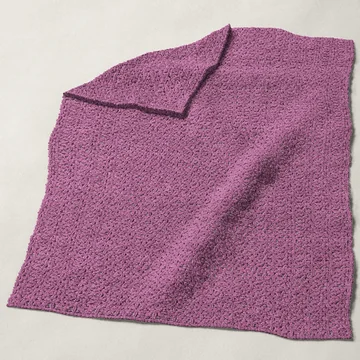
Open shell stitch baby blanket
Easy 31 3/4 × 40 1/2 in medium yarn
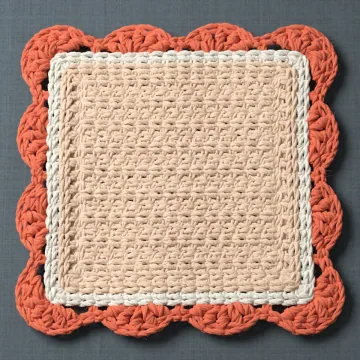
Shell stitch border
Easy 1 in deep medium yarn
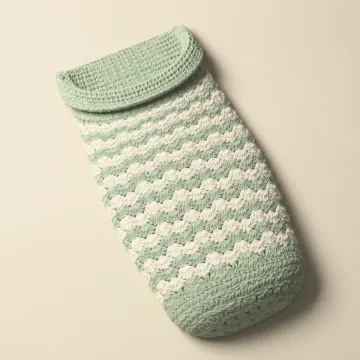
Baby snuggle sack
Easy Newborn to 3 months medium yarn
Winter shell stitch throwShell stitch washcloth
The other 26 patterns that use it
- Blue ombre baby blanket
- Rose shell scarf
- Plum shell lap blanket
- Blue and yellow shell throw
- Sweetheart shell throw
- Spring shell stitch throw
- Shell stitch throw in mermaid colors
- Maple shell throw
- Pastel shell stitch baby blanket
- Mint and gray shell stitch baby blanket
- Shell stripe wrap
- Shell stitch cowl
- Pink and cocoa shell baby blanket
- Two-color shell baby blanket
- Girls' shell scarf
- Red, white and blue striped throw
- Baby girl shell blanket
- Preemie shell baby blanket
- Christmas shell stitch throw
- Hydrangea shell baby blanket
- Ivory wedding shell throw
- Fall shell stitch throw
- Shell stitch infinity scarf
- Shell lace bookmark
- Shell stitch table runner
- Ring bearer pillow
At a glance
- Level
- Easy
- Kind
- Shells, fans and V-stitches
- Also called
- solid shell stitch
- Used for
- baby blankets, throws and shawls; scarves and cowls; a scalloped edging round a piece worked in another stitch
- Multiple
- The chain is a multiple of 6 plus 2 (20 or more).
- Chains for 5, 10 or 20 shells
- 32, 62 and 122
- Row repeat
- Rows 2 and 3.
- Sides
- Looks much the same on both sides.
- Edges
- Straight. The second row and every even row begins with chain 3: it counts as the first double crochet, and the row after it ends in its top. The first row and every odd row begins and ends with a single crochet. The one chain you turn with there does not count, and nothing is worked into it.
- In a pattern
- Written out, as 5 dc in next st, or named once as a shell (sh) with the pattern saying what its shell is.
- Stitches in a shell
- Five here. Other patterns use three to seven.
Tips and variations
Tips
- When a row ends in a single crochet, the last stitch goes into the top of the three chains that began the row below. It is easy to pass over.
Variations
- Open shell. Put one chain in the middle of the shell: two double crochets, chain 1, two double crochets, all in one stitch. In the next row the single crochet goes into that chain space, not into a stitch. The fabric is lighter and has a small hole at the heart of each shell.
- Stacked shells. Shells with a chain space can also be set one straight above the other: each new shell is worked into the chain space of the shell below, with no row of single crochets between. Some patterns call a group like this a fan.
- Bigger and smaller shells. A shell can have three stitches or seven, and can be made of half double crochet (UK half treble) or of treble crochet (UK double treble). A wider shell needs more skipped stitches at each side, so the multiple changes with it.
- Scallop stitch. Scallop is not the name of one stitch. Some teachers use it for shell stitch itself. Most often it means the edging: on a row whose count is a multiple of 4 plus 1, single crochet in the first stitch, then skip 1, five double crochets in the next, skip 1, single crochet in the next, to the end. It is also printed for other round shapes, such as seven single crochets in a loop of five chains, or five treble crochets with a chain between each two. Read which one your pattern means.
- Clam stitch and clamshell. A shell is often said to look like a clam shell, so some patterns call their shells clams. There is no one set of rows behind the word: published clam stitches have repeats of six, eight and ten stitches, and each is a different stitch. Follow the rows of the pattern in your hands.
- Slanted shell, also printed as diagonal shell. Shells of a single crochet, three chains and double crochets that lean to one side.
- Crazy shell, now called crazy stitch. Needlework books of an earlier time give the name crazy shell to crazy stitch: a single crochet, three chains and three double crochets in one place, again and again.
- Picot shell. A shell with a small point at its top: two double crochets, a picot, and two more double crochets, all in one place. Some patterns put three at each side of the picot. The picot is made of three chains closed into a ring with a slip stitch or a single crochet. It is mostly held down by a single crochet or a slip stitch at each side.
- Interlocking shells. Two rows that fit together like teeth. The first is a row of shells with half shells at its ends. In the second, five double crochets are closed together over five stitches, with two chains at each side and a single crochet in the middle of each shell, so a shell stands upside down between every two. Chain a multiple of 6 plus 4 and put the first two double crochets in the fourth chain. In the next row of shells, each shell goes into one of those single crochets, with half shells at the ends, and a single crochet goes into the top of each closed group. Patterns change color after every row or after every second row, so that the shapes show.
- Shells and posts. Open shells (2 double crochets, chain 1, 2 double crochets) stacked in columns, with one double crochet between each two columns. That stitch is worked round the post below it: from the front on right-side rows and from the back on wrong-side rows, so its ridge is always on the right side. Chain a multiple of 6 plus 3.
- Boxed shells. A row of two double crochets and three chains by turns, then a row with five double crochets in the middle chain of every three. In the next row a double crochet goes into the first and the last of the five, with three chains between, and the boxes come back. A double crochet stands at each end of every row. Chain a multiple of 5 plus 4.
- Flying shells. A row of small shells (single crochet, chain 3, 3 double crochets in one place, then skip 3), and a row of V-stitches (double crochet, chain 1, double crochet in one place) with a single crochet between. Chain a multiple of 4 plus 2. The rows repeat after four.
- Woven shells. Two groups of three double crochets that cross, with three chains between them. The second group goes into a chain passed over before the first, in front of it. A double crochet stands between one crossed pair and the next. Chain a multiple of 6 plus 3.
- Scales that overlap. For scales that lie over one another like a dragon's or a fish's, the stitch is crocodile stitch. Its groups are worked round posts, not into one stitch.
- Pineapple stitch. Shells carried up the two sides of a lace motif.
Questions
- What is the multiple for shell stitch?
- For this five-stitch shell the starting chain is a multiple of 6 plus 2: six chains for each shell and its single crochet, and two more for the last single crochet and the turn. The starting chain calculator works out the number for a width of your own.
- Does shell stitch look the same on both sides?
- Yes. The two sides look alike, so it suits scarves and blankets that are seen from both.
- Is a shell the same as a fan?
- Often, yes. Many patterns use the two words for the same group of stitches. Some keep fan for a group that has chain spaces in it. The page on fan stitch sets out what different sources mean.
- How do I change color in shell stitch?
- Change at the end of a row: work the last stitch until two loops are left on the hook, and pull the new color through them. Changing every row gives stripes that follow the scallops.
- What does shell in shell mean?
- Work a new shell into the middle of the shell below, in the chain space between its two halves. It is also written shell over shell. The shell of such a pattern has chains in its middle, for example 2 double crochets, chain 2, 2 double crochets.
- How do I work shell stitch in the round?
- Use a multiple of 6 stitches with nothing added. A ring has no edges, so it needs no half shells. Work single crochet, skip 2, shell, skip 2 all the way round and join to the first single crochet. Start the next round with a shell in that same stitch: chain 3, which is its first double crochet, and four more. Then go on as in rows: a single crochet in the middle of each shell and a shell in each single crochet. At the end, join to the top of the chain 3. The round after begins with a single crochet in the middle of that first shell, so slip stitch across to its third stitch first. Or make the first shell in two parts: chain 3 and two double crochets now, and the last two at the end of the round. Then the place where you join is already its middle.
- What is a reverse shell?
- In many patterns it is a shell upside down: several double crochets, each begun in its own stitch, closed together at the top in one pull. It fills the dip between two shells. A pattern that uses it says how many stitches are closed together.