How to put a stem on a crochet flower
For most flowers, fold a piece of florist's wire in half, hook the fold through the middle of the flower, twist the two halves together and wind green yarn round them. A pipe cleaner, a crocheted cord and a thin stick make stems too. Choose by the weight of the flower and by who will hold it.
On this page
Which stem to choose
| Stem | What it suits | What holds it |
|---|---|---|
| Florist's wire, folded | Most flowers, flat or deep | The fold, caught in the stitches |
| Pipe cleaner, folded | Small, light flowers. It bends easily, so double it | The fold and a few stitches |
| Crocheted cord with wire inside | A tall stem with a heavy head | Sewn on round the top |
| Crocheted cord alone | A soft stem that hangs or is sewn down | Sewn on round the top |
| Thin dowel or skewer | A cup-shaped or rolled flower | Glue, inside |
| Covered stem wire, bought ready | The same flowers as plain wire, with nothing to wind | The fold, caught in the stitches |
No flower yet? See a first flower, a rose or our flower patterns.
Before you start
You need: the finished flower, the stem, green yarn and a blunt yarn needle. For wire, add wire cutters, and pliers if it is stiff. A stick needs glue.
Leave the flower's yarn ends hanging: they are covered with the stem.
How thick the wire should be
The higher the gauge number, the thinner the wire. Thick wire is sturdier and harder to bend.
| Gauge | Thickness, American wire gauge | Use it for |
|---|---|---|
| 16 to 18 | 1.3 to 1.0 mm | One wire under a heavy flower, or inside a long crocheted stem |
| 20 | 0.8 mm | Folded in half, for roses and other medium flowers |
| 22 to 24 | 0.6 to 0.5 mm | Leaves |
Other scales differ, so go by the millimeters. If the head droops, fold the wire in half or take a thicker one. See also crocheting with wire.
How long to cut it
For a wire that goes into the flower itself, this allows 1 in (2.5 cm) for the flower and 1 in (2.5 cm) to turn up at the foot. A folded wire counts twice.
| Finished stem | One wire | Wire to be folded |
|---|---|---|
| 4 in (10 cm) | 6 in (15 cm) | 12 in (30 cm) |
| 6 in (15 cm) | 8 in (20 cm) | 16 in (41 cm) |
| 8 in (20 cm) | 10 in (25 cm) | 20 in (51 cm) |
| 10 in (25 cm) | 12 in (30 cm) | 24 in (61 cm) |
Twisting takes up a little: cut long and trim.
A stem of folded wire
- A deep flower, such as a rolled rose: fold the wire in half first and pinch the fold narrow. From the front, push both ends down through the center, one on each side of a strand, until the fold sinks out of sight.
- Or a flat flower: keep the wire straight. Slide one end under a few stitches at the center of the back and draw half the wire through. Fold it there, so that both halves hang down. Nothing shows on the front.
- Make it firm. With the yarn needle, take a few stitches through the flower's base and between the two halves of the wire.
- Twist the halves together right under the flower, and on down.
- Sew on the green circle now, if you want one (see "Hide the join").
- Turn up the foot. Bend the last 1 in (2.5 cm) back on itself, so that no cut end shows.
- Cover it, as below.
With one thick wire, for a deep flower, bend a small closed loop at the top. Pass the other end down through the center from the front until the loop sits inside. Stitch over the loop, or glue it. Go on from step 5.
A pipe cleaner stem
A pipe cleaner, also called a chenille stem, is wire with a soft, furry cover. Fold it in half, give the fold a twist and push it into the back of the flower until it holds, with nothing showing on the front. Go on from step 3 above. A green one can be left bare.
A crocheted stem
- Start the tube. Leave a long tail. Chain 5 or 6 and join with a slip stitch. Work one single crochet (United Kingdom: double crochet) in each chain, then go round and round in single crochet with no joins: a round cord. For a thinner stem work an i-cord.
- Stop at the length you want. To back the flower too, widen the top: two stitches in every stitch, then one round plain. Fasten off with a long tail.
- Put in the wire, if you want one. One thick wire, not folded, is enough. Cut it 1½ in (4 cm) longer than the tube (not by the table above). Turn over ½ in (1.3 cm) at both ends and leave ½ in (1.3 cm) standing out at the top.
- Close the bottom. Run the starting tail through the stitches round the hole, draw it tight and fasten off.
- Join the flower. Push the wire that stands out into the back of the flower, under a few stitches if it is flat. Sew round the top of the tube, through the back of the flower only.
A stick for a stem
- Take a bamboo skewer or a thin dowel, for a small cup-shaped flower.
- Cover all but the top inch (2.5 cm) with yarn, before the flower goes on.
- Open a gap under the flower with the needle, between stitches and not through a strand. Push the bare top up into it.
- Draw the stick most of the way out, put glue on the top, push it back and hold it until it sets.
A flower made as a strip can be rolled straight round the bare top, glued as you go. Give a flat flower wire instead.
How to cover a stem with yarn
On wire, do this last: flower and circle are on, and the foot is turned up.
- Knot the yarn round the stem, close under the flower or its circle (on a bare stick, 1 in (2.5 cm) below the top). Lay the tail, and any ends from the flower, down along the stem.
- Wind over the stem and the tails together, each turn against the last. After a little way, turn the stem and let the yarn wind on. Close up any gaps.
- Wind right to the end, over a wire's turned-up foot.
- Knot the yarn there, fix the knot with a dab of glue, let it dry and cut the end.
Crochet cover, instead of winding. Put a slip knot on the hook. Hold the stem level, the yarn behind it, close under the flower. Single crochet round it: hook under the stem, draw up a loop, yarn over above the stem and through both loops (working over a ring has pictures). Work down to the foot, the stitches close together. Fasten off and weave in the end. The tops make a ridge down one side.
Tape cover. Wind floral tape on in the same way, from the flower down.
Hide the join under the flower
A small green circle hides the twist. It goes on before the cover. Leave a tail at each end. (Ch is chain, sl st slip stitch, sc single crochet, st stitch, rnd round.)
Ch 4, sl st in first ch to make a ring.
Rnd 1: Ch 1, 6 sc in ring, sl st in first sc (6 sc).
Rnd 2: Ch 1, 2 sc in each st around, sl st in first sc (12 sc).
Slide it up the stem, with the flower's yarn ends through its hole too. Sew its edge to the back of the flower with one tail, and leave the other to be covered.
Leaves on the stem
For the leaf itself see how to crochet a leaf.
Sewn on: cover the stem first, and sew the foot of the leaf to it with its own tail.
Wound in: make the leaf first, on thin wire.
- Cut the wire 3 in (8 cm) longer than the leaf. Bend a small closed loop in one end, wide enough for the hook.
- Make the leaf's chain. Lay the wire along it: its loop at the slip knot, where the tip will be, and its straight end past the last chain, the foot.
- Work up the first side: for every stitch the hook goes into the chain and under the wire. Work the tip into the last chain and through the loop.
- The wire stays in the middle: turn the piece and work the second side over it too. Leave out the leaf's own stem, and fasten off.
- Wind the stem down to the leaf's place and stop. Hold the bare wire at the foot of the leaf against the stem, and wind on over both.
Stand them in a jar or tie a bouquet
- Measure the vase first. The turned-up foot has to pass its neck.
- Vary the heights. Trim or bend the stems.
- Keep them from turning. Bend the wires until each flower stays where you put it, or cross the stems inside the vase.
- To hold: gather the stems and bind them with ribbon, tied in a bow.
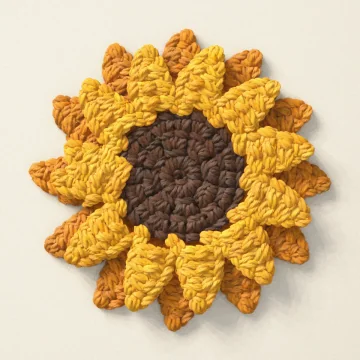
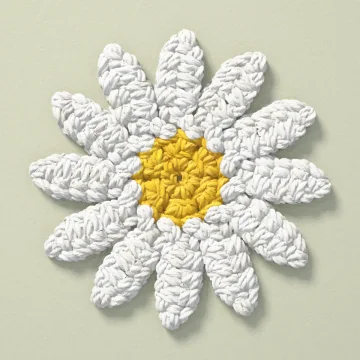
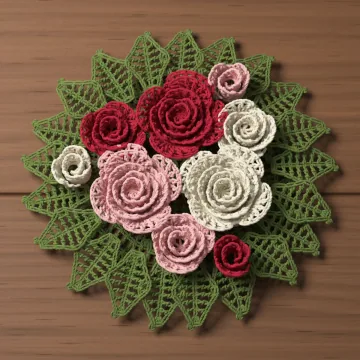
Patterns to use: a jar vase cover, tiny rolled thread roses, a sunflower and a daisy.
Questions people ask
What about a flower for a child? The ends of a wire can poke. Leave the stem off, or sew on a crocheted cord with nothing inside.