Crochet guide
How to crochet a rose
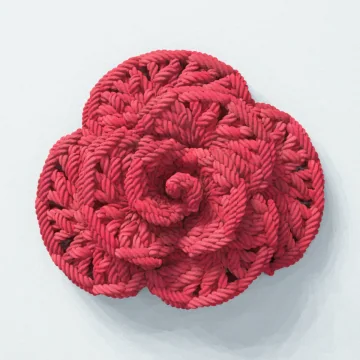
There are two plain ways to crochet a rose. The rolled rose is a flat strip of petals, rolled up from one end and sewn at its foot. The layered rose is worked in rounds and lies flat, with a ring of large petals behind a ring of small ones. Both are below, row by row and round by round.
On this page 6 parts

| Rolled rose | Layered rose | |
|---|---|---|
| Worked | Flat, in two rows | In five rounds |
| Looks like | A full round rose that stands up | A flat open rose |
| Petals | 9, small to large | 5 small in front, 5 large behind |
| The hard place | Rolling and sewing | Finding the stitches behind the first petals |
| Good for | Bags, clips, stems, gift wrap | Appliques, clothes, blankets |
Know first: the chain, the slip stitch, single crochet (double crochet in United Kingdom terms), half double crochet (UK half treble), double crochet (UK treble) and treble crochet (UK double treble). In the lines they are ch, sl st, sc, hdc, dc and tr; st is a stitch, sk means skip, Rnd is a round, RS the right side, and a ch-3 sp is the space under 3 chains. What stands in brackets is worked as many times as the line says.
The rolled rose
These are the rows of our rolled rose pattern, about 3 in (8 cm) across.
You need: about 15 yd (14 m), an estimate, of medium yarn (weight 4) in one color, a 5 mm (H-8) hook, a yarn needle, scissors and pins.
1. Make the chain
Chain 37: 36 for the stitches and 1 to turn.
2. Work row 1
Put the first half double crochet in the second chain from the hook, then one in each chain. The loop on the hook is not counted.
Row 1: Hdc in 2nd ch from hook, hdc in next 35 chs (36 hdc).
Count: 36. Each petal will use 4 of these stitches, and 9 petals use them all.
3. Learn one petal
A petal is a shell: several stitches in one stitch. Slip stitch in the next stitch, skip one, work the whole petal in the next, skip one. The slip stitch pulls the edge down, and the skipped stitches give the petal room.

4. Work row 2, the petals
Chain 1 and turn. The chain is not counted: the first slip stitch goes into the very first stitch, the last one you made in row 1. There are three sizes of petal, three of each: 5 half double crochet, then 6 double crochet, then 7 treble crochet.
Row 2: Ch 1, turn, [sl st in next st, sk next st, 5 hdc in next st, sk next st] 3 times, [sl st in next st, sk next st, 6 dc in next st, sk next st] 3 times, [sl st in next st, sk next st, 7 tr in next st, sk next st] 2 times, sl st in next st, sk next st, 7 tr in next st, sl st in next st (15 hdc, 18 dc, 21 tr).
Count: 9 petals. The side that faces you in this row is the right side. Fasten off, leaving a 24 in (61 cm) tail for sewing. The strip will not lie straight: the crowded edge curls. That is right, and it helps in step 5.

The chart shows the right side. Row 1 begins at the left and row 2 at the right. An oval is a chain, a dot a slip stitch, a T a half double crochet; one bar makes it a double crochet, two bars a treble.
5. Roll it up
To open the petals first, pin them out flat, spray the strip with water and let it dry (blocking), as our pattern does. The strip still rolls. You may also roll it as it is, curl and all.
Take the tail down the back of the last petal to the straight edge with the needle. Lay the strip wrong side up with the petals pointing away from you, and start at the end with the small petals.

Roll petal 1 tightly on itself: it is the center. Wrap the rest round it, a little looser at each turn, and keep the straight edge level all the way, so that it makes a flat spiral underneath. Try to bring each petal over a gap between two petals of the turn inside.

6. Sew the foot
Hold the roll by its foot and turn it over. Run the needle through every turn from one side to the other, through the middle. Turn the rose a little and sew through again, and once more. Draw the yarn snug but not so hard that the foot is squeezed.

A turn that the needle missed lets the rose unroll from the center. Pull at petal 1: if it moves, sew again.
7. Fasten the tail and open the petals
Make two small stitches in one place in the foot, run the needle back through the turns and cut the yarn. Or keep the tail, to sew the rose to something. Weave in the short end. Then fold the outer petals back a little.
A smaller or a larger rolled rose
Each petal takes 4 stitches, so the chain is 4 times the petals, plus 1.
| Petals | Chain | Stitches in row 1 | Strip in medium yarn, about | Petals of each size |
|---|---|---|---|---|
| 6 | 25 | 24 | 7 in (17 cm) | 2, 2, 2 |
| 9, as above | 37 | 36 | 10¼ in (26 cm) | 3, 3, 3 |
| 12 | 49 | 48 | 13¾ in (35 cm) | 4, 4, 4 |
| 15 | 61 | 60 | 17¼ in (44 cm) | 5, 5, 5 |
The sum for 12: 12 times 4 is 48, and 1 more is 49 chains. End row 2 as the line does: after the last petal there is no skipped stitch left, only one stitch for a slip stitch. The length is worked out from the pattern's gauge, 14 stitches to 4 in (10 cm).
The layered rose
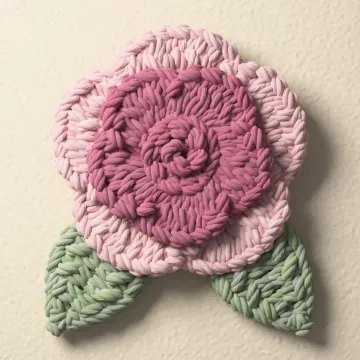
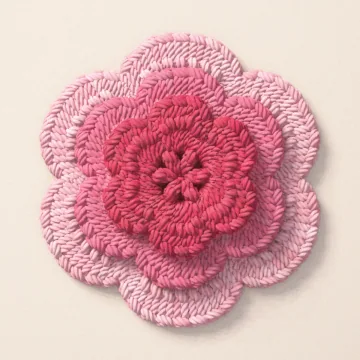
These are the five rounds of the rose in our small rose with leaf. The rose is about 2¼ in (6 cm) wide. Its page adds a coiled center and two leaves.
You need: light yarn (weight 3), as estimates 6 yd (6 m) of A for the front petals, with enough over for the pattern's center, and 7 yd (7 m) of B for the back, a 4 mm (G-6) hook, a yarn needle and scissors.
1. Work round 1
With A, make a magic ring and work 10 single crochet into it. The chain 1 of the line is the chain that holds the ring. Pull the tail until the hole is shut, then slip stitch in the first stitch. The front faces you in every round: do not turn. In the charts of this rose a plus is a single crochet, and the other symbols are those of the strip.
Rnd 1 (RS): Ch 1, 10 sc in ring, sl st in first sc to join (10 sc).
2. Make the front arches
Five arches of 3 chains go from stitch 1 to 3, 3 to 5 and so on. The five stitches under them, ringed in the picture, stay empty: the back petals will need them.

Rnd 2: Ch 1, sc in same st, [ch 3, sk next st, sc in next st] 4 times, ch 3, sk next st, sl st in first sc to join (5 sc, 5 ch-3 sps).
3. Fill the front arches
Each arch takes 7 stitches, worked into the space under it.
Rnd 3: Ch 1, [(sc, hdc, 3 dc, hdc, sc) in next ch-3 sp] 5 times, sl st in first sc to join (10 sc, 10 hdc, 15 dc).

Count: 5 petals. Fasten off A.
4. Make the back arches
This is the hard place. The front still faces you. Fold the front petals down toward you and look behind them. Between the stitches that hold the front arches you see the five that were left: 2, 4, 6, 8 and 10.
Join B in one of them, and work only into those five. The hook goes in as always: under both strands of the top, from the front to the back. The petals stay in front of the hook and the yarn, so each new arch passes behind them.

Rnd 4: Join B with sl st in 2nd sc of Rnd 1, working behind Rnds 2 and 3, ch 1, sc in same st, [ch 4, sk next sc of Rnd 1, sc in next sc of Rnd 1] 4 times, ch 4, sl st in first sc to join (5 sc, 5 ch-4 sps).
5. Fill the back arches
The back arches have 4 chains and take 11 stitches each, so these petals are larger. Each stands behind a gap between two front petals.
Rnd 5: Ch 1, [(sc, hdc, dc, 5 tr, dc, hdc, sc) in next ch-4 sp] 5 times, sl st in first sc to join (10 sc, 10 hdc, 10 dc, 25 tr).

Count: 5 petals of 11 stitches. Fasten off, leaving a 6 in (15 cm) tail, and weave in the ends.
A third layer
Make another round of arches behind, longer again, and fill them with more stitches. Our Irish rose has three layers of six petals in three shades, on arches of 3, 5 and 7 chains. Irish lace tells where such roses come from.
How large
The same lines in another yarn make another size. These come from the patterns' own gauges, and each is approximate. The Irish rose is the one of three layers linked above.
| Yarn and hook | Rolled rose | Layered rose | Irish rose, 3 layers |
|---|---|---|---|
| Fine (2), 3.25 mm | 2 in (5 cm) | 1¾ in (4.5 cm) | 3 in (8 cm) |
| Light (3), 4 mm | 2¼ in (6 cm) | 2¼ in (6 cm) | 3½ in (9 cm) |
| Medium (4), 5 mm | 3 in (8 cm) | 3 in (7.5 cm) | 4½ in (11 cm) |
| Bulky (5), 6.5 mm | 3¾ in (10 cm) | 3¾ in (9.5 cm) | 5¾ in (15 cm) |
Change it
- Tighter or fuller: roll tightly for a small closed rose, loosely for a wide open one. More petals, rolled just as tightly, make a rose that is fuller and wider too.
- In shades: a yarn that changes color shades the rolled rose from center to edge. In the layered rose each layer is a color of its own.
- Leaves: how to crochet a leaf. Our rose with leaves sews three under a rolled rose.
- A stem: fold a florist's wire in half and pass it through the middle of the rose, so that nothing shows on top. Twist the halves together below and wind yarn round them. Crochet with wire has more.
- A tendril: a curlicue sewn beside a leaf.
- On a hair tie or a ring: crochet around objects.
To fasten a rose down, sew through its foot or, for the layered one, through the stitches of round 1 from the back. The petals stay free. Sewing and attaching has the stitches.
If it goes wrong
| What you see | Why | What to do |
|---|---|---|
| The rolled rose opens from the middle | The sewing missed the inner turns | Sew through the foot again, from side to side through the center |
| The foot is a lump or a cone | The straight edge slid up or down as you rolled | Unroll, and keep the edge level at each turn |
| The foot is squeezed and the rose will not sit | The sewing is pulled too tight | Ease the tail, and keep the foot a flat spiral |
| The large petals are in the middle | Rolled from the wrong end | Start at the petals of half double crochet |
| The wrong side shows | Rolled right side up | Lay the strip wrong side up, petals away from you |
| One stitch is left in row 2 | A skipped stitch was missed | Pull back and check each petal: slip stitch, skip, petal, skip |
| Back petals sit behind front ones | Round 4 was worked in the stitches of round 2 | Use the five stitches left between |
| The back petals hide | The arches are no longer than the front ones | 4 chains in each, and 11 stitches |
Common questions
Do I roll first and sew after? Roll first, look at it, unroll and try again until you like it, then sew.
Can I make a rose from one chain without counting? Count the chain: 4 for each petal and 1. With another number the last petal has no place.
Which one goes on a blanket or a sweater? The layered rose. It lies flat, and it is sewn down by its center.