Crochet with scales
Each scale is a small flat leaf with a hole near its top. The hook goes through a stitch and through the hole, so that the scale is caught as the stitch is made and hangs over the rows below. Scales go in every other stitch of every other row, and each row of them is moved over by one.
On this page
Scales, or a stitch that looks like scales
This page is about separate scales of metal or plastic. If you want scales made of yarn alone, the stitch is crocodile stitch.
| What | What to look for |
|---|---|
| Scales | Small ones are about 9/16 in (1.4 cm) wide and 7/8 in (2.2 cm) long. They are sold in aluminum and in plastic, which is lighter |
| The hole | On small scales about 1/4 in (0.6 cm) across. The hook and a loop of yarn must pass it |
| Yarn | Medium (worsted) yarn fills the hole and holds the scale firmly |
| Hook | One that gives a firm fabric of about 16 single crochet (double crochet in the United Kingdom) in 4 in (10 cm). Start at 3.5 mm (E-4), which one glove pattern names, and go up a size if you get more than 16 |
Feel each scale before you use it. File off a sharp corner, or leave that scale out.
One scale in one stitch
Work with the wrong side of the piece facing you. The scale goes on the side away from you, which is the right side. The trial piece in the next part shows which row that is. The outside of a scale is the side you want to see. On a curved scale it is the side that bulges. The stitch is single crochet (double crochet in United Kingdom terms).
- Put the hook in the next stitch.
- Put a scale on the hook. Hold it behind the work. Its outside faces away from you and its point hangs down. Pass the tip of the hook through the hole.
- Yarn over beyond the scale.
- Draw the loop through. Bring it through the hole and through the stitch. There are two loops on the hook, and the scale is caught.
- Finish the stitch. Yarn over and draw through both loops.
- Look. Keep the scale pointing down while you make the next stitch, which locks it.

To see the scales as you work. Slide a scale onto the hook in front of the loop that is already there, with its outside toward you. Put the hook in the next stitch, draw a loop through the stitch and on through the scale, then yarn over and draw through both loops. The scale hangs on the side that faces you, so work it on right side rows. A smaller hook, for this move only, goes through a tight hole.
Those who knit with scales catch them the same way, and the spacing below comes from them.
The rows
For a sample of 17 stitches: chain 18, and work 3 plain rows of 17. Turn after every row, and chain 1 at the start, which does not count. Row 1 is a right side row, so row 4, the first with scales, has the wrong side facing you.
- Scale row (wrong side). 1 plain stitch. Then a stitch with a scale and a plain stitch, 8 times. (17 stitches, 8 scales)
- Plain row (right side). Single crochet in each stitch. (17) The scales face you now, and all point down.
- Scale row, moved over (wrong side). 2 plain stitches. Then a stitch with a scale and a plain stitch, 7 times. Then 1 plain stitch. (17 stitches, 7 scales)
- Plain row (right side). As the plain row before.
Repeat these four rows. They fit any odd number of stitches. Leave the first and the last stitch of a row without a scale, and at least one plain stitch between two scales.

Work from the bottom up, so that each row lies over the one below and the points hang toward the beginning. Scales worked on every row land on both sides of the fabric.
How far apart
Scales should just touch or overlap a little. The distance from the hole of one to the hole of the next is the width of the stitches between.
| Stitches in 4 in (10 cm) | A scale in every 2nd stitch | In every 3rd stitch |
|---|---|---|
| 14 | 9/16 in (1.45 cm) apart | 7/8 in (2.18 cm) apart |
| 16 | 1/2 in (1.27 cm) apart | 3/4 in (1.91 cm) apart |
| 20 | 3/8 in (1.02 cm) apart | 5/8 in (1.52 cm) apart |
| 24 | 5/16 in (0.85 cm) apart | 1/2 in (1.27 cm) apart |
Choose the figure nearest to the width of your scale, or a little smaller. A small scale of 1.4 cm goes in every 2nd stitch at 14 or 16 stitches, and in every 3rd stitch at 20 or 24. At 14 and at 20 a gap of 1 mm or so is left, and the row above covers it.
How many scales
Count a row of scales and multiply by the rows of scales.
- A patch of 17 stitches and 16 rows of the pattern, about 4 in by 4 in (10 cm by 10 cm) at 16 stitches and 16 rows, has 8 scale rows: eight scales in one and seven in the next. That is 4 x 8 + 4 x 7 = 60 scales.
- A tube of 60 stitches and 24 rounds has 30 scales in each of 12 scale rounds: 360.
Rows that are less tall take more. A teacher who knits with the same small scales, at 30 rows to 4 in, gives about 100 for 3 in (7.5 cm) by 4 in (10 cm). Buy a few over.
Weight. Weigh ten scales on a kitchen scale, divide by ten and multiply by your number. Thousands of metal scales make a heavy piece that drags the yarn. Gloves, pouches and chokers are what this is used for.
In the round
Use an even number of stitches, so that the pattern meets at the join. Round 1: a stitch with a scale, a plain stitch, over and over. Round 2: plain. Round 3: a plain stitch, a stitch with a scale, over and over. Round 4: plain. Repeat these four.
The scales always land on the side away from you. In a tube that is the inside, so turn the tube inside out when it is done. Or hang each one on the side that faces you, as under "To see the scales as you work".
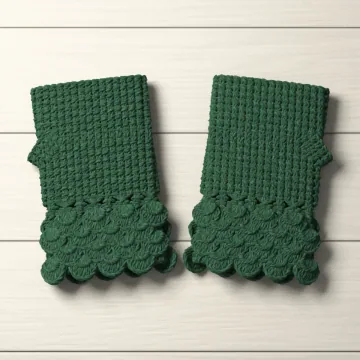
For the backs of gloves, keep the scales to the stitches across the back of the hand and leave the palm plain, so that the hand can close. Mittens and gloves has the shaping.
Increases and decreases
Put them in the plain rows or rounds, at the edges if you can. An increase is two stitches in one, and a decrease makes one stitch of two. In the next scale row look at the row of scales below and put each new one between two of them. Keep the first and the last stitch plain, and at least one plain stitch between two scales. Where the piece narrows, leave a scale out: two side by side push each other up.
Chain mail in crochet
Chain mail is a fabric of rings, in which each ring of the common weave goes through four others, two above and two below. Crochet can make real rings or only the look of them.
- Rings of chain, linked as they are made. In gray or silver yarn, chain 12. At 4 chains to 1 in (2.5 cm) that is a ring about 1 in (2.5 cm) across. Take out the hook, pass the end of the chain through the rings it has to link, put the hook back, and slip stitch in the first chain. Fasten off, and weave both ends round the ring. Row 1 is 6 loose rings. Row 2 is 5 rings, each through two neighbors of row 1. Row 3 is 6 rings: the first through the first ring of row 2 alone, the next four through two neighbors each, the last through the last ring alone. Repeat rows 2 and 3. Lay it flat as you go, and keep all the rings of a row leaning one way.
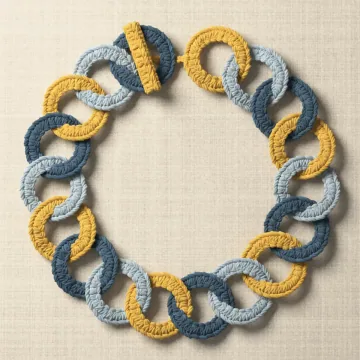
- Rings of plastic or metal. Cover closed rings with single crochet over the ring and join each to its neighbors with a slip stitch in the last round. They touch and do not hang through one another.
- A stitch that looks like mail. A loose net in gray yarn, such as mesh or Solomon's knot, reads as mail from a distance and is light to wear.
Scale gloves are told above, under In the round, and the dragon scale gloves have scales of yarn alone.
Care and mending
- Do not block a piece with scales, and do not wring it. Dry metal scales with a cloth if they get wet. Keep plastic ones away from heat.
- A loose scale. Thread a needle with the same yarn. From the back, bring the needle up through the fabric and the hole, go over the top rim, and go down into the fabric where the old strand did. Do it twice, and weave in both ends at the back.
- Keep scales away from small children and animals, who may pull them off.
What goes wrong, and the cure
| What you see | What to do |
|---|---|
| The scale is on the wrong side | You were on a right side row: undo that row, work it plain, and put the scales in the next |
| It turns sideways | Hold its point down as you make the next stitch |
| It flops about | Use a thicker yarn or a smaller hook |
| Gaps of crochet show between | Put scales in more stitches, or check that rows are moved over |
| The scales stand out like tiles | They are too close: one more plain stitch between |
Where to go next
- Beads and sequins, which land on the same side.
- Bag bases for a pouch: begin the scales after the base.
- Recycled materials for can tabs crocheted in the same way.