Post stitches and cables · Intermediate
Cables
Crochet cables are post stitches worked out of order, so that they cross. For a simple cable of four stitches, skip two stitches, work a front post treble crochet (UK double treble) round each of the next two, then go back and work one round each of the two you skipped. The two made second lie across the front of the first two. Cables are set in a plain fabric, such as double crochet (UK treble). The stitch pattern called cable stitch, given after the steps, gets a small twist from one crossing stitch and uses no post stitches at all.
How to work it
Skip two, and go round the third

Work along the row to the four stitches of the cable. Pass over the first two. Yarn over twice and pass the hook round the post of the third stitch: in at the front, behind the post, and out at the front again.
Go back for the two you skipped

Now work a front post treble round the first stitch you skipped, and another round the second. Reach across the front of the two stitches you have just made to get to them. The four stitches have changed places: the cable is crossed.
The row after

Turn and work the next row as the pattern says. In cable patterns worked in rows it is often a wrong-side row, with a back post stitch round each of the four cable stitches, taken in the order they now stand. Back post stitches on wrong-side rows keep the cable raised on the right side.
The stitch pattern, row by row
- Multiple
- Chain a multiple of 4 plus 3 (11 or more).
- Starting chain
- The rows here are written for a chain of 19, which is 4 times the multiple of 4, plus 3.
- The ch 3 at the start of a row counts as a dc. The last stitch of the next row is worked into the top of it.
- The ch 1 at the start of a row does not count as a stitch.
- Row 1 is the wrong side.
- The last double crochet of each group goes back into the skipped stitch, in front of the three just made, and lies across them.
- No post stitches are used: the cable is made by that one crossing stitch.
- Foundation. Ch 19.
- Row 1 (WS). Sc in 2nd ch from hook and in each ch across (18 sc).
- Row 2. Ch 3 (counts as dc), turn; [sk next st, dc in next 3 sts, dc in skipped st] 4 times, dc in last st (18 dc).
- Row 3. Ch 1, turn; sc in next 17 sts, sc in top of turning ch (18 sc).
Repeat rows 2 and 3 for the pattern.
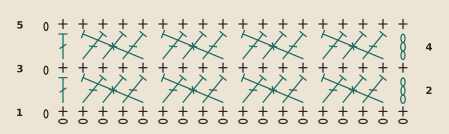
What each symbol meansHow to read a chart
Abbreviations in these rows
- ch
- chain stitch
- sc
- single crochet (UK double crochet)
- dc
- double crochet (UK treble)
- WS
- wrong side
- sk
- skip
- st
- stitch
At a glance
- Used for
- raised ropes and braids on hats, scarves, sweaters and blankets; a panel of texture in a plain fabric
- Abbreviations in a post stitch cable
- FPtr, front post treble crochet; BPdc, back post double crochet; sk, skip
- In UK terms
- A US front post treble crochet (FPtr) is a UK raised double treble front (RdtrF). The plain fabric round it, US double crochet, is UK treble.
- Stitches in a cable
- Four in the cable on this page. Cables of two and of six are crossed the same way.
- Multiple
- The chain is a multiple of 4 plus 3 (11 or more).
- Row repeat
- Rows 2 and 3.
- Sides
- Has a right side: row 2 and every second row after it are worked with it facing.
- Edges
- The side edges are straight: where a row begins with a chain that counts, that chain is the edge stitch and the last stitch of the next row goes into its top; a row that begins with a chain that does not count begins and ends in a stitch, and that chain is not worked into. Inside the edges the stitches lean one way and then the other.
The steps above cross a cable of post stitches. The written rows on this page are a different and simpler thing, the stitch pattern called cable stitch, so they are not rows for that cable. For rows that use post stitches, see basketweave stitch.
The rows above are the stitch pattern known as cable stitch. It has no post stitches. Three double crochets are worked, and a fourth goes back into the stitch that was skipped before them. That fourth stitch lies across the other three.
In a post stitch cable, the post stitches are usually a size taller than the plain stitches around them: treble crochet in a fabric of double crochet. The plain stitches on each side are what the cable stands out from.
A cable is not crossed on every row. Between two crossing rows, each of its stitches is worked straight up, round the post of the stitch below: front post stitches on right-side rows and back post stitches on wrong-side rows. How many straight rows come between crossings is part of each pattern.
In the cable on this page the stitches worked second lie in front. Those are the two that were skipped, because the hook reaches across the front of the first pair to work them.
Small gaps can open in the fabric behind a crossing. Patterns deal with them in different ways, and some makers sew them closed afterward.
When it goes wrong
- After a cross I cannot tell which stitch to work round next.
- The four stitches now stand in a new order. On the next row, work round them in the order they stand along the row, not the order they were made in.
- My cable does not stand out.
- Work the cable in post stitches a size taller than the fabric, such as front post trebles in double crochet, and keep plain stitches on each side of it.
Left-handed
The pictures show the hook held in the right hand. For the left hand, read each picture as its mirror image.
Variations
- Front post treble crochet. The stitch most cables are made of.
- Crossed stitches. The same crossing with plain stitches worked into the tops of the row below.
- Wider cables. Skip three stitches, work a front post treble round each of the next three, then one round each of the three you skipped: a cable of six.
Questions
- What stitches are crochet cables made of?
- Post stitches, most often front post double crochet and front post treble crochet, with back post stitches on the wrong-side rows.
- Can you crochet a cable without post stitches?
- Yes. Cable stitch, the stitch pattern on this page, makes its twist by working one double crochet back into a skipped stitch, across the three before it.
- Which stitches end up in front?
- In the cable on this page, the ones worked second. They are made by reaching across the front of the stitches already there.