Mesh and lace · Easy
Eyelet stitch
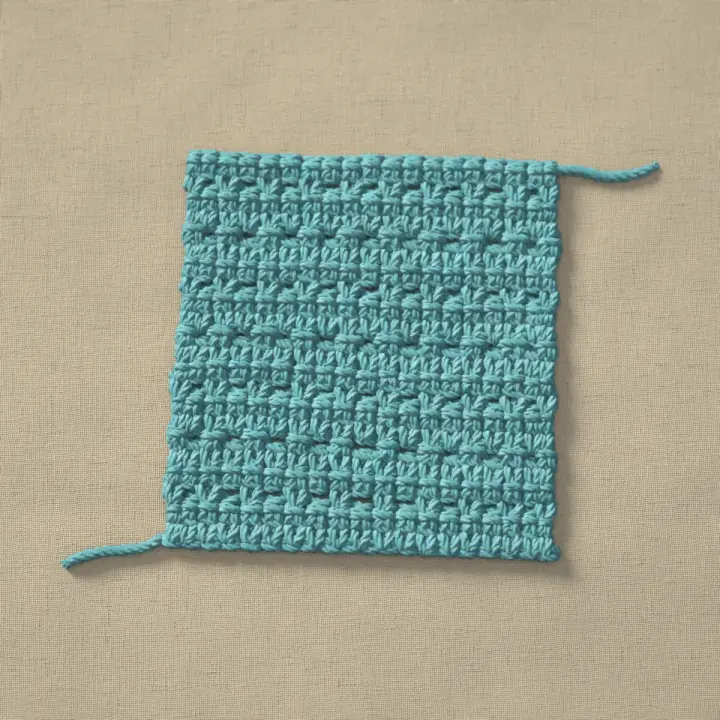
An eyelet is a small hole made on purpose: chain 1, skip one stitch, and work into the next. In this eyelet stitch the fabric is plain single crochet (UK double crochet), and every third row is a row of eyelets, a chain over a skipped stitch and a single crochet in turn. On the row after it a single crochet goes into every stitch and every chain space, so the count never changes.
How to work it
Chain 1 and skip a stitch

Start the row with a single crochet. Then chain 1, skip the next stitch and work a single crochet into the stitch after it. The chain lies over the skipped stitch and leaves a small gap under it: that is the eyelet. Go on in the same way to the end of the row: chain 1, skip one, single crochet in the next.
Work into the chain spaces on the next row

Chain 1, turn, and work a single crochet into every stitch and one into every chain space. For a chain space, put the hook into the gap under the chain, not into the chain itself. The row has as many stitches as a plain row.
The stitch pattern, row by row
- Multiple
- Chain a multiple of 2 (6 or more).
- Starting chain
- The rows here are written for a chain of 20, which is 10 times the multiple of 2.
- The ch 1 at the start of a row does not count as a stitch.
- Row 1 is the right side.
- Foundation. Ch 20.
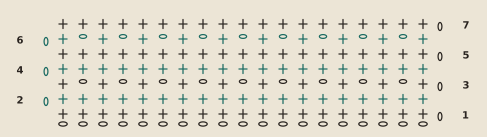
- Row 1 (RS). Sc in 2nd ch from hook and in each ch across (19 sc).
- Row 2. Ch 1, turn; sc in each st across (19 sc).
- Row 3. Ch 1, turn; sc in next st, [ch 1, sk next st, sc in next st] 9 times (10 sc, 9 ch-1 sps).
- Row 4. Ch 1, turn; sc in next st, [sc in next ch-1 sp, sc in next st] 9 times (19 sc).
Repeat rows 2 to 4 for the pattern.
What each symbol meansHow to read a chart
Abbreviations in these rows
- ch
- chain stitch
- sc
- single crochet (UK double crochet)
- RS
- right side
- sk
- skip
- sp
- space
- st
- stitch
At a glance
- Used for
- a ribbon, a cord or a tie threaded in and out of a row of holes; a line of small holes across plain fabric
- Multiple
- The chain is a multiple of 2 (6 or more).
- Row repeat
- Rows 2 to 4.
- One eyelet
- Chain 1 over one skipped stitch
- The row after
- One single crochet in each stitch and in each chain space
Each chain stands in for the stitch it passes over, so a row of eyelets is as wide as a plain row. It begins and ends with a single crochet, which is why the rows need an odd number of stitches and the starting chain an even number.
The name eyelet stitch is given to more than one stitch pattern. Other published rows of that name make each hole with three chains over two or three skipped stitches and fill it with five single crochets on the next row. The rows here are one way, and the plainest: one chain over one stitch.
In mesh stitch every row is a stitch and a chain in turn, so the whole fabric is holes. Here the holes come in one row out of three and the rest is solid.
When it goes wrong
- My row is short of stitches after the eyelets.
- A chain space was passed over. On the row after the eyelets, work one single crochet into every chain space as well as into every stitch, and count them at the end of the row.
- The holes are too small for my ribbon or cord.
- Make a wider hole. Published eyelet rows also use two or three chains in place of one.
Left-handed
The pictures show the hook held in the right hand. For the left hand, read each picture as its mirror image.
Variations
- Eyelets in taller stitches. The same hole is made in a row of half double crochet (UK half treble) or double crochet (UK treble): chain 1, skip one stitch, and work the tall stitch into the next. A fabric of nothing but such rows of double crochet is mesh stitch.
- A few eyelets in a row. A row can hold only one or two eyelets, set where a cord or a tie is to pass, with plain single crochet between them.
Questions
- What is an eyelet in crochet?
- A small hole left on purpose by a chain worked over a skipped stitch. Patterns call a row that holds them an eyelet row.
- How many chains do I start with?
- An even number, 6 or more. The rows here are written for 20 chains, which gives 19 stitches.
- What are the holes for?
- One use is threading: a ribbon, a cord or a tie is woven in and out of the row of holes.
- Do I work into the chain or under it?
- Under it. A chain space is the gap below the chain, and the hook goes into that gap.