Mesh and lace · Easy
Filet crochet
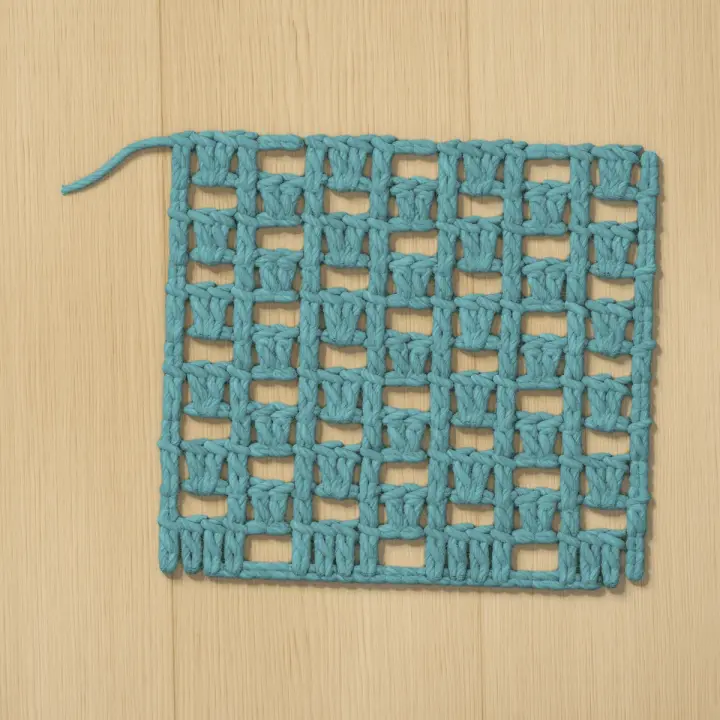
Filet crochet is a mesh of small squares, some left open and some filled in, which together make a pattern or a picture. It uses two stitches only: the chain and the double crochet (UK treble). The design is read from a chart, one square of the chart for one square of the mesh.
How to work it
Read the chart

A filet chart is a grid. An empty square is an open square of the mesh, called a space. A filled or marked square is a solid one, called a block. Begin at the bottom. Read row 1 from right to left and row 2 from left to right, and keep changing direction at each row, as the work does when it is turned.
Work an open square

Chain 2, skip the next 2 chains or stitches, and work a double crochet into the one after. The 2 chains are the top of the square. The double crochets on each side of them are its walls.
Work a filled square

Work a double crochet into each of the next 3 stitches: two fill the square and the third is its far wall. Where the square below is open, work the first two into the space under its 2 chains, and the third into the double crochet beyond.
The stitch pattern, row by row
- Multiple
- Chain a multiple of 6 (24 or more).
- Starting chain
- The rows here are written for a chain of 24, which is 4 times the multiple of 6.
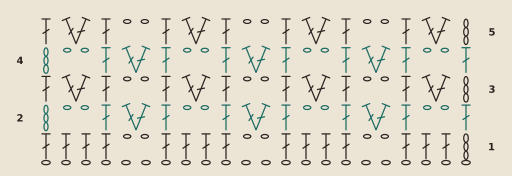
- The ch 5 at the start of a row counts as a dc and a ch-2 sp. The last stitch of the next row is worked into its 3rd ch.
- The ch 3 at the start of a row counts as a dc. The last stitch of the next row is worked into the top of it.
- Row 1 is the right side.
- Stitches in parentheses, or several of one stitch, are all worked into the one place named after them.
- Foundation. Ch 24.
- Row 1 (RS). Dc in 4th ch from hook (skipped chs count as dc), dc in next 2 chs, [ch 2, sk next 2 chs, dc in next 4 chs] 3 times (16 dc, 3 ch-2 sps).
- Row 2. Ch 5 (counts as dc and ch-2 sp), turn; sk next 2 sts, dc in next st, [2 dc in next ch-2 sp, dc in next st, ch 2, sk next 2 sts, dc in next st] 2 times, 2 dc in next ch-2 sp, dc in next st, ch 2, sk next 2 sts, dc in top of turning ch (14 dc, 4 ch-2 sps).
- Row 3. Ch 3 (counts as dc), turn; [2 dc in next ch-2 sp, dc in next st, ch 2, sk next 2 sts, dc in next st] 3 times, 2 dc in next ch-2 sp, dc in 3rd ch of turning ch (16 dc, 3 ch-2 sps).
Repeat rows 2 and 3 for the pattern.
What each symbol meansHow to read a chart
Abbreviations in these rows
- ch
- chain stitch
- dc
- double crochet (UK treble)
- RS
- right side
- sk
- skip
- sp
- space
- st
- stitch
At a glance
- Used for
- curtains, tablecloths, table runners and place mats; letters, borders and pictures in an open, lacy fabric; lace in fine cotton thread, or a larger mesh in yarn
- Stitches used
- Chain and double crochet.
- Open square (space)
- 2 chains over 2 skipped stitches, then a double crochet.
- Filled square (block)
- 3 double crochets.
- Chains to start
- Squares times 3, plus 3 when row 1 begins with a block, plus 5 when it begins with a space.
- Chart
- One square of the chart, one square of the mesh. Row 1 from the right, row 2 from the left.
- Checkerboard rows: multiple
- The chain is a multiple of 6 (24 or more).
- Checkerboard rows: repeat
- Rows 2 and 3.
- Sides
- Looks much the same on both sides.
- Edges
- The side edges are straight: where a row begins with a chain that counts, that chain is the edge stitch and the last stitch of the next row goes into its top.
The rows on this page are the plainest filet there is: blocks and spaces by turns, like a chessboard, seven squares to a row. Row 1 begins with a block, so its chain is 7 times 3 plus 3, which is 24. Any other chart is worked the same way, square by square.
Neighboring squares share a wall. A block on its own is 4 double crochets, and each block that follows it without a gap adds 3 more, so three blocks side by side are 10 double crochets. Most often the picture is worked in blocks and the ground around it in spaces.
The mesh here has 2 chains to a space. A smaller mesh has 1 chain to a space and 1 double crochet filling a block, so that each square is two stitches wide. A pattern says which one it uses. With 2 chains a square tends to come out wider than it is tall. The smaller mesh gives squarer squares, and so does a taller stitch worked in place of the double crochet.
The edge of a piece can step in or out by whole squares. To drop squares at the start of a row, slip stitch across 3 stitches for each square and into the next stitch, then chain 3 and work on from there. To add squares at the start of a row, extra chains are made at the end of the row before, and the new row begins by working back along them.
Fine cotton thread and a small hook give a detailed picture that looks like lace. Thicker yarn and a larger hook give the same chart larger, with bigger steps along every slanting line.
Tips
- Smooth cotton shows the squares clearly.
When it goes wrong
- My squares are wider than they are tall.
- Block the finished piece first: stretched and pinned out, the squares open up. If they are still wide, use the smaller mesh, or work a taller stitch in place of the double crochet.
- The last square of a row has no wall.
- The last double crochet of a row goes into the turning chain of the row below: the top chain of 3, or the third chain of 5.
Left-handed
The pictures show the hook held in the right hand. For the left hand, read each picture as its mirror image, and read each row of the chart from the other end.
Questions
- How many chains do I need for filet crochet?
- Count the squares across the chart and multiply by 3. Add 3 if row 1 begins with a filled square, or 5 if it begins with an open one. A chart 7 squares wide needs 24 chains or 26. This is for the mesh with 2 chains to a space.
- Which way do I read a filet crochet chart?
- From the bottom up, one row of squares for each row of crochet. Row 1 runs from right to left and row 2 from left to right, and so on by turns.
- What is the difference between a block and a space?
- A space is an open square: 2 chains with a double crochet at each side. A block is a filled square: double crochets all the way across. Both are three stitches wide, plus the wall they share with the next square.