Double crochet
To double crochet, take the yarn over the hook, push the hook into the next stitch and pull up a loop, then yarn over and pull through two loops, twice. It is taller than a half double crochet (UK half treble) and shorter than a treble crochet (UK double treble), and United Kingdom patterns call it treble.
- Abbreviation
- dc
- In UK terms
- treble (tr)
- Chart symbol
 an upright line with a bar across the top and one short slash through it
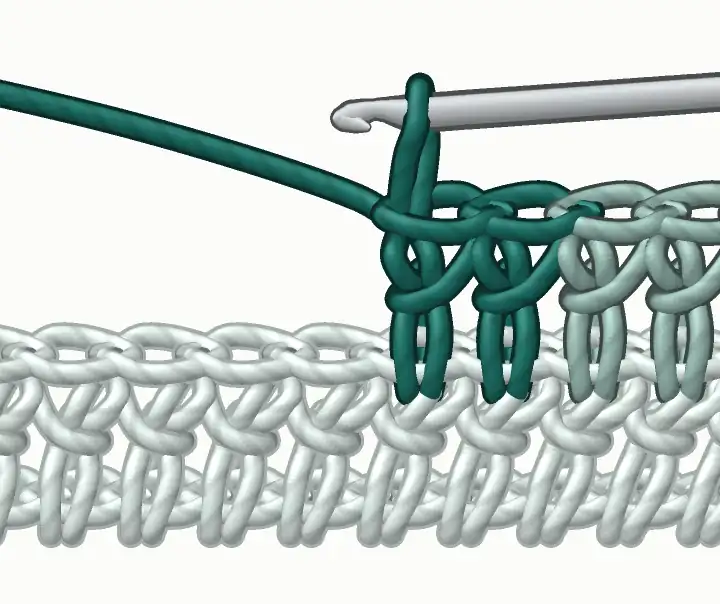
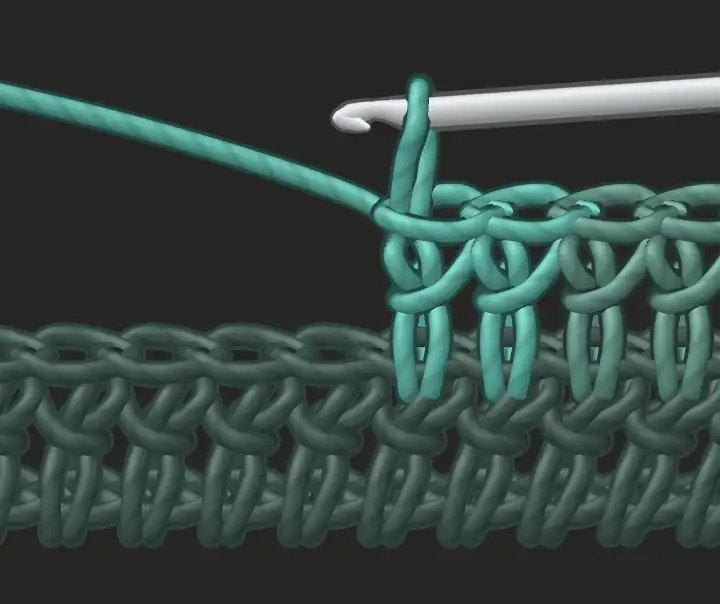
- Yarn over first, before the hook goes in.
- Hook under both top strands of the next stitch, front to back.
- Yarn over.
- Pull it back through the stitch. Three loops.
- Yarn over, pull through the two nearest loops. Two remain.
- Yarn over, pull through both. One double crochet.
- The next stitch is the same.
How to work it
Never held a hook? How to crochet. Red is what is new. Left-handed? Press Left-handed, and every picture turns.
Yarn over

Take the yarn that leads to the ball over the hook from back to front: up behind the hook and over its top toward you. The yarn over stays on the hook beside the loop you started with, and counts as a loop: there are two loops on the hook.
Pull up a loop

Keep both on the hook. Find the next stitch of the row below, the first one you have not yet worked into. Its top is two strands that lie side by side like a V. Push the hook under both strands, from the side that faces you through to the back. There, at the back of the work, take the yarn over the hook again, the same way, and draw it back through the stitch, to the side that faces you. There are three loops on the hook.
Through two

Take the yarn over the hook, the same way, and draw it through two of the three loops: the two nearest the head of the hook, which are the first two it comes to. Two loops are left on the hook.
Through two again

Take the yarn over the hook, the same way, and draw it through the two loops that are left. One loop is left on the hook and the stitch is made.
On a starting chain, yarn over and work the first double crochet into the fourth chain from the hook. The three chains you skipped stand as the first stitch of the row, so a chain of 22 gives a row of 20: nineteen worked stitches and the skipped chains.
At the end of a row, chain 3 and turn. Because the chain 3 stands for the first stitch, do not work into the stitch at its base: the first worked stitch goes into the second stitch of the row. At the other end, work the last stitch into the top chain of the turning chain of the row below.
Not every pattern does it this way. Some make a turning chain of 2, and some do not count the chain as a stitch. A pattern says which it uses.
When it goes wrong
- My rows gain or lose a stitch.
- When the chain 3 counts as a stitch, a double crochet worked into the stitch at its base adds a stitch. Leaving out the last stitch, the one in the top of the turning chain below, loses one. It is an easy one to overlook.
- There is a gap at the start of every row.
- Some crocheters find a turning chain of 2 tall enough for double crochet, and use it to close the gap.
Left-handed
The pictures show the hook held in the right hand. Press Left-handed, under the moving drawing, and every picture here turns for the left hand. In the words, read left for right.
Patterns that use it
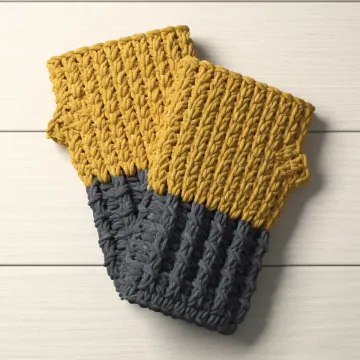
Chunky fingerless gloves
Beginner Women's small and medium to large
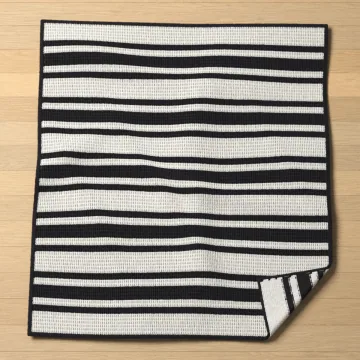
Black and white striped throw
Beginner 50 × 56 in
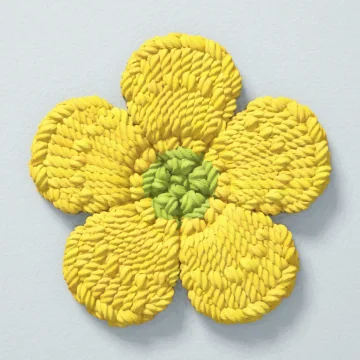
Buttercup flower
Beginner 1 3/4 in across
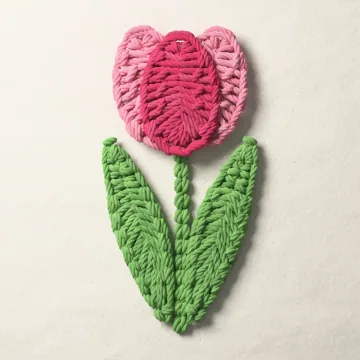
Tulip
Beginner 3 in wide
Single and double row scarfLemon peel stitch throw
2,742 patterns use this stitch; these are some of the easiest. All crochet patterns
At a glance
- Level
- Beginner
- Kind
- Basic stitches
- Used for
- granny squares and other pieces worked in rounds; shells and other groups of stitches worked into one place
- Height
- Taller than a single crochet (UK double crochet) and a half double crochet, shorter than a treble crochet
- To turn
- Chain 3. It counts as the first stitch of the row unless the pattern says otherwise.
- On a starting chain
- The first stitch goes in the fourth chain from the hook, and the three skipped chains count as a stitch.
Tips and variations
Tips
- Count your stitches each time you finish a row, with the turning chain as one of them when it stands for a stitch.
- In turned rows, every other row shows the back of its stitches, which does not look quite like the front. The pictures here draw every row alike.
Variations
- Front post double crochet. A double crochet worked round the post of a stitch from the front, so that it stands forward.
- Back post double crochet. The same stitch worked round the post from the back of the work.
- Linked double crochet. Each stitch is joined to the one before it, halfway up.
- Herringbone double crochet. One move differs: the loop pulled up is drawn straight on through the next loop on the hook.
- Extended double crochet. One extra move after the loop is pulled up makes the stitch a little taller.
- Crossed double crochet. A pair of stitches worked out of order, so that they cross like an X.
- Foundation double crochet. The starting chain and the first row made at the same time.
- Chainless starting double crochet. A way to begin a row of double crochet with no turning chain.
- Standing double crochet. A whole stitch that starts a row or round on a new yarn, with no chain.
- Double crochet decrease. Two stitches started in two places and closed under one top.
Questions
- Is double crochet the same as treble?
- In United Kingdom patterns, yes: a US double crochet (dc) is written treble (tr) there. The names shift by one, so a UK double crochet is a US single crochet.
- Does the chain 3 count as a stitch?
- Usually, yes. In single crochet (UK double crochet) the turning chain never counts as a stitch. In double crochet (UK treble) and treble crochet (UK double treble) it counts unless the pattern says otherwise. In half double crochet (UK half treble) patterns differ, so go by the pattern, and where the pattern is silent choose one way and keep to it.