Texture · Intermediate
Honeycomb stitch
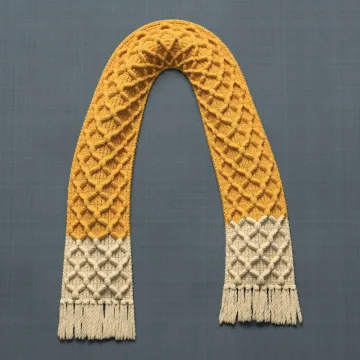
Honeycomb stitch most often means a solid fabric of single crochet (UK double crochet) with raised cells on one side. Every second stitch of a row is a spike stitch worked two rows down. In the next row, a single crochet is worked through the near legs of two neighboring spikes, which pulls them together. The next row of spikes is moved one stitch along, and the legs outline cells like a honeycomb. It is also printed as smock stitch. An open mesh and a Tunisian stitch carry the name honeycomb too.
How to work it
A row of spikes

Work a single crochet into the first stitch. For the next stitch, put the hook into the stitch two rows down, pull up a loop as tall as the row you are working, and finish it as a single crochet. That is a spike stitch: its loop shows as two long legs. Keep taking turns to the end of the row: a single crochet, a spike.
Join the legs

In the row after, work single crochets, and over each stitch that stands between two spikes work a joining single crochet. Put the hook under the last leg of the spike before and the first leg of the spike after, pull up a loop through both, and finish the single crochet. The stitch of the row below that lies behind it is skipped. The two legs are pulled together under the new stitch.
Move the next row of spikes over

Work the next row of spikes one stitch along, so that each spike stands where a joining stitch was. Put the hook in two rows down so that, on the far side of the work, it comes through between the two joined legs, under the point where they meet. Then join the legs of this row in the same way. The four rows repeat: spikes, joining, spikes moved over, joining.
At a glance
- Also called
- smock stitch, honeycomb smock stitch
- Used for
- bags; a dense, textured fabric with one right side
- Rows that repeat
- Four: a row of spikes, a joining row, a row of spikes moved one stitch along, a joining row
- Stitches
- Single crochet only, worked in three places: into the stitch, two rows down, and through two legs
- Sides
- The cells show on one side. The other side looks like moss stitch
- Fabric
- Dense and a little thick
Three publishers print these rows, as honeycomb stitch, as honeycomb stitch also known as smock stitch, and as honeycomb smock stitch. They agree row for row. They name the joining stitch differently: one calls it a single crochet worked in two spike stitches, one a modified stitch, one a front post single crochet. It is the same move.
The texture is all on one side, and it matters which. The back has no cells: it has an even, bumpy look that publishers compare to moss stitch.
Honeycomb mesh is another fabric. It is an open net: a double crochet (UK treble) and 4 chains, again and again, with each double crochet worked into the chain space below. The trellis stitch on this site is a net of the same kind made with single crochet.
The Tunisian honeycomb is a third. In Tunisian crochet the simple stitch and the purl stitch take turns along the row, and in the next row each is worked over the other.
Tips
- Pull the loop of each spike up to the height of the row you are working, so that it does not pucker the rows it crosses.
When it goes wrong
- My rows are getting wider.
- The stitch behind each joining stitch is being worked as well. The joining stitch takes its place: skip it and go on to the next stitch.
- I see zigzags and no cells.
- Every second row of spikes has to be moved one stitch along, so that each spike stands between two joined legs of the row before.
Left-handed
The pictures show the hook held in the right hand. For the left hand, read each picture as its mirror image.
Variations
- Spike stitch. The stitch worked into a row below, step by step.
- Trellis stitch. An open net of chain arches.
- Waffle stitch. Another raised grid, made with post stitches.
- Moss stitch. The look of the back of this fabric.
Patterns that use it
Questions
- What is the honeycomb stitch in crochet?
- Most often a single crochet fabric in which spike stitches are worked two rows down and their legs are then joined in pairs, row after row, so that they outline cells. An open mesh and a Tunisian stitch are called honeycomb as well.
- Is honeycomb stitch the same as smock stitch?
- Yes, for the stitch on this page. The same rows are printed as honeycomb stitch, as smock stitch and as honeycomb smock stitch.
- Is the crochet honeycomb stitch the Tunisian honeycomb stitch?
- No. The Tunisian honeycomb is made on a Tunisian hook with the simple stitch and the purl stitch by turns. The stitch on this page is ordinary crochet in single crochet.
- Does honeycomb stitch look the same on both sides?
- No. The cells are on one side only. The other side is flatter and looks like moss stitch.