Changing color · Easy
Spike stitch
A spike stitch is a stitch worked into a row below the one you would normally work into, so that a long strand of yarn lies over the rows it passes. Put the hook into a stitch one or more rows down, pull up a loop to the height of the row you are working, and finish the stitch as usual, most often as a single crochet (UK double crochet). Keep the long loop loose, or the rows bunch up.
How to work it
Find the stitch below

Look at the next stitch, the one you would work into for a plain single crochet. Follow it down to the stitch it stands in, one row below. That is where the hook goes for the spike on this page.
Pull up a long loop

Put the hook into that lower stitch. Yarn over and pull up a loop, and draw it up until it is level with the row you are working. Two loops are on the hook. Leave the long loop loose.
Finish it like a single crochet

Yarn over and pull through both loops. The spike is made: a long V of yarn that lies over the stitch it passed.
The stitch pattern, row by row
- Multiple
- Chain a multiple of 2 (8 or more).
- Starting chain
- The rows here are written for a chain of 20, which is 10 times the multiple of 2.
- The ch 1 at the start of a row does not count as a stitch.
- Row 1 is the right side.
- Foundation. Ch 20.
- Row 1 (RS). Sc in 2nd ch from hook and in each ch across (19 sc).
- Row 2. Ch 1, turn; sc in each st across (19 sc).
- Row 3. Ch 1, turn; sc in next st, [spike sc in next st, sc in next st] 9 times (10 sc, 9 spike sc).
- Row 4. Ch 1, turn; sc in each st across (19 sc).
- Row 5. Ch 1, turn; sc in next 2 sts, [spike sc in next st, sc in next st] 8 times, sc in next st (11 sc, 8 spike sc).
Repeat rows 2 to 5 for the pattern.
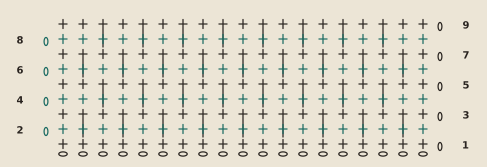
What each symbol meansHow to read a chart
Abbreviations in these rows
- ch
- chain stitch
- sc
- single crochet (UK double crochet)
- RS
- right side
- st
- stitch
- yo
- yarn over
- spike sc
- spike single crochet: insert hook in the st 1 row below the next st, yo, pull up a loop to the height of the row being worked, yo, pull through 2 loops; the st behind the spike is left unworked.
At a glance
- Used for
- long dashes of one color laid over a row of another; texture on dishcloths and pillow covers; a fabric with spikes on both sides
- Abbreviation
- None is standard. A pattern defines its own, such as SpSt, and says how far down the hook goes.
- In UK terms
- spike stitch, the same name. A spike single crochet is a UK spike double crochet.
- Loops on the hook
- 2 before the last pull, as for a plain single crochet
- Multiple
- The chain is a multiple of 2 (8 or more).
- Row repeat
- Rows 2 to 5.
- Sides
- Looks much the same on both sides.
- Edges
- The side edges are straight: a row that begins with a chain that does not count begins and ends in a stitch, and that chain is not worked into.
How far down the hook goes is up to the pattern: one row, two rows, three or more. The further down, the longer the spike. Spikes of different lengths, and spikes set in different places from row to row, make patterns in the fabric.
Patterns do not all count the rows the same way. On this page the hook goes into the stitch one row below the next stitch, which is the stitch the next stitch stands in. Many patterns call that same place two rows below. They count down from the row being made: the stitches you would normally work into are one row below it, and the stitches under those are two rows below. Read how the pattern describes its own spike before the first one.
In the rows on this page every other row is plain single crochet. The rows between have a spike in every other stitch, and the spikes move over by one stitch from one spike row to the next.
The long loop has to reach from the lower stitch up to the row you are working, without pulling. Drawn up too tight, it squeezes the rows it lies over and the fabric bunches. Drawn up to the full height, it lies flat.
A spike can be any stitch. Single crochet is the usual one, and half double crochet (UK half treble) and double crochet (UK treble) are worked the same way: put the hook in lower down, draw the loop up to the working height, and finish the stitch as usual.
Spike stitches are often worked in more than one color. A spike in the new color reaches down over the row of the old color below it. The spikes show on both sides of the fabric.
When it goes wrong
- My fabric puckers at the spikes.
- The long loops are too short. Draw each one up loosely until it is level with the top of the row you are working, then finish the stitch.
- My row has gained stitches.
- The stitch behind each spike was worked as well. A spike takes the place of that stitch, so skip it and work the next one.
Left-handed
The pictures show the hook held in the right hand. For the left hand, read each picture as its mirror image.
Variations
- Longer spikes. Put the hook in two or more rows down. The loop has further to come up, so take extra care to leave it loose.
Questions
- What does "two rows below" mean in a spike stitch pattern?
- It depends on how the pattern counts. In many patterns the count starts from the row you are making: the stitches you would normally work into are one row below, and the stitches under those are two rows below. Check the pattern's own description of its spike.
- Can any stitch be a spike stitch?
- Yes. The stitch is made as usual. Only the place the hook goes into is different.
- Do spike stitches show on the back?
- Yes. A spike makes a long strand on both sides of the fabric.