Finishing · Easy
Romanian cord
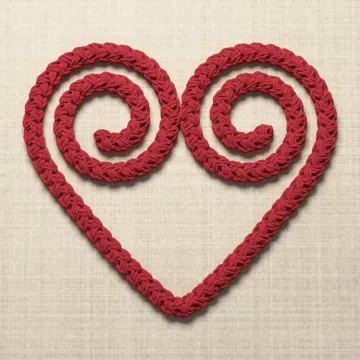
A Romanian cord is a firm, narrow crochet cord that looks like a braid. It is one single crochet (UK double crochet) wide. After every stitch the work is turned half round, and the next stitch goes under the two strands that now lie across the front. Two chains start it, and it can be made as long as you like without counting a foundation first.
How to work it
Chain two

Leave a tail of 6 in (15 cm) or more for sewing. Make a slip knot and chain 2. Count from the hook: the chain next to the hook is 1, and the one beyond it is 2.
Turn half round and find one bar

Keep the yarn behind the hook. Turn the little piece half round as you would turn a page, the right side of it toward you and over to the left (clockwise, seen from above), so that the edge you began from is below the hook. One strand now lies across the front. Put the hook under it from right to left.
Turn again and find two bars

Turn half round, the same way as before, with the yarn behind. From now on two strands lie across the front, one under the other, close below the hook. They are the two strands of one earlier stitch. Put the hook under both, from right to left.
Stitch under both, and repeat

Yarn over and pull a loop out from under both strands, yarn over and pull through the 2 loops on the hook. Turn half round the same way, go under the two strands, and make the next stitch. Every stitch from here is the same.
At a glance
- Also called
- Romanian lace cord, Romanian point lace cord
- Used for
- drawstrings, ties and small bag handles; the outlines of Romanian point lace; a cord that can be shaped into loops and sewn down
- Romanian cord
- Single crochet, the work turned after each one; the hook goes under two side strands. Firm, and looks braided.
- Double chain
- No turning. Each stitch goes into the left loop of the stitch just made. Firm; also used as a foundation.
- I-cord
- No stitches, only chains, worked through three loops that are held off the hook in turn. A smooth round tube.
- Single crochet cord
- A chain with one row of single crochet along it. Flat. Its length is fixed by the chain.
- Loops on the hook
- 1 between stitches; 2 once the new loop is pulled out from under the strands.
- The turn
- Half round after every stitch, always the same way.
- Abbreviations used
- ch, sc (UK dc)
The cord grows as it is turned: each stitch is a row of its own, and the two strands you work under are the end of the row before last. That is why they always come up at the front after a half turn. A stitch under one strand alone makes a thinner, uneven place.
Turning. Turn the work, not your wrist. The yarn to the ball gets a half turn with every stitch, so let the cord hang now and then and spin back. Keep the yarn at the back of the hook before each turn: if it comes round the front it lies across the two strands and hides them.
In Romanian point lace the cord draws the picture. The design is marked on paper or on firm cloth, and the cord is tacked down along its lines, with the places where it meets itself sewn together. The shapes between the cords are then filled with a needle, with nets of buttonhole stitch or with woven bars, and these are anchored in the loops along the edges of the cord. Cord and needle stitches together make a lace that holds without the paper. The cord by itself is only a technique and can be used for anything.
To sew the cord to a piece in a line or a curve, pin it first, with the side that curves in eased a little closer than the side that curves out. Sew with the tail, or with matching thread, through the loops along one edge, and then through those along the other, so that it cannot roll.
Tips
- Make the stitches loose enough to leave a gap under the two strands for the hook.
- If you lose your place, hold the cord so that the loop on the hook is at the top, and turn it until two strands lie across the front just below the hook. Those are the ones.
When it goes wrong
- The cord twists like a rope.
- Every half turn puts a little twist in the yarn. Let the cord hang free now and then and spin back. If the braid itself changes its look partway, a turn went the other way: take the cord back to that place, and turn the same way after every stitch.
- I can see only one bar.
- That is right for the second stitch of the cord only. After that, look just below the first strand for another, or bring the yarn to the back: it may be lying over it.
- One edge is longer than the other and the cord curls.
- On some stitches the hook went under one strand. Take the cord back to where it was even, and go under both every time.
- The hook will not go under the strands.
- The stitches are too tight. Pull each loop up a little before finishing the stitch, or use a hook a size larger.
- The start is lumpy.
- The first two stitches have fewer strands to work under. Pull the tail to close the first chain. The cord is even from the third stitch on.
Left-handed
The pictures show the hook held in the right hand. For the left hand, read each picture as its mirror image: the hook goes under the strands from left to right, and the turn is the other way, again the same way every time.
Variations
- Double chain. A cord of single stitches with no turning, each worked into the left loop of the stitch before.
- I-cord. A round cord of chains worked through loops held off the hook.
Patterns that use it
Questions
- How do I join a Romanian cord to a bag?
- Leave tails at both ends. Lay the end of the cord against the wrong side, or fold it through a ring, and sew it down with its own tail through several strands.
- How do I join two Romanian cords?
- Lay the ends or the edges together and sew through the loops along the edges with the tail. In the lace, cords are sewn to each other wherever they touch.
- Is it the same as a double chain?
- No. Both are one stitch wide. The double chain is never turned and goes under one loop; the Romanian cord is turned after every stitch and goes under two.
- How wide is a Romanian cord?
- As wide as your stitch: the cord is one single crochet with its side strands wrapped round it. A thicker yarn or a larger hook makes it wider. Work 4 in (10 cm) and measure before you decide on the yarn.