Basic stitches · Beginner
Slip stitch
To slip stitch, push the hook into the stitch, take the yarn over the hook, and pull it through the stitch and through the loop on the hook in one move. It is the shortest crochet stitch and adds almost no height, so it is used to join and to move along rather than to build fabric.
- Abbreviation
- sl st
- In UK terms
- slip stitch (ss)
- Chart symbol
 a filled dot
How to work it
Hook in

Push the hook into the stitch or the chain that the pattern names, from the side that faces you through to the back. In a stitch, the hook goes under both strands at its top, the two that lie side by side like a V. In a chain, it goes through the middle of the chain's V, unless the pattern names another place. The loop you started with is still the only loop on the hook.
Yarn over

The head of the hook is now at the back of the work. There, take the yarn that leads to the ball over the hook from back to front: up behind the hook and over its top toward you. It lies on the hook beside the loop.
Pull through both

Catch that yarn in the head of the hook and draw it back through the stitch, to the side that faces you, and then on through the loop that was on the hook. One loop is left on the hook and the slip stitch is made.
At a glance
- Used for
- joining a chain into a ring; joining the end of a round to its beginning; moving along a row without adding height; seaming two pieces together; a plain edge to finish a piece
- Height
- The shortest of the stitches
To close a ring, chain the number the pattern gives, then push the hook into the first chain you made, take the yarn over, and pull it through that chain and the loop on the hook. The chain is now a ring, and the first round is worked into its center.
To join a round, finish the last stitch of the round, then slip stitch into the top of the first stitch of the same round. This is done in rounds that are joined, and not in rounds worked as a continuous spiral.
To move along a row, slip stitch into each stitch you want to pass. The yarn ends up further along without the row getting taller there.
Tips
- Work slip stitches loosely. They pull tight easily.
When it goes wrong
- I have two loops on the hook and I am not sure what to do.
- Pulling the yarn through the stitch alone leaves two loops, which is the first half of a single crochet (UK double crochet). For a slip stitch, carry the same pull on through the loop on the hook, so that one loop is left.
- My slip stitch edge is pulling the piece in.
- The stitches are too tight. Keep the yarn loose as you make them.
Left-handed
The pictures show the hook held in the right hand. For the left hand, read each picture as its mirror image.
Variations
- Fabric worked all in slip stitch. A whole piece can be worked in rows of slip stitch, which is known as slip stitch crochet. It is unusual: in most patterns the slip stitch does the jobs between other stitches.
Patterns that use it
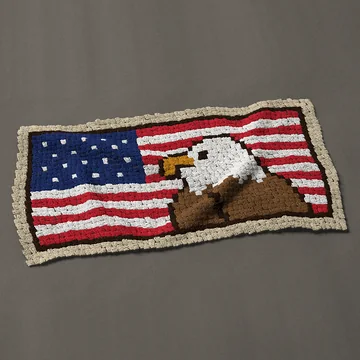
45 × 24 in Intermediate
American flag and bald eagle C2C graph
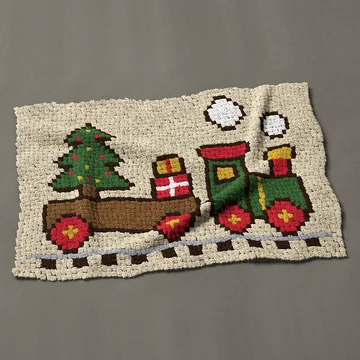
50 × 33¾ in Advanced
Christmas train with presents C2C graph
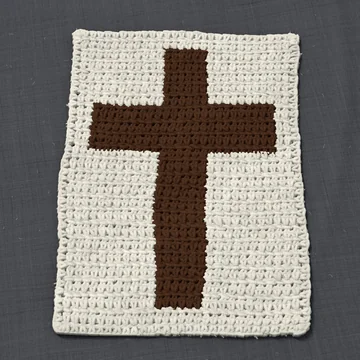
9 × 12¼ in Intermediate
Cross graph
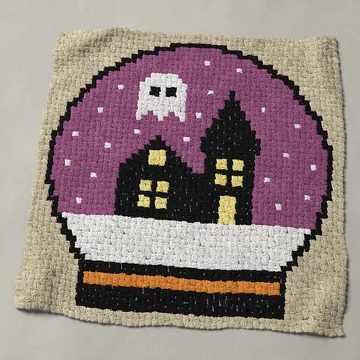
41 × 42 in Intermediate
Halloween snow globe C2C graph
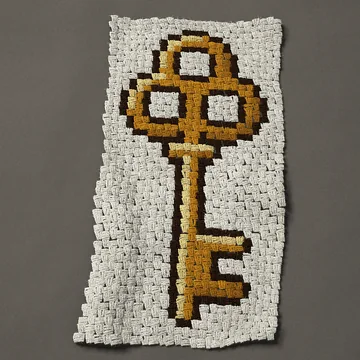
18 × 36 in Intermediate
Vintage gold skeleton key C2C graph
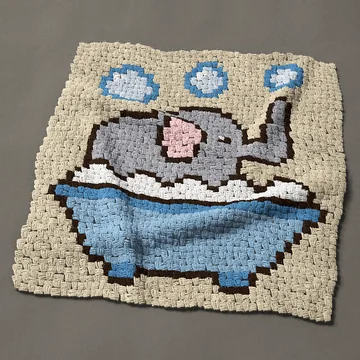
33¾ × 36¾ in Intermediate
Baby elephant in a bubble bath C2C graph
Questions
- Does a slip stitch add height?
- Almost none. It is the shortest stitch, which is why it is used to travel across stitches and to join.
- What does ss mean in a pattern?
- Slip stitch. United Kingdom patterns often write ss where United States patterns write sl st.