Tunisian lace
Tunisian lace is Tunisian crochet with holes set in it on purpose. The hole comes from a yarn over, and one loop drawn up under two bars beside it keeps the count. If you can do Tunisian simple stitch you can do this. Take a hook a size or two larger than usual and chain 15.
How to work it
Never held a hook? How to crochet. Red is what is new. Left-handed? Read each picture as its mirror image.
Work the first row plain

Leave the chain nearest the hook alone. Draw up a loop in each of the other 14 chains, and keep them all on the hook: 15 loops. This is the forward pass.
Work the loops off

Do not turn. Yarn over and draw it through one loop. Then yarn over and through two loops, again and again, until one is left. This return pass is the same after every row of the lace.
Go under two bars at once

Slide the hook under the next two bars together. Yarn over and draw one loop out from under both. Two stitches of the row below have become one.
Yarn over

Take the yarn over the hook from back to front, and leave it there. It counts as the stitch that was lost. Go on at the next bar.
Work a plain row over it

Simple stitch in every bar. A yarn over shows as a slanting strand with a hole under it: put the hook under that strand, as if it were a bar. Count 15. The picture shows two lace rows with plain rows between.
Or let the holes slant

Begin every lace row one stitch later than the one before, and the holes climb in a line. The chart shows four lace rows with plain rows between, read from right to left. A ring is a yarn over.
The stitch pattern, row by row
- Multiple
- Chain a multiple of 4 plus 3 (11 or more).
- Starting chain
- The rows here are written for a chain of 15, which is 3 times the multiple of 4, plus 3.
- Every row is a forward pass and a return pass. The return pass is always: yo, pull through 1 loop, [yo, pull through 2 loops] to the end.
- The loop on the hook is the first stitch of each row. The last stitch goes under both strands of the edge.
- A yarn over counts as a loop, and on the next row as a bar.
- For slanting holes: row 1 is [Tss2tog, yo, Tss 2] 3 times, Tss 1. Row 3 is Tss 1, [Tss2tog, yo, Tss 2] 3 times. Row 5 is Tss 2, [Tss2tog, yo, Tss 2] 2 times, Tss2tog, yo, Tss 1. Row 7 is Tss 3, [Tss2tog, yo, Tss 2] 2 times, Tss2tog, yo. Each ends with the edge stitch, and the rows between are plain.
- Foundation. Ch 15. Draw up a loop in 2nd ch from hook and in each ch across; return (15 loops).
- Row 1. Sk first bar, [Tss in next 2 bars, Tss2tog, yo] 3 times, Tss in next bar, Tss in last st; return (15 loops).
- Row 2. Sk first bar, Tss in each bar and yo across; return (15 loops).
- Row 3. Sk first bar, [Tss2tog, yo, Tss in next 2 bars] 3 times, Tss in next bar, Tss in last st; return (15 loops).
- Row 4. As row 2 (15 loops).
Repeat rows 1 to 4 for the pattern. End with a plain row.

What each symbol meansHow to read a chart
Abbreviations in these rows
- ch
- chain stitch
- Tss
- Tunisian simple stitch: hook under the front bar, yo, pull up a loop
- Tss2tog
- hook under the next 2 bars at once, yo, pull up one loop
- yo
- yarn over, left on the hook
- sk
- skip
- st
- stitch
Every lace row keeps one rule: one yarn over for one loop lost. Two bars together lose a loop, a skipped bar loses a loop, and the yarn over puts it back. If a chart has more rings than pairs the fabric grows wider, and that is how a lace shawl is shaped.
The order decides on which side of the hole the pair stands. With the pair first and the yarn over after it, as here, the pair is at the right of the hole. Some patterns put the yarn over first. Keep the order that your pattern gives in every row, or the lines of holes will not match.
Lace off the hook looks shrunken and uneven. Blocking does the most for it: wet, pinned to size and dried, the holes open and the plain stitches between them settle.
When it goes wrong
- I have one loop too few.
- A yarn over was left out or fell off. Look for a pair of bars taken together with no strand after it, and lift the yarn over the hook there.
- I have one loop too many.
- A pair was worked as two single stitches. Find the repeat with no two bars on one loop.
- I cannot find the yarn over in the next row.
- It is the strand that slants, with a hole under it. The hook goes under that strand from right to left.
- The holes are tiny.
- Use a larger hook, make the yarn over loosely, and block the piece.
- The return pass closes the hole.
- The yarn over was worked off together with its neighbor. Each pull takes the working loop and one more, and the yarn over has a pull of its own.
Left-handed
For the left hand, read each picture as its mirror image. The forward pass then runs from left to right, and the charts are read from left to right too.
Patterns that use it
At a glance
- Level
- Easy
- Kind
- Mesh and lace
- Also called
- Tunisian lace stitch
- Used for
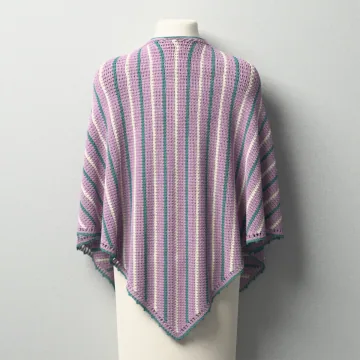
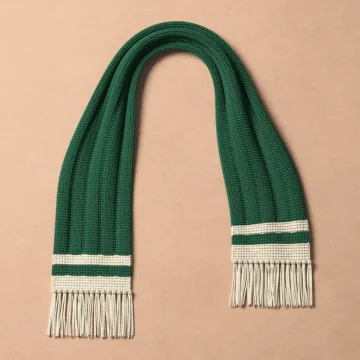
- shawls and wraps; scarves; summer tops; light blankets
- Multiple
- 4 plus 3, edges counted
- Loops at the end of every forward pass
- As many as chains: 15 for a chain of 15
- Hook
- A long Tunisian hook, or an ordinary one for a narrow piece, one or two sizes larger than the yarn usually takes
- Hole by yarn over and two together
- The row on this page, and yarn over lace, where every second stitch is a hole
- Hole by yarn over and a skipped bar
- Mesh: yarn over, skip one bar, simple stitch. The bar is left alone, and the count stays
- Hole in the return pass
- Three stitches are worked off together, through four loops, with a chain on each side. On the next row three loops are picked up again in that place, and one of them is a yarn over
- Hole by hook alone
- A plain stitch on a much larger hook is loose and open all over, with no set holes
- Curling
- Lace with many yarn overs curls little or not at all
- Chain for a scarf
- 31 chains, about 8 in (20 cm), or 39 chains, about 10 in (25 cm), at 4 stitches to 1 in (2.5 cm) before blocking
- Chain for a wrap
- 79 chains, about 20 in (50 cm), at the same gauge
Tips and variations
Tips
- Count the loops before every return pass. A yarn over that slipped off is easy to put back now and hard to find later.
- Put a marker between the repeats of the first lace row.
Variations
- Mesh. Yarn over and skip a bar all the way: a light net that lies flat.
- In knit stitch. The same holes with the hook put between the strands of each stitch. The plain parts look knitted.
- Wider lace. Work two or three more simple stitches between the holes: each one adds to the multiple. With 6 in place of 2 the multiple is 8 plus 3, and the second lace row starts its group with two simple stitches, the pair and the yarn over, so that its holes fall between.
Questions
- Can you make lace in Tunisian crochet?
- Yes. Yarn overs make the holes, and two bars taken together or a skipped bar keep the count.
- Is Irish lace a kind of Tunisian crochet?
- No. Irish crochet lace is made of motifs, in ordinary crochet stitches finished one at a time. Tunisian lace keeps a whole row of loops on the hook.
- Do I need a double-ended hook for lace?
- No. The lace here never turns and needs one hook with a stopper. A double-ended hook is for a fabric in two colors, with both faces worked.
- How do I make diagonal lace?
- Move the hole over by one stitch on every lace row. The slanting rows above do it with a plain row between.
- What yarn is right for it?
- A smooth, thin or medium yarn shows the holes. A fuzzy one fills them.