Easy white running stitch T. rex head hand embroidery pattern
Beginner · 1 color · 1 kind of stitch
Download free PDFPDF, US Letter · 20 KBFor your own stitching, gifts and handmade pieces you sell. Do not resell or share this PDF or copies of it. Selling, classes and kits: the rules
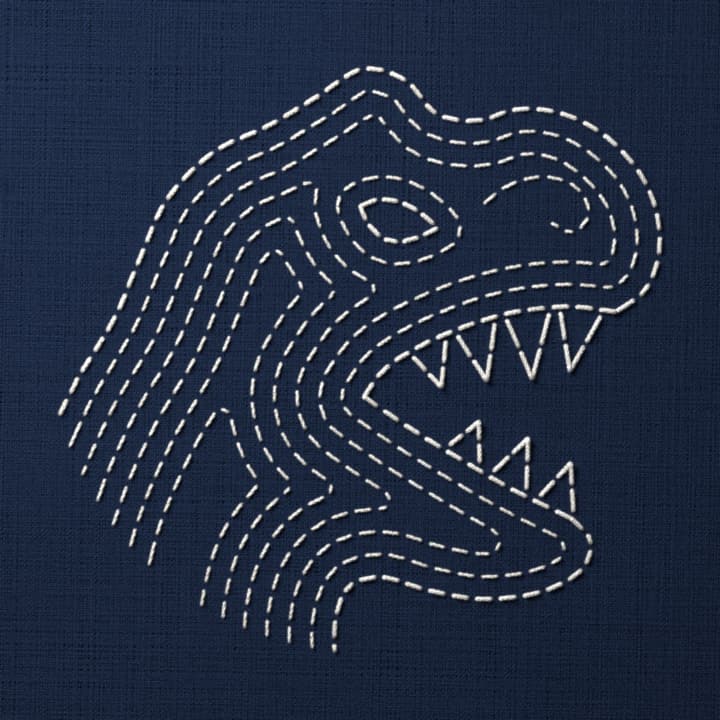
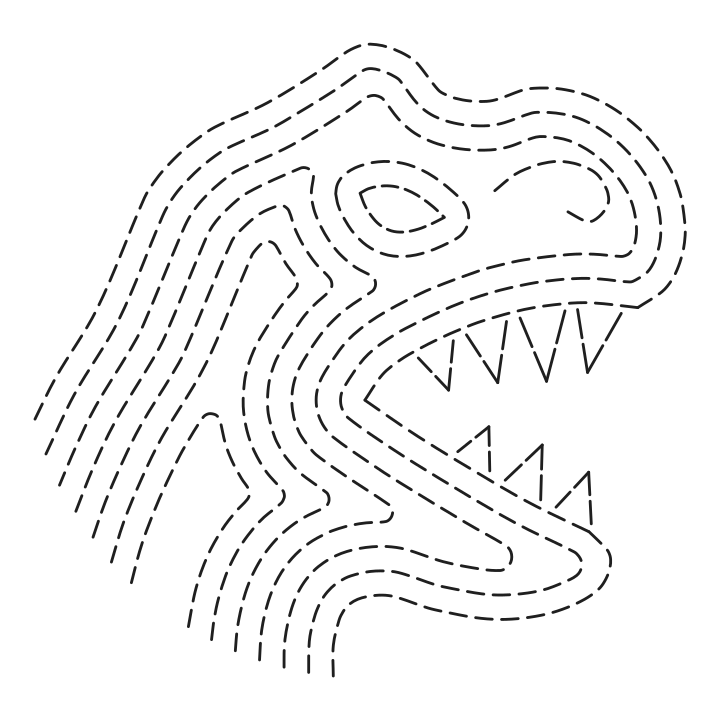
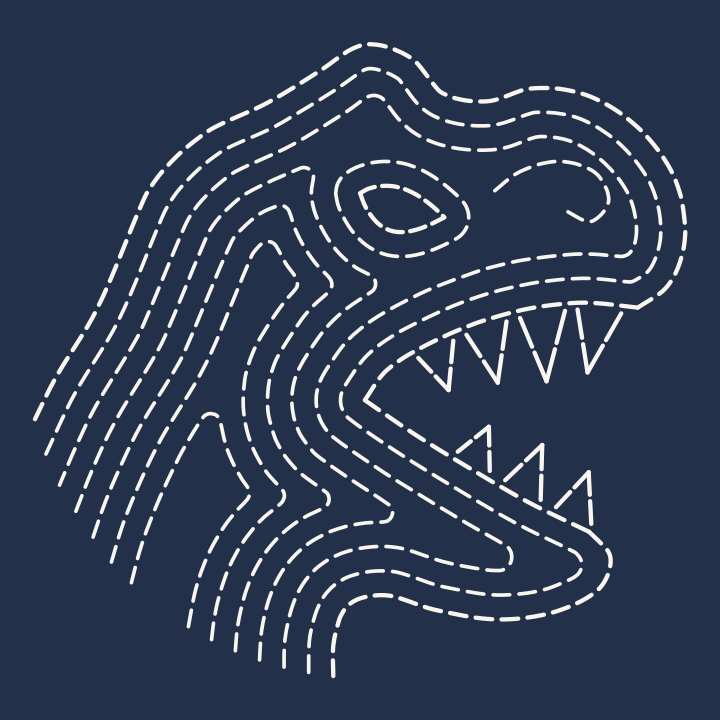
A T. rex head and neck face right with the jaws wide open. Everything is running stitch in one white thread: a heavy contour, then lighter lines inside it that keep an even distance and flow round the brow, eye, cheek and throat like hand quilting. Seven plain triangles are the teeth and one almond is the eye. The open mouth is left as bare cloth.
Size and details
Beginner. Running stitch only, fewer than 450 stitches in all.
1 color of floss and 1 kind of stitch:
| Hoop | Inches | Centimeters |
|---|---|---|
| 3 in (8 cm) | 1.8 × 1.7 in | 4.6 × 4.3 cm |
| 4 in (10 cm) | 2.7 × 2.6 in | 6.9 × 6.6 cm |
| 5 in (13 cm) | 3.6 × 3.5 in | 9.1 × 8.9 cm |
| 6 in (15 cm) | 4.5 × 4.4 in | 11.4 × 11.2 cm |
| 8 in (20 cm) | 6.3 × 6.1 in | 16 × 15.5 cm |
The pattern is drawn inside a circle about half an inch (1.3 cm) smaller all around than the hoop.
What you need
- DMC 3865 Winter WhiteEcho lines, contour, teeth and eye
Skeins: one is enough. An estimate for the largest size, the 8 inch hoop: the length of each line and the area of each filled shape, a fifth added for tails and ends, a tenth of every 8 m (8.7 yd) skein kept spare.
On children’s clothes. Wash and dry the garment first. A T-shirt or a sweatshirt needs a stabilizer that sticks or irons on. Keep to flat stitches: tall raised ones and long loose threads catch. How to embroider on clothes has every step, and How to embroider a shirt says where and with which stitches.
On a quilt. Wash and press the cloth first, and stitch the block before the blocks are joined: two strands of floss, three for a bold line. How to embroider quilts has every step.
In a hoop. The floss is six-strand cotton; the stitch guide says how many strands to use. You also need a hoop, an embroidery needle (a size 7 to 9 for two or three, 3 to 5 for four or more) and plain cotton or linen fabric. To frame the piece in its hoop, cut a square 3 inches (8 cm) wider than the hoop: a 9 inch (23 cm) square for a 6 inch hoop.
When it is stitched, how to finish a hoop shows how to back it for the wall.
Stitch guide
- Put the pattern on the fabric (how to transfer a pattern) and the fabric in the hoop.
- Stitch the long lines first, then the short ones.
Start each thread with a small knot on the back or one of the knotless starts, and end it by running the needle under the backs of a few stitches. (Starting and ending a thread shows how.) Use the strands this list gives, and begin as it says, also where a page about a stitch names another number or begins with a knot.
- Running stitch 3 to 5 strandsContour, echo lines, eye, teeth
Getting it onto your fabric
The PDF holds the pattern twice at actual size: once as drawn, and once mirrored for an iron-on transfer pen. Print it at 100% with scaling off and check the one-inch square (25.4 mm) with a ruler before you trace. How to transfer a pattern explains tracing, carbon paper, the sticky wash-away sheet for knits, denim and dark cloth, and the other ways. The files are under Downloads.
Downloads
- Download free PDF PDF, US Letter, 3 pages, for a 6 inch (15 cm) hoop
- Download free PDF, A4 PDF, A4, 3 pages, for a 6 inch (15 cm) hoop
More patterns like this
Advanced prints 3–14 in · 16 colors
Mama T. rex and baby
Easy 3–8 in hoop · 7 colors
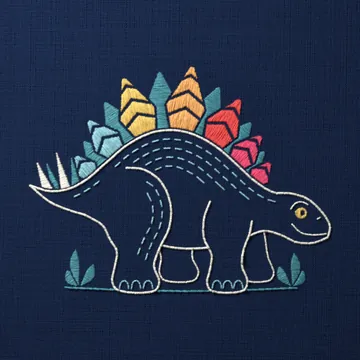
Easy stegosaurus with satin plates
Easy prints 3–14 in · 5 colors
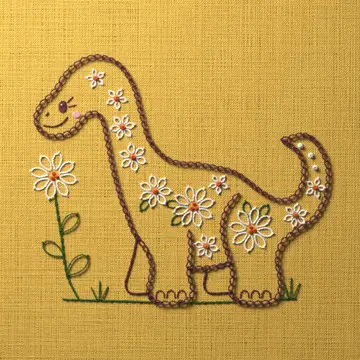
Easy long neck dinosaur with daisy spots
Easy prints 3–14 in · 7 colors
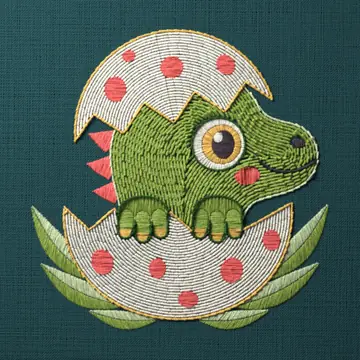
Easy dinosaur egg with a peeking eye
Easy prints 3–14 in · 6 colors
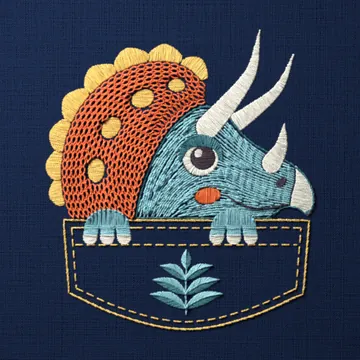
Easy triceratops pocket peeker
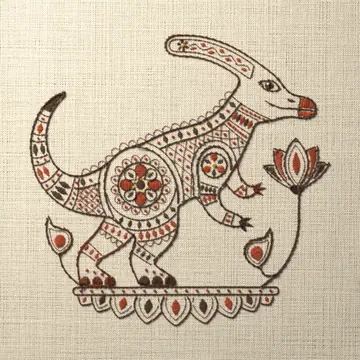
Intermediate prints 3–14 in · 5 colors
Parasaurolophus in mehndi style
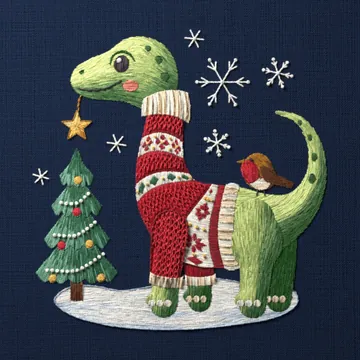
Advanced 3–8 in hoop · 23 colors
Christmas dinosaur in a knitted sweater
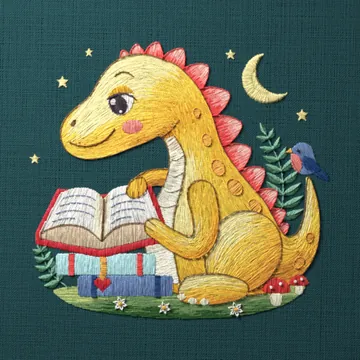
Advanced 3–8 in hoop · 22 colors
Yellow dinosaur reading a book
New to hand embroidery? Starting hand embroidery, step by step