Sashiko scales for a denim pocket hand embroidery pattern
Beginner · 3 colors · 1 kind of stitch
Download free PDFPDF, US Letter · 16 KBFor your own stitching, gifts and handmade pieces you sell. Do not resell or share this PDF or copies of it. Selling, classes and kits: the rules
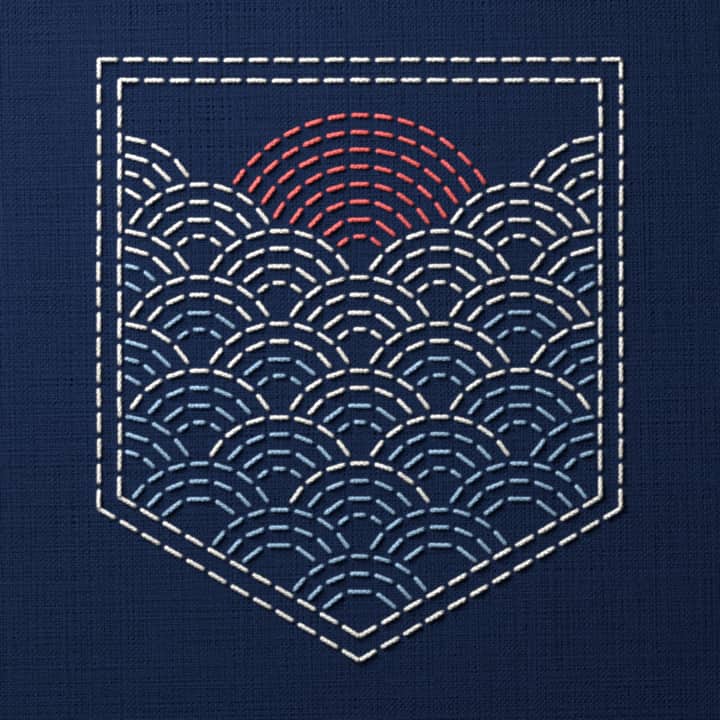
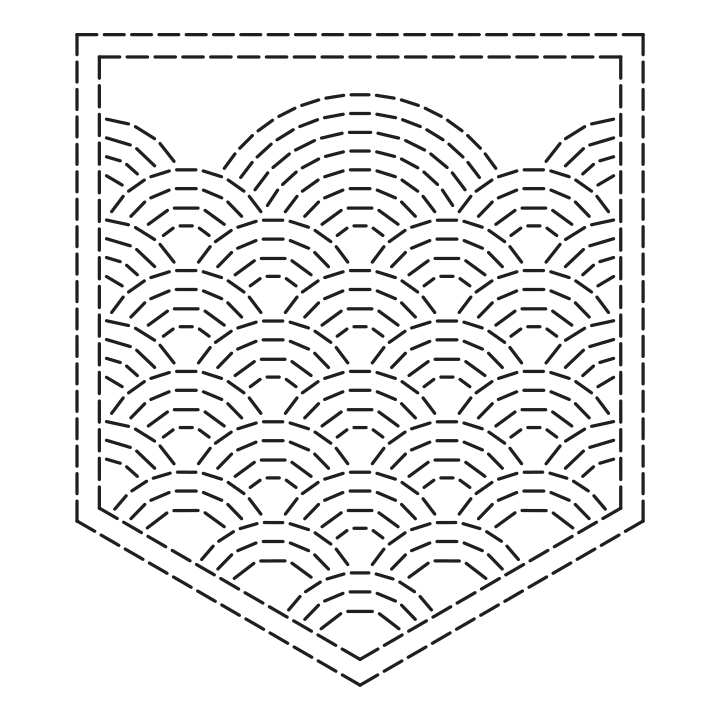
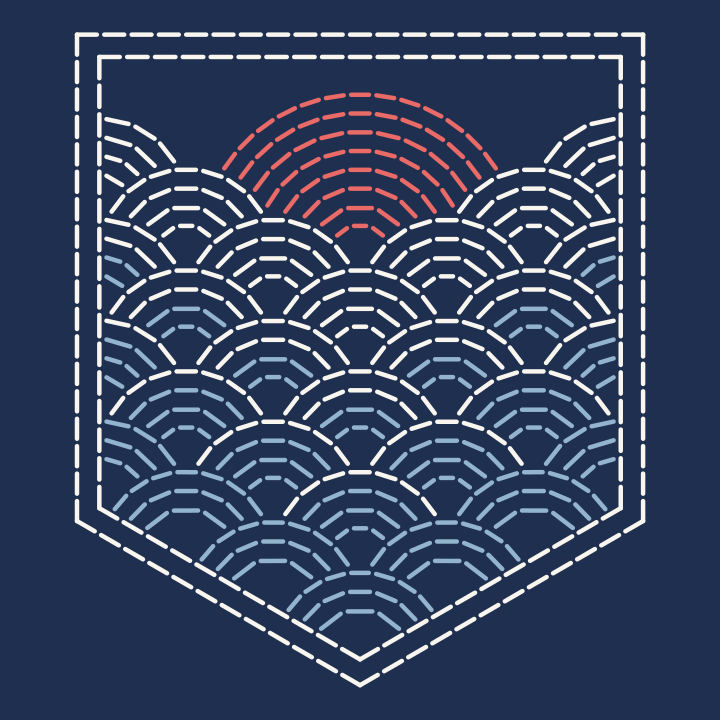
A jeans pocket, the same on both sides, is drawn by two closed rows of running stitch. Overlapping scales, in the manner of sashiko, stand on its pointed foot and rise in rows that repeat the slope of the point. The lowest scales are blue, the next rows carry white over blue, and the top row is white. In the valley at the top rises one large coral scale, like a sun. Everything is running stitch in four strands. It is drawn for indigo linen.
Size and details
Beginner. Running stitch only, fewer than 450 stitches in all.
3 colors of floss and 1 kind of stitch:
| Hoop | Inches | Centimeters |
|---|---|---|
| 3 in (8 cm) | 1.4 × 1.6 in | 3.6 × 4.1 cm |
| 4 in (10 cm) | 2 × 2.3 in | 5.1 × 5.8 cm |
| 5 in (13 cm) | 2.7 × 3.1 in | 6.9 × 7.9 cm |
| 6 in (15 cm) | 3.4 × 3.9 in | 8.6 × 9.9 cm |
| 8 in (20 cm) | 4.8 × 5.5 in | 12.2 × 14 cm |
The pattern is drawn inside a circle about half an inch (1.3 cm) smaller all around than the hoop.
What you need
- DMC 351 CoralGreat scale
- DMC 3755 Baby BlueScales (darker)
- DMC 3865 Winter WhiteScales (lighter), pocket seam
Skeins: one of each color is enough. An estimate for the 8 inch hoop, from the length of each line and the area of each filled shape, with a fifth added for tails.
On denim. Wash and dry it first. Plain denim is firm enough to need no backing: stick a printed wash-away sheet on it and stitch with a sharp needle. On jeans and jackets work the lines in three strands of floss or more with an embroidery needle 5 or 3, or a chenille 24 or 22; finely shaded parts keep the strands of the list. On a thin denim shirt take two or three strands and a needle 7 or 5. How to embroider jeans has every step and says where the hand reaches, and the placement chart says where a design goes.
In a hoop. The floss is six-strand cotton; the stitch guide says how many strands to use. You also need a hoop, an embroidery needle (a size 3 to 5 suits four or more strands) and plain cotton or linen fabric, in indigo, the color it is drawn for. A pencil line does not show on it: see how to transfer a pattern to dark fabric. To frame the piece in its hoop, cut a square 3 inches (8 cm) wider than the hoop: a 9 inch (23 cm) square for a 6 inch hoop.
When it is stitched, how to finish a hoop shows how to back it for the wall.
Stitch guide
- Put the pattern on the fabric (how to transfer a pattern) and the fabric in the hoop.
- Stitch the long lines first, then the short ones.
On denim start with a small firm knot inside, which the cloth hides. End each thread by running the needle under the backs of a few stitches. (Starting and ending a thread shows how.) Use the strands this list gives, and begin as it says, also where a page about a stitch names another number or begins with a knot.
- Running stitch 4 strandsGreat scale, scales, pocket seam
Getting it onto your fabric
The PDF holds the pattern twice at actual size: once as drawn, and once mirrored for an iron-on transfer pen. Print it at 100% with scaling off and check the one-inch square (25.4 mm) with a ruler before you trace. How to transfer a pattern explains tracing, carbon paper, the sticky wash-away sheet for knits, denim and dark cloth, and the other ways. The files are under Downloads.
Downloads
- Download free PDF PDF, US Letter, 3 pages, for a 6 inch (15 cm) hoop
- Download free PDF, A4 PDF, A4, 3 pages, for a 6 inch (15 cm) hoop
More patterns like this
Easy prints 3–14 in · 7 colors
Sashiko swirl sun over hills
Intermediate 3–8 in hoop · 7 colors
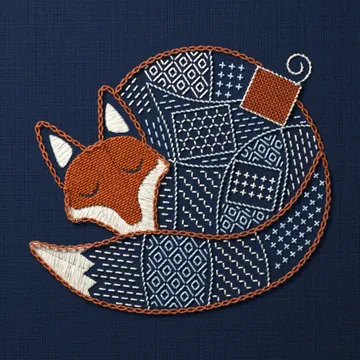
Sashiko fox with boro-style patches
Advanced 3–8 in hoop · 10 colors
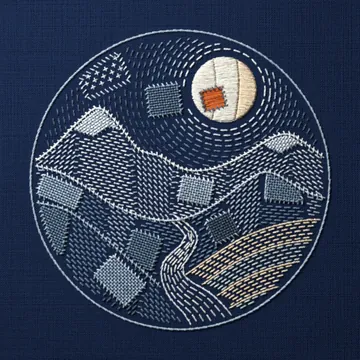
Boro patchwork mountains and moon
Advanced prints 3–14 in · 15 colors
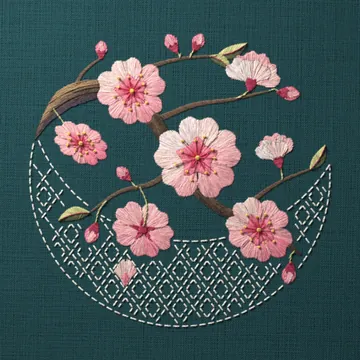
Cherry blossoms on a sashiko lattice
Beginner prints 3–14 in · 3 colors
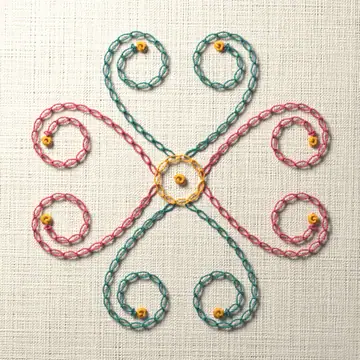
Chain stitch spiral rosette
Beginner prints 3–14 in · 2 colors
Small butterfly outline for a pocket
Easy prints 3–14 in · 3 colors
Simple lotus line for a pocket
Easy 3–8 in hoop · 3 colors
Easy neygi kasuti style bookmark
New to hand embroidery? Starting hand embroidery, step by step