Woven stitches · Easy
Woven wheel stitch
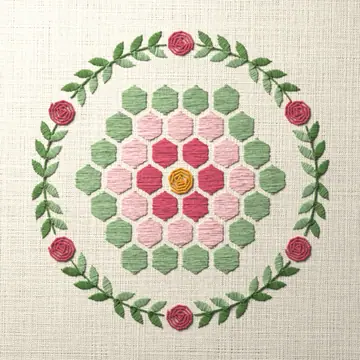
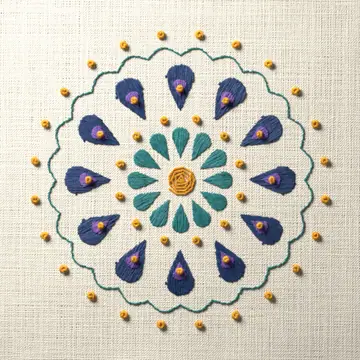
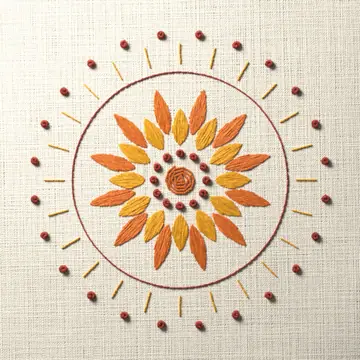
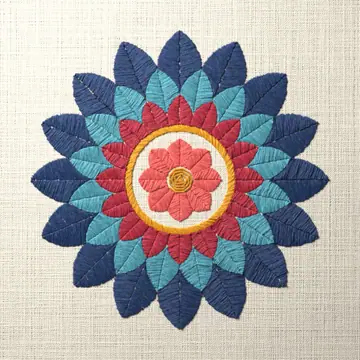
A woven wheel is a round, raised flower made by weaving the thread over and under five straight spokes until they are hidden. It looks like a small rose and is a simple way to stitch one.
How to work it
Stitch the first spoke

Draw a circle and mark five evenly spaced points on its edge, plus the center. Bring the needle up at A on the edge and take it down at B in the center.
Stitch all five spokes

Make a straight stitch from each of the other four marks to the center. You need an odd number of spokes. Five or seven are the usual choices.
Come up beside the center

Bring the needle up at C, as close to the center as you can, between two spokes. From here on, the needle does not go through the fabric until the wheel is full.
Weave over one spoke, under the next

Slide the needle over the first spoke and under the second, then pull the thread through. Either direction works. Just keep going the same way.
Keep weaving around the wheel

Carry on over and under, round and round. Because the number of spokes is odd, each round goes over the spokes the last round went under.
Fill the wheel and finish

Stop when the spokes are covered. Take the needle down through the fabric at the edge of the wheel and fasten off on the back.
At a glance
- Also called
- woven wheel, woven rose, woven spider web, woven spider wheel
- Used for
- roses and other round flowers; ribbon embroidery roses; raised circles and spots; embellishment in surface embroidery and crewelwork
- Thread
- Almost any thread works: stranded floss, pearl cotton, wool or silk. Three strands of floss is a good place to start. Narrow silk ribbon makes a rose with layered petals.
- Needle
- Use an embroidery (crewel) needle or a chenille needle for the spokes. For the weaving, a tapestry needle with a blunt tip is easiest.
Tips
- A small holding stitch over the center, made before you weave, keeps the spokes together.
- Weave with a blunt tapestry needle, or turn your needle around and lead with the eye, so that you do not snag the spokes or the fabric.
- Any odd number of spokes works. Five or seven are the usual choices.
- Another way to set up the spokes is to start with a fly stitch, which gives three spokes at once, and then add straight stitches for the rest.
- How many rounds you weave is up to you. Stopping early leaves the ends of the spokes showing.
When it goes wrong
- The thread goes over the same spokes on every round
- The wheel has an even number of spokes. Use five or seven, so the over and under pattern shifts by one on each round.
- The spokes still show
- Keep weaving until the thread reaches the ends of the spokes.
- The needle catches the fabric or splits a spoke
- Switch to a tapestry needle, or weave with the eye end first.
Left-handed
Weave in whichever direction feels natural. The direction does not change how the wheel looks.
Variations
- Ribbed spider web. The thread is wrapped back around each spoke instead of woven over and under. The spokes become raised ribs and the wheel looks like a web.
- Shaded rose. A variegated thread shades the rose as you weave, with no need to change threads. The spokes can also be a different thread from the weaving.
- Ribbon rose. The same weaving is done with silk ribbon. The ribbon folds back on itself and builds up layers like rose petals.
Patterns that use it
Questions
- How many spokes does a woven wheel need?
- An odd number. Five or seven are the usual choices. With an even number the weaving does not alternate from spoke to spoke, and the wheel does not come out the same.
- Is woven wheel stitch the same as spider web stitch?
- The names are often used for the same thing. Woven wheel, woven rose and woven spider web all mean weaving over and under the spokes. A ribbed spider web is different: the thread wraps around every spoke and leaves raised ridges.
- How do you finish a woven wheel?
- When the spokes are covered, take the needle through to the back at the edge of the wheel and fasten the thread there.