Straight stitches · Beginner
Straight stitch
A straight stitch is a single stitch: the needle comes up at one point and goes down at another, leaving one straight line of thread on the fabric. It can be any length and point in any direction, and many other embroidery stitches are built from it.
How to work it
Come up at one end of the mark

Each short line on the pattern is one stitch. Bring the needle up at A, at the outer end of the first line, and pull the thread through.
Go down at the other end

Push the needle down at B, at the other end of the line. Pull the thread through completely, so the stitch lies flat and straight on the fabric.
Come up at the next mark

Carry the thread across the back and bring the needle up at C, at the outer end of the next line.
Lay the next stitch

Go down at D to finish the second stitch. It does not have to match the first: straight stitches can each have their own length and angle.
Build the shape one stitch at a time

Carry on until every line is covered. Here five stitches of different lengths make a tuft of grass.
At a glance
- Also called
- single satin stitch, stroke stitch
- Used for
- grass and leaf veins; small petals and leaves; stars and snowflakes; insect legs and other fine details; texture
- Thread
- One strand of six-strand floss gives a very fine line for delicate detail. Two or three strands make a bolder stitch, and all six a chunky one. Straight stitch can be worked in any thread.
- Needle
- An embroidery (crewel) needle with a sharp point. A size 8 suits two strands and a size 9 or 10 suits one. Use a larger needle, which has a lower number, for all six strands.
Tips
- Vary the length of the stitches for a natural look, as in grass or petals.
- Pull the thread through completely at the start and end of each stitch.
- Do not carry the thread a long way across the back between stitches. A thread carried across an empty space can show from the front.
- Keeping the fabric taut in a hoop helps the stitches lie flat.
When it goes wrong
- The stitches look loose or loopy
- Pull the thread through completely at the end of each stitch, and keep the fabric taut in a hoop.
- The fabric puckers under the stitch
- Ease off on the pull. Stop as soon as the thread lies flat.
- Thread on the back shows through the fabric
- Fasten off and start again when the next stitch is far away, or run the thread under the backs of nearby stitches.
Left-handed
Nothing changes. A straight stitch can be worked in any direction, so place each one in whatever order feels comfortable.
Variations
- Seed stitch. Tiny straight stitches scattered in every direction to fill a shape with light texture.
- Satin stitch. Straight stitches worked side by side, parallel to one another, to make a smooth, solid filling.
- Running stitch. Straight stitches repeated along a line with even gaps between them.
- Star stitch. Straight stitches worked in a set order to make a small star or snowflake.
Patterns that use it
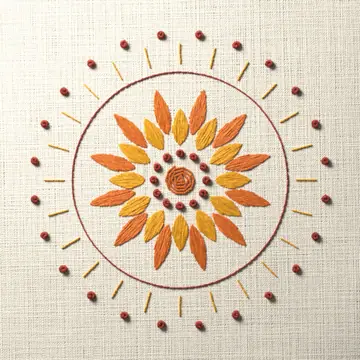
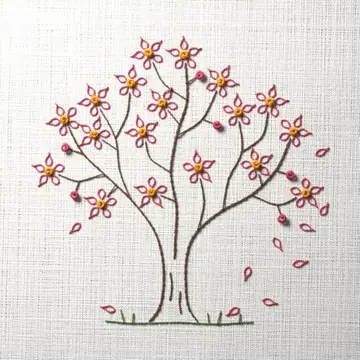
Questions
- How do you do a straight stitch in embroidery?
- Bring the needle up at one end of the line and take it down at the other end. That single line of thread is the whole stitch.
- What is the difference between straight stitch and satin stitch?
- A straight stitch stands on its own. Satin stitch is many straight stitches laid side by side so close that they fill a shape.
- How long can a straight stitch be?
- There is no fixed length. A straight stitch can be small and delicate or larger and heavier, and one group can mix stitches of different lengths.
- What is straight stitch used for?
- It is used for anything made of short lines: grass, leaf veins, small petals, insect legs, stars and simple texture.