Needlepoint guide
Can you use acrylic or knitting yarn for needlepoint?
Yes. Any yarn that slips through the holes and hides the canvas can be used, acrylic included. It is the usual yarn on plastic canvas. On woven canvas, wool is the better choice, because acrylic stretches as you pull and is hard to block square.
On this page 12 parts
Start here
Match the yarn to the canvas before anything else. Canvas is sold by its mesh, the number of holes in one inch (2.5 cm); plastic canvas calls the same number its count. The number on the yarn's label, from 0 to 7, is its thickness. Find it in the table below, then do the cover trial that follows. If the trial looks right and the yarn still looks like yarn at the end of the length, go ahead.
- Plastic canvas or big mesh, 7 holes to the inch or coarser: acrylic is a good choice and the common one.
- 10 mesh canvas: a light (DK) yarn or a fine wool can work well.
- 12 to 18 mesh canvas: ordinary knitting yarn is too thick. Use sock or lace weight, or a thread made for canvas.
- A chair seat, a belt, a rug for a busy floor: use wool made for canvas at any mesh.
What is different about it
Many threads sold for needlepoint are knitting yarns put up in short lengths, so there is no wall between the two. What differs is what a yarn was spun to do.
- Stretch. Knitting yarn is made to give. Pulled through canvas it lengthens, thins and then draws back, which pulls the holes together. Stitch with a lighter hand than you would with tapestry wool.
- Wear in the needle. Canvas is stiff, and every pass rubs. Soft, loosely twisted yarn goes fuzzy or thins before the length is used up.
- Pilling. Soft yarns, and acrylics most of all, form small balls of fluff where they are rubbed.
- Blocking. Wool, damp, can be pulled to shape and will dry there. Acrylic does not take a shape from water. If the canvas leans, an acrylic piece is hard to straighten.
- Saving. A large ball is a bargain on a large piece. For a few square inches of one color, a short skein of canvas thread costs less.
The sensible uses are big mesh, plastic canvas, a first trial of the craft, a child's piece, and special effects: a beard, fur, wild hair, a wool sweater on a figure.
Which yarn fits which mesh
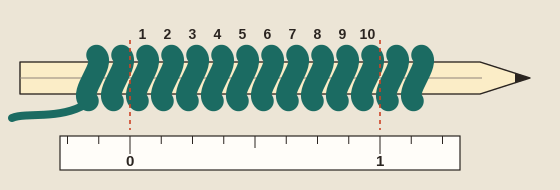
Yarn is compared by wraps: how many turns lie side by side in one inch (2.5 cm). A starting rule can be worked out from the usual pairings, worsted on 7 mesh, sport and light yarns on 10 and a fine two-ply on 18: multiply the mesh by one and a half, and look for a yarn with about that many wraps to the inch. On 10 mesh that is 15 wraps. On 13 mesh it is about 20.
| Number and kind on the label | Wraps in 1 in (2.5 cm) | Mesh for one strand | Other ways |
|---|---|---|---|
| 0, lace | 30 or more | 20 and finer | Two strands together on 13 or 14, one or two on 18 |
| 1, sock, fingering, baby | 14 to 30 | 12, 13 or 14; the finest on 18 | Two strands together on 10 |
| 2, sport | 12 to 18 | 10 | plastic canvas with 10 holes to the inch |
| 3, light, DK | 11 to 15 | 10 | Two strands on 7 |
| 4, medium, worsted | 9 to 12 | 7 | Two strands on 5; on 10, a four-ply yarn split into two thinner ones |
| 5, bulky, chunky, rug | 6 to 9 | 5 | Rug canvas |
| 6, super bulky | 5 to 6 | 3 to 4 | Couched: laid on the surface and fastened with small stitches |
| 7, jumbo, most T-shirt yarn | 4 or fewer | None | Couched on the surface |
A ply is one of the thin yarns that are twisted together to make the whole: untwist a cut end and count them. A four-ply yarn has four, and can be parted into two yarns of two plies each.
Two yarns with the same number are not always the same thickness, and the wraps overlap, so the table is where to begin and not a promise. The thread and needle chart has the threads made for canvas, strand by strand.
The cover trial
- Choose a spot. Use the bare margin or a scrap of the same canvas, held taut.
- Cut a length. About 18 inches (45 cm), shorter if the yarn is fuzzy. If the table gives two strands, cut two.
- Find the grain. Stroke the strand under your chin one way, then the other. Thread it so that it goes through the canvas in the smoother direction.
- Choose the needle. Take the size for your mesh from the table in the next section. The yarn should slide in the eye with no force and without rattling about.
- Try the needle without yarn. Push it through a hole. It should pass with a gentle pull. If it has to be tugged even when it is empty, take a thinner needle, with a larger number.
- Start the thread. Knot its end. Take the needle down from the front 1 inch (2.5 cm) outside the square, leave the knot on top, and come up where the first stitch begins. Cut the knot off at the end. How to start and end a thread has the rest.
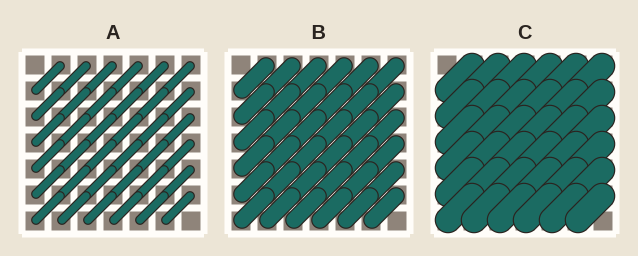
- Stitch a square. Work ten stitches by ten in the stitch you plan to use. Tent stitch, the small slanted one, covers better than upright stitches such as bargello.
- Look from arm's length. Canvas showing between the stitches means the yarn is too thin. Stitches pushing one another up mean it is too thick, and so does a tug on the yarn when the empty needle went through easily.
- Look at the tail. If the last of the length is thin and hairy, cut shorter lengths or choose a smoother yarn.
- Rub it. Rub a fingertip over the square twenty times. If it pills now, keep it off anything that will be leaned on.
The needle
| Canvas | Tapestry needle |
|---|---|
| 4 and 5 mesh | 13 |
| 7 mesh | 16 |
| 10 mesh | 18 |
| 12 mesh | 18 |
| 13 and 14 mesh | 20 |
| 18 mesh | 22 |
| 24 mesh | 24 or 26 |
A smaller number is a bigger needle. Between two rows, try the bigger needle first, and the finer one if the bigger has to be tugged. Needle sizes has the rest.
Plastic canvas and rug canvas
This is where knitting yarn belongs. Medium weight acrylic on plastic canvas with 7 holes to the inch is the standard pairing, and the sheet keeps its shape, so nothing has to be blocked. Keep the yarn just snug: a hard pull curls the sheet. Use two strands of medium yarn on 5 holes to the inch, sport weight or a split four-ply yarn on 10, and floss or size 5 pearl cotton on 14. Plastic canvas covers cutting and joining.
On woven canvas of 5 mesh and coarser, use rug yarn or another bulky yarn, wool if the piece will be walked on: see quickpoint and how to make a rug.
T-shirt yarn and fabric strips are too thick for nearly every canvas. A narrow strip can be stitched on plastic canvas with 5 holes to the inch. Otherwise lay it on the surface and fasten it down with small stitches: see couching.
Merino and sock yarn
A smooth, well twisted merino or sock yarn is the knitting yarn most like a needlepoint thread. Choose plied yarn that looks round and firm. Single-ply, felted or brushed yarns soon wear thin in the eye of the needle. For a bigger mesh put two strands in the needle side by side. Do not fold one strand double, because half of it would then run against its grain, and the folded end is hard to undo.
Opening a skein or a hank
- A pull skein of floss. Hold it by its bands and draw the loose end out of the end with the wider band. If it catches, stop and try the other end.
- A twisted hank. Untwist it and it opens into one large loop tied in a place or two. Do not pull an end. Either hang the loop over a chair back and wind it into a ball, or, for canvas work, cut straight through the loop. Cut once for lengths as long as the loop is round, or at both ends for lengths half as long.
- A ball. Find the end from the middle if you can, so that the ball does not roll.
Persian wool in hanks cut at both ends gives lengths of about 33 inches (84 cm). Cut them once more for stitching.
Separating strands
Separate the strands of any thread that is made to divide: embroidery floss, Persian wool, stranded silk and many four-ply yarns. Do it even when you will use every strand, since strands that lie side by side spread out and cover, and strands still twisted together make a thin rope.
- Cut the length first. About 18 inches (45 cm). Long strands tangle.
- Open the end. Hold the length near one end and tap the cut end with a finger until the strands spread.
- Take one strand. Pinch a single strand and hold the rest loosely just below.
- Draw it straight up. Pull it out of the bunch in one steady movement. The rest gathers up under your fingers.
- Smooth the bunch. Let it drop, and stroke it straight before the next strand.
- Lay them side by side. Keep every strand pointing the same way.
- Thread as many as you need. Put the ends together, thread them, and let the needle hang now and then so that they untwist.
Tapestry wool and pearl cotton are not made to be divided. Neither is a knitting yarn whose plies come apart only with a struggle.
Washing and blocking
Keep to what the label says about heat and water, and to what the canvas will stand. Canvas holds a stiffener that water softens, so needlepoint is not put in a washing machine even when the yarn could be: see how to clean needlepoint.
For an acrylic piece that leans, heat does what water does not. Draw a rectangle of the size the piece should be on paper, lay it on a padded board, and pin the piece over it face down, through the bare margin, until its edges lie on the lines: how to block shows the order of the pins. Hold a steam iron above it, never touching, and let the steam pass over. Leave it pinned until it is cold and dry. It is better not to need this: use a frame, and work basketweave in the large areas.
What goes wrong
| What you see | Why | What to do |
|---|---|---|
| Canvas shows through | Yarn too thin or pulled too tight | Add a strand, or pull less |
| Stitches bulge, canvas ripples | Yarn too thick | Part it into fewer plies, use a finer yarn or a coarser canvas |
| Rows draw in | Stretchy yarn pulled tight | Lighter pull, a frame, shorter lengths |
| Fuzz on the surface | Wrong direction, or worn in the needle | Check the grain, cut shorter, take a thicker needle (a smaller number) |
| Yarn splits under the needle | Loose plies | Stab straight up and down with a blunt needle |
| Colors change mid-piece | Two dye lots | Buy enough of one lot at the start |
Questions people ask
Is yarn for needlepoint different from knitting yarn? Tapestry and Persian wools are spun firm and with little stretch, to stand up to canvas. Knitting yarn is spun soft and elastic. Both are yarn, and the soft kind can be used where wear does not matter.
Can I mix acrylic and wool in one piece? Better not in a piece that will be blocked or used hard, because they stretch, wear and shine differently. For a small accent it does no harm.
Can I use crochet cotton? Yes. It is a firm twisted cotton, like pearl cotton. Choose it by the same trial.
How much yarn do I need? Work one square inch (6.5 square cm), measure the yarn it used, and multiply by the number of square inches in the design. The answer is an estimate: add about 30 percent for ends and the tail left in the needle. The thread calculator does the sum for threads made for canvas, and the thread guide tells you what those are.