Needlepoint guide
Needlepoint canvas and mesh sizes
Mesh is the number of holes in an inch of canvas. It decides how big your design comes out, how much detail it can hold and which thread fits.
What mesh means
A 13 mesh canvas has 13 holes, and so 13 stitches, in every inch. An 18 mesh canvas has 18. The higher the number, the smaller the stitches. The same chart stitched on a higher mesh comes out smaller and finer. You will also see mesh called count or gauge.
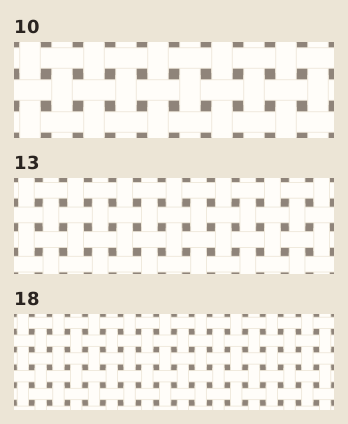
To find a finished size, divide the stitch count by the mesh. A design 72 stitches wide is 4 inches (10 cm) on 18 mesh and about 5 1/2 inches (14 cm) on 13 mesh. The canvas size calculator does this for any size.
The common sizes
| Mesh | Stitches per square inch | Good to know |
|---|---|---|
| 10 | 100 | Big stitches; takes tapestry wool, or all three strands of Persian wool |
| 12 | 144 | Takes tapestry wool, or two strands of Persian wool |
| 13 | 169 | One of the two usual sizes for hand-painted canvases; takes tapestry wool, or two strands of Persian wool |
| 14 | 196 | Takes tapestry wool, or two strands of Persian wool |
| 18 | 324 | The other usual size for hand-painted canvases, and the finer of the two; takes one strand of Persian wool |
| 22 and up | 484 or more | Very fine work, used for petit point; definitions differ on where petit point begins: see Needlepoint vs embroidery |
Mono canvas is most often sold in 10, 12, 13, 14 and 18 mesh, and most hand-painted canvases are 13 or 18. Thirteen has bigger holes and fewer stitches to make. Eighteen fits nearly twice as many stitches into the same space, so it holds more detail and takes more stitches to fill. For the thread each mesh takes, see the thread guide.
Types of canvas
- Mono canvas is a plain weave of single threads. It has a little give, which suits things like pillows that will be sat on, and a frame keeps it stable while you stitch. Painted canvases are almost always mono.
- Interlock canvas has a pair of fine threads twisted around each crossing thread, which locks every intersection in place. It is stable and can be trimmed close without unraveling, so it is common in printed kits and useful for odd shapes. It is lighter in weight than mono canvas.
- Penelope canvas has pairs of threads. You can stitch over each pair for large stitches or split the pairs for small ones in the same piece, so its size is given as two numbers, such as 10/20. It is hard-wearing, and it suits tramé and half cross stitch.
- Plastic canvas is a sheet of plastic with square holes, sold in 5, 7, 10 and 14 mesh. It suits three-dimensional pieces.
Interlock is most often sold in white, and Penelope is often brown. Mono canvas comes in white and in a range of colors.
How much canvas to cut
Add at least two inches (5 cm) to every side of the design; two to three inches (5 to 8 cm) is common. Each pattern page and chart PDF gives a size of canvas to cut for what is charted, which allows two inches (5 cm) a side, the least to leave. A belt is the exception: its chart is a length of belt, so its pages say instead to cut the canvas for the whole length you will stitch, with two inches (5 cm) more at each end and along each side. A 4 inch (10 cm) ornament wants a piece 8 to 10 inches (20 to 25 cm) square. The margin is where the canvas is tacked to stretcher bars and pinned out for blocking, and it is needed again for finishing. Bind the cut edges with masking tape so they do not fray or catch your thread.
Which mesh to choose
- More detail in less space: 18 mesh.
- Bigger holes and fewer stitches, for a first project: 13 mesh.
- Big stitches in thick wool: 10 or 12 mesh.
Pattern pages show the stitched size and the canvas to cut at 10, 12, 13, 14 and 18 mesh, for what is charted; a belt's page sizes only the length of belt in its chart.