Needlepoint vs embroidery
Embroidery is the family name. Needlepoint is one member of it, the one worked on canvas. To choose one to try, take needlepoint on a printed canvas if you have never held a needle. The terms people mix up are sorted out first, and the choice comes after them.
On this page
Embroidery
Embroidery is the art of decorating fabric with a needle and thread. Its techniques fall roughly into two kinds:
- Free-style embroidery, such as crewel work, is not tied to the weave of the cloth.
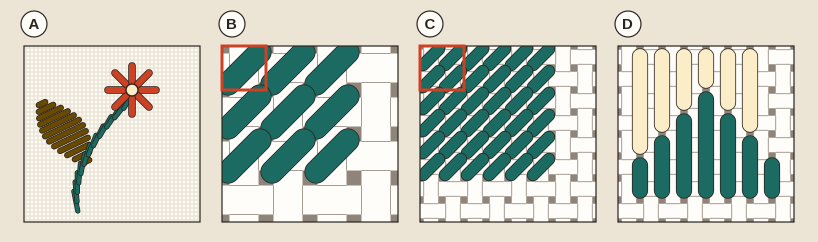
- Counted work follows the grid of the ground, so every stitch has an exact place. Cross stitch and needlepoint both belong here.
Needlepoint
Needlepoint is embroidery on canvas, and it was called canvas work until the early nineteenth century. The stitches are counted and worked over the threads of a stiff, open-weave canvas, and most designs cover it completely. Worked in wool, the result is a very durable fabric. The basic stitch is tent stitch, but there are more than 150 canvas stitches; the stitch library here shows many of them step by step.
Related terms
| Term | What it means |
|---|---|
| Petit point | Fine tent stitch. Definitions differ on where it begins. One encyclopedia definition is needlepoint on canvas with 16 to 20 or more holes to the inch, and one teacher's is 16 and finer; by those, everyday 18 mesh is petit point. One shop's canvas guide keeps the name for 22 mesh and finer, which is how the mesh guide uses it. On double-thread (Penelope) canvas it means tent stitches worked over single threads. |
| Gros point | Larger tent stitch: by the encyclopedia's definition, canvas of about 7 to 16 holes to the inch. On double-thread canvas it means stitches worked over each pair of threads, so one gros point stitch covers the area of four petit point stitches. |
| Bargello | Needlepoint in upright stitches arranged in zigzag or wave patterns, in graded or contrasting colors. See what is bargello. |
| Tapestry | Strictly, a textile woven on a loom, with the design built up in the weaving. The word is also routinely used for needlepoint, and needlepoint wool is sold as tapestry wool. |
| Crewel | Free-style embroidery in two-ply worsted wool, a smooth wool of two strands twisted together, on linen or cotton cloth, plain or twilled (woven with a fine slanting rib). It is named for the yarn, not for any stitch. |
| Cross stitch | Crossed stitches counted on canvas or on evenly woven fabric. See needlepoint vs cross stitch. |
Crafts like needlepoint sets ten crafts beside needlepoint, latch hook, punch needle and rug hooking among them.
How to tell what you are looking at
- Stiff mesh ground, completely covered in small slanted stitches: needlepoint.
- Evenly woven fabric or canvas with X-shaped stitches set on its grid: cross stitch.
- Wool stitches running freely across linen or cotton cloth: crewel.
- The design is part of the weave itself and the cloth is reversible: woven tapestry.
Which is easier, needlepoint or embroidery?
Needlepoint on a printed or painted canvas is the easier start. There is one stitch to learn, the holes set the length and slant of it, and the design is already there. In hand embroidery on plain cloth you put the design on the cloth first, and you choose the place, length and direction of each stitch by eye. Embroidery on cloth with the design printed on it comes close: the lines are there to follow, and two or three stitches are enough.
| You | Easier for you | A first piece |
|---|---|---|
| have never held a needle | Needlepoint | An ornament or coaster on a printed canvas, 13 mesh, in tent stitch |
| cannot make stitches even | Needlepoint | The same. The canvas spaces them |
| do not like to count | Needlepoint on printed canvas, or embroidery on printed cloth | Not a chart |
| like to draw | Embroidery | A leaf or your own line drawing in backstitch or stem stitch |
| want to decorate a shirt, towel or napkin | Embroidery | A small flower. Canvas would have to be sewn on as a patch |
| find small work hard to see | Needlepoint | 10 mesh canvas and wool: see easier to see and hold |
| are choosing for a child | Needlepoint | Plastic canvas with 7 holes to the inch: see needlepoint for kids |
| want few stitches | Embroidery | An outline on cloth. Needlepoint fills the background too: 4 inches (10 cm) square on 13 mesh is 52 by 52, or 2,704 stitches |
Each has its own hard part, and it comes at a different time.
| Needlepoint | Hand embroidery on cloth | |
|---|---|---|
| Before the first stitch | Little, if the design is on the canvas. Cover the cut edges with tape | Putting the design on the cloth, which is what beginners ask about most |
| While you stitch | Filling a plain background. Canvas that pulls out of square | Even stitches, smooth curves, cloth that puckers unless it is held taut |
| When you go wrong | Pull it out: the hole is still there | Pull it out. A needle mark or a drawn line may show |
| At the end | Blocking, which is damping it and pinning it square to dry, if it leans. Then finishing, which is sewing | Often only pressing. What you embroidered may be a finished thing already |
Try one line of each
A small scrap settles it better than advice. In needlepoint, on 10 mesh canvas with tape over its edges, a blunt size 18 tapestry needle and one strand of tapestry wool:
- Come up. Bring the needle up in a hole well in from the right edge. Hold 1 inch (2.5 cm) of the tail behind, along the row to the left, so that the next stitches catch it.
- Cross one intersection. Go down in the next hole up and to the right.
- Move over. Come up in the hole just to the left of where the last stitch began, and go down again in the next hole up and to the right.
- Make ten, working to the left. Every stitch keeps the same slant. Ten stitches take 1 inch (2.5 cm).
In embroidery, on plain cotton cloth in an embroidery hoop, with a sharp embroidery needle and two or three strands of floss with a knot in the end:
- Draw a line. Tape the cloth over a drawing on a sunny window and trace a curve in one unbroken stroke. Then put the cloth in the hoop.
- Make a stitch. Come up on the line one stitch length, about 1/8 inch (3 mm), from its right end, and go down at that end.
- Step ahead. Come up on the line again, one stitch length to the left of where the stitch came up.
- Go back. Go down where the last stitch came up, so that the two meet. That is backstitch. Make ten, all of a length.
If the ten slants looked good at once and you liked the rhythm, take up needlepoint: how to needlepoint. If you liked choosing where the line goes, take up embroidery.
Crewel, gros point, long stitch: which side of the line?
Ask two things. What is it stitched on? Canvas makes it needlepoint. Who decides where the stitches go? If the holes decide, it is counted work; if a drawn line does, it is free embroidery. All needlepoint is embroidery, so "is it embroidery?" is yes for every row but the lace.
| Name | Stitched on | What places the stitch | Is it needlepoint? |
|---|---|---|---|
| Crewel | Firm, close cloth | A drawn line | No. It is free embroidery in wool |
| Crewel stitches on canvas, or crewel point | Canvas | The drawn shape, fitted to the holes | Yes |
| Gros point | Canvas | Each crossing of threads | Yes, with large stitches |
| Petit point | Fine canvas or silk gauze | Each crossing of threads | Yes, with tiny stitches |
| Long stitch | Canvas | The edge of each shape | Yes |
| Bargello | Canvas | A count of threads | Yes |
| Satin stitch, stem stitch, French knots | Cloth or canvas | A line on cloth, the holes on canvas | On canvas, yes |
| Cross stitch | Countable cloth or canvas | The holes | On canvas, it is one of the needlepoint stitches |
| Tent stitch on linen | Even linen cloth | A count of threads | Counted thread work, with a needlepoint stitch |
| Gros point lace | Nothing: it is made of thread | The lacemaker's pattern | No. It is a raised needle lace of Venice |
Gros point and regular needlepoint. They are the same stitch, so the comparison is one of size. Gros point is tent stitch on about 8 to 15 mesh. The everyday sizes of painted canvas are 13 and 18 mesh, so "regular needlepoint" on 13 is gros point, and on 18 it is on the petit point side.
| Gros point, 10 mesh | Regular, 13 mesh | Regular, 18 mesh | |
|---|---|---|---|
| Stitches in a square inch (6.5 square cm) | 100 | 169 | 324 |
| Width of one stitch | 1/10 inch (2.5 mm) | 1/13 inch (2 mm) | 1/18 inch (1.4 mm) |
| Best for | Rugs, seats, pillows | Pillows, stockings, a first piece | Ornaments, belts, faces, lettering |
Gros point hides less: curves step more, and small letters need more room. It fills a seat or a rug with far fewer stitches. Petit point and gros point has both on one canvas.
Is long stitch needlepoint considered embroidery? Yes, and it is needlepoint as well, because it is worked on canvas through its holes. It differs from tent stitch in one thing: each stitch runs straight from one edge of a shape to the other. A long stitch kit is a canvas of large holes with the design printed on it, thick yarn, and a diagram of which stitches go up and which go across. Some are made for children. The same stitch on cloth is called satin stitch and belongs to free embroidery. Long stitch shows the steps.
Crewel stitches on canvas. Any embroidery stitch can be worked on canvas, and those of crewel look well over finished tent stitch or on bare canvas that will be filled around. Use two strands of crewel wool on 18 mesh, and let each end of a stitch fall in a hole.
| In crewel it makes | On canvas, work |
|---|---|
| A stem, a vine | Stem stitch or chain stitch |
| A leaf | Fly stitch, set close, or satin stitch |
| A petal | Lazy daisy, a single loop of chain stitch, or buttonhole stitch for a round one |
| A flower center, berries | French knots |
| A fern, a garland | Feather stitch |
For a design to work them on, take a chart of flowers or birds, stitch the ground in tent stitch, and lay the stems and centers on top. Needlepoint and crewel has the wool, and how to tell which one an old piece is.
What are tiny needlepoint stitches called?
Petit point, which is French for small stitch. It is the plain tent stitch of needlepoint, over one crossing of threads, on fine canvas or silk gauze. It has been used for small areas of detail, such as a face or a flower in a larger piece, and for whole pieces as small as a brooch.
| Holes to the inch | One stitch is about | Stitches in a square inch (6.5 square cm) | Called |
|---|---|---|---|
| 10 | 2.5 mm wide | 100 | Gros point |
| 13 | 2 mm | 169 | Gros point |
| 18 | 1.4 mm | 324 | Petit point by most counts; everyday 18 mesh |
| 22 | 1.2 mm | 484 | Petit point |
| 24 | 1.1 mm | 576 | Petit point |
| 40, silk gauze | 0.6 mm | 1,600 | Petit point |
Each width is 25.4 mm, which is 1 inch, divided by the number of holes. The thread drops with the size too: one or two fine strands in place of wool. The largest stitches of all, on 3 to 7 mesh, are called quickpoint. For needles, gauze and thread at each count, see petit point and gros point; for things to make at that scale, see how to make a miniature.