Needlepoint guide
Diamonds in needlepoint
A diamond is counted from its middle. In tent stitch, work one row of an odd number, then rows two stitches shorter above and below until one stitch is left. In straight stitch, work one tall stitch, then shorter ones on each side of it, each two threads shorter than the last.
On this page 12 parts
Start here
| You want | Go to |
|---|---|
| One solid diamond | In tent stitch or in straight stitch, just below |
| Only the line around it | Outlining a diamond |
| A whole area of small diamonds | Stitches that make diamonds |
| A trellis, with something in each space | A lattice of diamonds |
| A net of small diamonds over a whole ground | Diaper patterns |
| Argyle, or four triangles | The last two patterns on the page |
Tent stitch is the small slanted stitch over one intersection, the place where two canvas threads cross. Come up at its lower left hole and go down at its upper right one, so that it leans up to the right. Mesh is the number of canvas threads in an inch (2.5 cm).
| Mesh | Needle (tapestry, blunt) | Floss: tent, then straight | Persian wool: tent, then straight |
|---|---|---|---|
| 10 | 16 or 18 | 8 to 10, then 9 to 11 | 3, then 4 |
| 13 | 20 | 7 or 8, then 8 or 9 | 2, then 3 |
| 14 | 20 | 6 or 7, then 7 or 8 | 2, then 3 |
| 18 | 22 | 4 to 6, then 5 to 7 | 1, then 2 |
The figures are strands, the thin parts that floss or Persian wool comes apart into. Begin with the lower one. For an outline take one or two strands of floss. Starting and ending a thread shows the knot to begin with.
A diamond in tent stitch

- Mark the center. Make one tent stitch over the middle intersection of the space. How to find it is at the foot of the page. An even space has no middle intersection: take any of the four around its middle hole.
- Work the middle row. Count three intersections to the right of the center and begin there. Stitch to the left, pass the center stitch, and end three to its left: 3 and 1 and 3 make a row of 7.
- Go up. Each row above is one stitch shorter at each end, so it begins straight above the second stitch of the row below: 5, 3, 1 (A).
- Go down in the same way from the middle row: 5, 3, 1 (B).
- Check. The top and the bottom stitch are straight above and below the center.
The slope is yours to choose. One over one, as here, gives a square corner at each point. Two over one takes two stitches away at each end of every row, and gives a wide diamond (C). One over two keeps two rows at each width above and below the middle row, and gives a tall one (D).
| Middle row | Rows | Stitches in all | Across on 13 mesh | Across on 18 mesh |
|---|---|---|---|---|
| 5 | 5 | 13 | 0.38 in (1 cm) | 0.28 in (0.7 cm) |
| 7 | 7 | 25 | 0.54 in (1.4 cm) | 0.39 in (1 cm) |
| 9 | 9 | 41 | 0.69 in (1.8 cm) | 0.5 in (1.3 cm) |
| 13 | 13 | 85 | 1 in (2.5 cm) | 0.72 in (1.8 cm) |
A diamond in straight stitch

- Find the center hole, the pale dot in A. Halve the canvas threads each way: if both numbers are even, there is a hole in the middle. If one is odd, take the hole next to the middle.
- Make the center stitch. Come up four threads below it (1) and go down four threads above it (2).
- Step to the right. In the next line of holes begin one thread higher and end one thread lower: over 6 (3 to 4).
- Go on over 4 and over 2.
- Work the left side to match (B): over 6, 4 and 2 again, each in the next line of holes to the left.
- Divide long stitches if the piece will be handled. Each stitch over 6 or 8 becomes two that meet in the middle row of holes (C).
Even lengths have a hole at the center. Odd ones, such as 1, 3, 5, 3, 1, have a canvas thread there. Use one strand more than for tent: see straight stitches.
Outlining a diamond

- In tent stitch (A) count the rows of a solid diamond, and work only the first and the last stitch of each. The two sides that lean right are smooth, and the two that lean left break into dashes. Work those in reverse tent, which leans left (B). The points are stitches, so the diamond is an odd number wide.
- In backstitch over one intersection (C) every size works. The points are holes, so it is an even number wide: here 8.
- In backstitch over two (D) each side must hold an even number of intersections, so the widths are 4, 8, 12, 16. At 6 or 10, the last stitch of each side would be a short one.
- For a thick line lay a cord or braid in couching, with a tie at every point. Outlines compares the lines.
To place a line in backstitch, find the center hole. Count half the width from it to the left, right, up and down: for a width of 8, four threads each way. Those four holes are the points. Work from point to point on a slant, one thread over for every thread up or down. Backstitch goes one stitch ahead under the canvas, comes up, and goes back down where the last stitch came up.
Which line for which diamond? One in tent stitch has a stitch in its center, so give it an outline of tent (A or B), one stitch wider on each side than the diamond. One in straight stitch has a hole in its center, so it takes C or D. The diamond above, over 8 in the middle, takes a line exactly 8 wide.
Fill first and outline last. The line covers the uneven ends.
Filling a painted diamond
| Size, in threads across | Fill it with |
|---|---|
| Under 7 | Tent, or upright stitches from edge to edge |
| 7 to 15 | Satin stitch, begun with the longest stitch in the middle, each stitch divided in two or three where it would cross more than 5 threads; or tent in rings of two shades, an outer ring in one and the next ring in the other |
| 16 and more | Hungarian or pavilion, with the middle of one small diamond on the center of the big one |
Work the widest row first, whole units only. Then shorten the stitches that meet the outline, each in its own direction.
Stitches that make diamonds

Room is canvas threads across by up for two repeats, where a repeat is one whole unit of the pattern. A ground is the plain stitching around or behind a subject.
| Stitch | One diamond, across by up | Room | Use |
|---|---|---|---|
| A. Hungarian | 4 x 4 | 8 x 8 | Small all-over diamonds, clothes |
| B. Double Hungarian | 8 x 4, blunt | 16 x 8 | Clouds, grounds |
| C. Pavilion | 4 x 6 | 8 x 16 | Two-color diamonds |
| D. Alicia's lace | 2 x 2, open | 4 x 4 | Glass, lace, small areas |
| Diamond stitch, the same lattice twice as large | 4 x 4, open | 8 x 8 | Lace, light grounds, netting |
| E. Diamond ray | 4 x 4, like a leaf | 8 x 8 | Trees, feathers |
| F. Scotch, every other square leaning left | 6 x 6 | 12 x 12 | Grounds |
| G. Triangle | 10 x 10 | 20 x 20 | Geometric patterns |
| H. Woven trellis | A slanted lattice | 8 x 8 | Baskets, grounds |
| Bargello | Any you draw | Any | Whole pillows |
Diamond leaves is a chart that puts an arrow of stitches inside each diamond, for trees and shrubs. Diamond ray (E) gives a very similar surface. Tent stitch fills the tips of the trees.
Set in a net, small diamonds make a diaper pattern.
A lattice of diamonds
A lattice, or trellis, is a net of slanted lines. Each diamond is as wide as it is tall.

The spacing. A lattice fits when the width divides by the width of one diamond. Then it begins and ends on a point. The same holds for the height. A plain number in the table is how many diamonds fit exactly, and "4 over" means that 4 threads are left when no whole diamond fits any more.
| Width of the space | Diamonds of 4 | of 6 | of 8 | of 10 | of 12 |
|---|---|---|---|---|---|
| 4 in (10 cm) on 13 mesh: 52 threads | 13 | 4 over | 4 over | 2 over | 4 over |
| 8 in (20 cm) on 13 mesh: 104 | 26 | 2 over | 13 | 4 over | 8 over |
| 10 in (25 cm) on 13 mesh: 130 | 2 over | 4 over | 2 over | 13 | 10 over |
| 4 in (10 cm) on 18 mesh: 72 | 18 | 12 | 9 | 2 over | 6 |
| 8 in (20 cm) on 18 mesh: 144 | 36 | 24 | 18 | 4 over | 12 |
Share what is over between the two sides as part diamonds, or as a border of tent stitch.
- Work the ground first, in one quiet stitch, and lay the lattice on top. Or leave the canvas bare for an open ground.
- Find the points on the top edge. The first is half a diamond from the side, or from your border if threads are left over, and the others follow one whole diamond apart: for diamonds of 8, at 4, 12 and 20 threads. From each point one line runs down to the left and one down to the right, one thread over for every thread down.
- Work all the lines one way, then all the lines the other way, in backstitch: over two intersections for diamonds of 4, 8 and 12, over one for 6 and 10.
- Or lay long threads from edge to edge and tie each crossing down with one small stitch.
- Put something inside last: a French knot, a bead, a Smyrna cross over two threads, or an eyelet. For the eyelet come up two threads above, below, left and right of the center hole, and one intersection away from it on each slant: eight stitches, all down in the center. When the width is even, the center is a hole, and a Smyrna cross sits evenly around it.
Diaper patterns: what they are
A diaper pattern is a small pattern repeated all over, most often a net of diamonds, whose lines cross on both slants. It is a kind of pattern: there is no one diaper stitch. The word was first used of patterned silk cloth, later of linen and cotton, and cloth for babies was named after that weave. The lattice above is one. So is Hungarian in two colors by turns, or in three, as here.

- Begin at a crossing (1) with one dark diamond: upright stitches over 2, 4 and 2 threads, side by side. Set it on the upright middle line of the ground, near the top edge.
- Run a dark line down to the right: four more dark diamonds, the middle of each two threads to the right of the last one's and two lower. The fourth of these four is the next crossing (2).
- Run one down to the left in the same way (3), and so on from every crossing, down to the foot and up to the top edge.
- Fill each space with nine diamonds, three by three: eight in the pale color and the middle one in the third, red here.
- At the edges shorten every stitch that would cross the line, and keep it upright.
Crossings are 16 threads apart, across or down: 1.2 in (3.1 cm) on 13 mesh, 0.9 in (2.3 cm) on 18. Use it for grounds and clothes. Some English cushions and bags of the 1500s and 1600s have such nets, with flowers.
Argyle
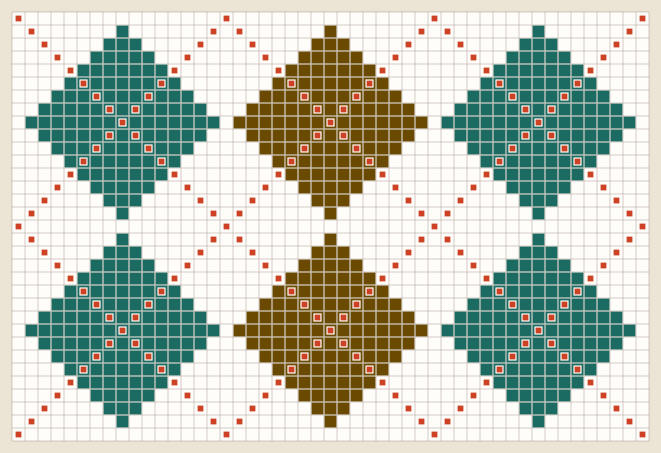
- Place the first diamond. Its center is the ninth square across and the ninth down. The next centers are 16 squares farther, across and down.
- Work the diamonds, rows of 1, 3, 5 up to 15 and back. Leave out the red squares: the center, and the squares on the two slanted lines through it, three to each side.
- Work the red lines, one stitch at a time along the diagonal. They cross at the center of each diamond.
- Fill the ground.
The red lines that lean left come out as separate dots, like A in the outlines above. If you want them solid, work the tents first and lay a backstitch over them.
Four triangles in a diamond outline

- Upper right, upright. Come up five threads above the center hole (1) and go down in it (2). Work four more to the right, one in each line of holes, over 4, 3, 2 and 1. All have their feet on the level line through the center (A).
- Lower right, level. Come up five threads to the right of the center (1) and go down in it (2). Work four more below, over 4, 3, 2 and 1, all ending on the upright line through the center (B).
- Lower left, upright. Come up five threads below the center and go down in it. Work four more to the left, over 4, 3, 2 and 1, all ending on the level line.
- Upper left, level. Come up five threads to the left of the center and go down in it. Work four more above, over 4, 3, 2 and 1, all ending on the upright line (C).
- Outline it in backstitch over one intersection. The points are the four holes five threads from the center.
In a square, not a diamond, four triangles are triangle stitch.
What goes wrong
| What you see | Cure |
|---|---|
| The diamond leans or has a flat side | A row was one stitch off center. Count from the center stitch both ways |
| A blunt point | The middle row was an even number. Make it odd in tent stitch |
| The outline does not close | The width is wrong for backstitch over two: make it 4, 8, 12 or 16 |
| Canvas shows between upright stitches | Add a strand |
| The lattice runs out before the edge | It was started at one side. Start in the middle, with a point or a whole diamond there |
| Diamonds do not nest | A gap was missed in the row above. Check the first row |
Questions
Which stitch makes the smallest diamonds? Alicia's lace, two threads wide, or tent and reverse tent by turns. Of the solid ones, Hungarian.
How do I find the center of the space? Count the threads each way and halve them. In 40 threads, count 20 from one side: the hole there is the middle. In 41, the middle is the 21st thread. Where the middle threads of an odd width and an odd height cross is the middle intersection.