How to make a needlepoint game board
Count the board and never rule it. Choose how many canvas threads one square has, or one point (a backgammon triangle), multiply, and mark every line with long stitches of sewing thread. Work it in flat stitches such as basketweave, so that pieces slide, and mount it hard, under glass or inside a wooden rim.
On this page
What to do first
- Choose the pieces. A square or a point has to be larger than the piece that stands on it. Measure the base of the largest one.
- Choose the finish from the table near the end. If you have the tray or the table already, its size decides.
- Find the count in the tables below, or take a chart: the game board patterns are backgammon boards and a checkerboard, ready counted.
- Choose two colors that read, one clearly light and one clearly dark.
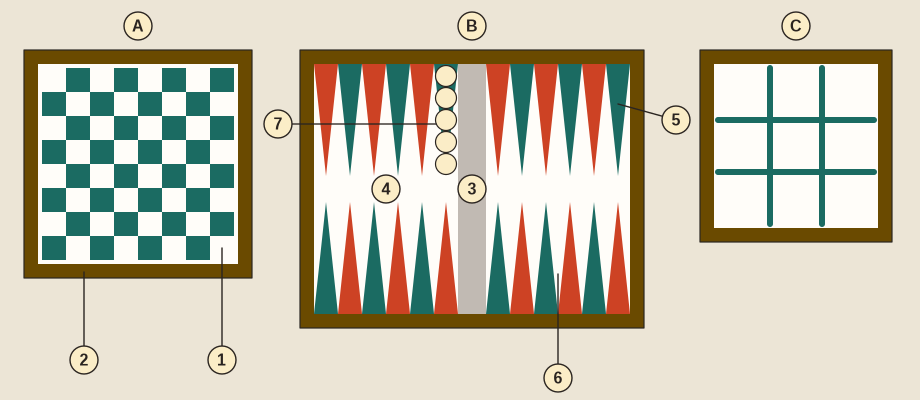
Checkers and chess: the count
The board is 64 squares, eight by eight. Both games use it. Chess players use both colors, checkers players the dark squares only, so let the dark color be the better one to look at.
Every square has the same number of threads each way. Mesh is the number of canvas threads to the inch (2.5 cm). One tent stitch, the short slanted stitch, covers one crossing of two threads, so threads and stitches are the same count. In the table, "10 threads; board 80" means ten threads to a square and eighty, eight times ten, to the whole board.
| Square, about | 10 mesh | 13 mesh | 18 mesh |
|---|---|---|---|
| 1 in (2.5 cm) | 10 threads; board 80, 8 in (20.3 cm) | 13; board 104, 8 in (20.3 cm) | 18; board 144, 8 in (20.3 cm) |
| 1 1/4 in (3.2 cm) | 13 threads; board 104, 10 3/8 in (26.4 cm) | 16; board 128, 9 7/8 in (25 cm) | 23; board 184, 10 1/4 in (26 cm) |
| 1 1/2 in (3.8 cm) | 15 threads; board 120, 12 in (30.5 cm) | 20; board 160, 12 5/16 in (31.3 cm) | 27; board 216, 12 in (30.5 cm) |
| 2 in (5.1 cm) | 20 threads; board 160, 16 in (40.6 cm) | 26; board 208, 16 in (40.6 cm) | 36; board 288, 16 in (40.6 cm) |
- For tournament pieces the world federation asks for squares of 2 to 2 3/8 inches (5 to 6 cm): the last row. Most needlepoint boards are smaller, for smaller pieces.
- The rule of four pawns: a square should hold four pawns, two by two, so it is at least twice as wide as a pawn's base. Or go by the king: its base is about three quarters of the square.
- Checkers 1 inch (2.5 cm) across sit well on squares of 1 1/4 to 1 1/2 inches (3.2 to 3.8 cm).
- If a stitch in blocks is wanted, choose a number it divides: 12, 16, 18, 20 or 26 for mosaic, which takes 2 threads; 15, 18, 27 or 36 for Scotch over 3.
Draw a checkerboard on canvas so that all 64 squares are exact
A ruler jumps from one row of holes to the next. Threads do not.
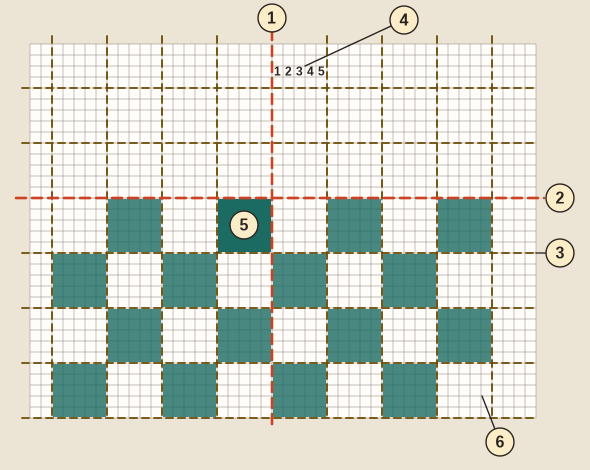
- Cut the canvas. Board, plus border, plus 2 inches (5 cm) bare on every side. A board of 12 inches (30.5 cm) with a border of 1 inch (2.5 cm) takes 18 by 18 inches (46 by 46 cm).
- Run the two middle lines (1, 2). Fold the canvas in half each way to find the middle. With sewing thread, in long stitches, follow one row of holes from edge to edge, in each direction. The eight squares make an even number, so both lines lie between squares.
- Count out to the next line (3). From the middle line count the canvas threads of one square (4), and run sewing thread down the next row of holes, from edge to edge. Do four lines to the right, four to the left, four up and four down.
- Check before you go on. Count the squares from outer line to outer line: eight. Then count the canvas threads of one square near each corner of the board: all four agree with your figure.
- Mark the first dark square (5). Left of the upright middle line and just below the level one.
- Mark every second square. Along the row, skip one and mark one. In the next row begin one square over. Dark squares touch at corners only. If two touch along a side, a row was miscounted.
- Look at the near right corner (6). Sit as a player does: the corner square at your right hand must be light. If it is dark, turn the canvas a quarter turn.
- Draw the border outside the last lines, and the line where the stitching ends.
- Pull out the sewing threads one by one as you stitch up to them.
You need not paint it. With the sewing threads in place, put one dot of waterproof pen in the middle of each dark square. To paint it, see painting squares. For the international game of checkers make ten by ten: each board figure in the table becomes ten times the square.
Backgammon: the count
A backgammon board has 24 points, the narrow triangles: twelve along each long side, in two groups of six, with a bar between the groups. The colors take turns all the way round, so a point faces one of the other color. Each player's home is one group of six and needs no mark.
A point has to hold five checkers in a row, as five stand on one at the start. So it is about five times as tall as it is wide. Choose an odd number of threads for its width, so that its tip is one stitch. In the table the bar is two threads wider than a point, and the gap between the tips one thread wider than a point.
| Mesh | Point: width by height, in stitches | Bar | Gap | Playing surface, in stitches | Playing surface, in inches | Checkers up to |
|---|---|---|---|---|---|---|
| 10 | 11 by 54 | 13 | 12 | 145 by 120 | 14 1/2 by 12 in (37 by 30 cm) | 1 in (25 mm) |
| 10 | 13 by 63 | 15 | 14 | 171 by 140 | 17 1/8 by 14 in (43 by 36 cm) | 1 1/8 in (29 mm) |
| 10 | 15 by 72 | 17 | 16 | 197 by 160 | 19 3/4 by 16 in (50 by 41 cm) | 1 3/8 in (35 mm) |
| 13 | 13 by 63 | 15 | 14 | 171 by 140 | 13 1/8 by 10 3/4 in (33 by 27 cm) | 7/8 in (22 mm) |
| 13 | 17 by 81 | 19 | 18 | 223 by 180 | 17 1/8 by 13 7/8 in (44 by 35 cm) | 1 1/8 in (29 mm) |
| 13 | 19 by 100 | 21 | 20 | 249 by 220 | 19 1/8 by 16 7/8 in (49 by 43 cm) | 1 3/8 in (35 mm) |
| 18 | 13 by 63 | 15 | 14 | 171 by 140 | 9 1/2 by 7 3/4 in (24 by 20 cm), to travel | 5/8 in (16 mm) |
| 18 | 19 by 100 | 21 | 20 | 249 by 220 | 13 7/8 by 12 1/4 in (35 by 31 cm) | 1 in (25 mm) |
The sum for any other: width is twelve points plus the bar; depth is two heights plus the gap. A full tournament board is 17 3/8 by 21 5/8 inches (44 by 55 cm) at the least, opened out. The border comes on top.
Draw a point by counting
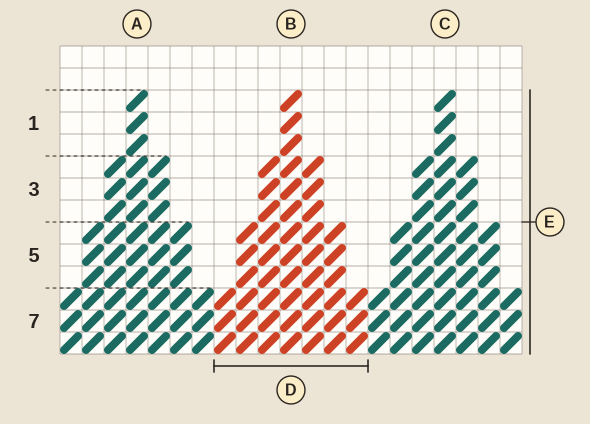
- Draw the base. In this small one it is 7 stitches.
- Work the same width for three rows. Then leave out one stitch at each end and work three rows of 5, three of 3 and three of 1. That is 12 rows.
- For a taller one change the rows, not the steps. A point 13 wide has seven steps: 13, 11, 9, 7, 5, 3, 1. Nine rows of each make 63.
- The rule for any width: add 1 to the width and halve it for the number of steps. For 13 that is 14 halved, 7. The height is the steps times the rows of each.
- Begin the next point in the very next stitch. The bases of six points stand side by side with nothing between, then comes the bar, then six more.
- Draw all the points of one side, then the gap, then the other side. The tips face each other: lay a thread across to see that they do.
| Width | Steps | Rows of each | Height |
|---|---|---|---|
| 11 | 6 | 9 | 54 |
| 13 | 7 | 9 | 63 |
| 15 | 8 | 9 | 72 |
| 17 | 9 | 9 | 81 |
| 19 | 10 | 10 | 100 |
| 23 | 12 | 10 | 120 |
Lay out the board
The figures in brackets are for the board of 171 by 140 stitches. Put your own in. The numbers in the picture are the steps.
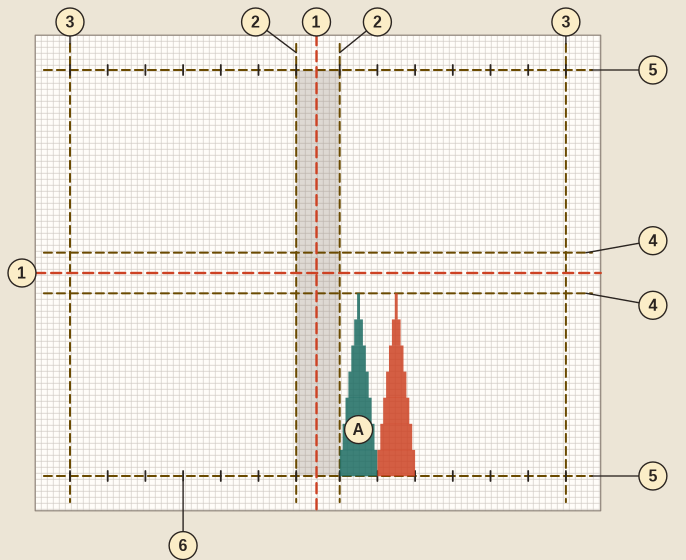
- Run sewing thread down the middle of the canvas, and across the middle.
- Mark the bar. It has an odd number of threads (15), so it cannot be halved by a line. Choose the canvas thread just to the right of the upright line as its middle thread. Count half of the rest to each side of that (7 and 7), and run sewing thread down both edges of the bar.
- Mark the two ends. From each edge of the bar count six points outward (6 times 13, so 78) and run a line down.
- Mark the tips. From the line across the middle count half the gap upward and half downward (7 and 7) and run a line across at both.
- Mark the long edges. From each line of tips count the height of a point outward (63) and run a line across. The points stand on these two lines.
- Mark where the points meet. On each long edge, begin at the bar and make a pencil tick every point's width (13), six times to each side.
- Work from the bar outward, in both directions. A miscount then shows at the outer line, where it can be put right, and not in the middle.
Your own board. The points can be any pair of colors. The gap, the bar and the border are where a custom board says something: a stripe, a vine, a small motif on the bar, a scene in the two fields behind the points. Keep the fields pale and quiet, or the points do not read. Draw it first on graph paper.
Tic-tac-toe and other small boards
A board has three squares each way with two lines between them, so its count is three squares and two lines: three times 18 and twice 3 is 60. The figures are stitches.
| Board | 10 mesh | 13 mesh | 18 mesh |
|---|---|---|---|
| Tic-tac-toe, 6 in (15 cm): three squares each way and two lines | Squares 18, lines 3: 60 | Squares 24, lines 3: 78 | Squares 34, lines 3: 108 |
| Tic-tac-toe, 4 in (10 cm) | Squares 12, lines 2: 40 | Squares 16, lines 2: 52 | Squares 22, lines 3: 72 |
Make five of each playing piece, in two colors. They can be needlepoint themselves: coasters made small, 1 1/4 inches (3.2 cm) across, with a felt back.
Canvas, thread, stitches and colors
| Choice | Use | Leave out |
|---|---|---|
| Canvas | Mono or interlock, 10, 13 or 18 mesh | Plastic, if the board is to fold |
| Thread | Wool, or cotton floss and pearl cotton, for a smooth surface | Metallic thread and anything that loops |
| Squares and points | Basketweave, the flattest. Continental in the thin tips | Rhodes, crosses, anything raised: checkers tip |
| One color of square in a texture | Mosaic or Scotch, which lie nearly flat | Long stitches, which catch |
| Border | Any border, if it lies outside the play: borders and corners |
Two colors that read. Photograph the two threads side by side and turn the picture to gray: if you can still tell them apart, so can a player under a lamp. Choose a dull thread, not a shiny one. The playing pieces need two more colors that differ from both.
Order. Stitch all the dark squares first, from the middle outward, then the light ones, then the border. Light thread worked second keeps clean.
Canvas to cut: the playing surface, two border widths, and 4 inches (10 cm). A board of 223 by 180 on 13 mesh with a border of 13 stitches is 249 by 206, which is 19 1/8 by 15 7/8 inches (49 by 40 cm). Cut 23 1/4 by 20 inches (59 by 51 cm). The canvas calculator does it for others, and the thread calculator estimates the thread.
Add two rows of the border color outside everything if the piece will be mounted on board: they turn over its edge.
Finish a backgammon or checkers board
Block it first, square to the last thread: a leaning board is seen at once.
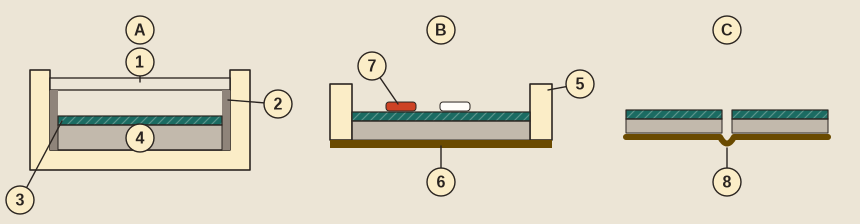
| Finish | Good for | What to know |
|---|---|---|
| A. Under glass, in a tray or a table | Chess and checkers, and a board that is used every day | Pieces slide on the glass. It must stand off the stitches: make a table or tray has the depths and the steps |
| B. Mounted on board, with a rim | Backgammon: dice land softly and stay in | Dust lies on the stitches. The rim has to be higher than a die |
| C. Folding, two panels with a hinge | Backgammon to carry | Stitch two panels of six points by two, each with half the bar along its inner edge, or with none where the rims make the bar. The fold never goes through stitching. A finisher's or a woodworker's work |
| Soft mat with a felt back | Checkers for a bag, rolled up | It is never quite flat. Work it on interlock, which is thin |
| Padded case that zips | A travel set | A finisher's work |
Mount it on board (B), step by step.
- Cut a board of firm mat board or thin plywood to the size that shows, less 1/8 inch (3 mm) on every side for the canvas that folds round it.
- Lace the piece over it, the two extra rows at the edge: how to lace a needlepoint. No padding under a board for play.
- Check the corners with a square, and pull the lacing until they are true.
- Set it in a frame without glass whose rim stands 3/4 inch (2 cm) or more above the stitches. A framer or a woodworking shop makes one to your board.
- Close the back with a panel, and stick felt on that, so that it slides on a table without scratching.
A soft mat.
- Trim the bare canvas to 3/4 inch (2 cm).
- Fold it to the back. Cut the tip off each corner of the bare canvas, fold the corner in, then the two sides over it.
- Sew the edge. Catch the fold down to the backs of the stitches. For a firm, braided edge work binding stitch all round through both layers: that page says where to fold.
- Cut felt 1/8 inch (3 mm) smaller than the mat on every side.
- Sew the felt on with small stitches all round.
- Roll it with the stitches outward round a tube.
What a finisher or a tray maker needs to know: the playing surface in inches and the whole stitched size; how high the rim should be; with glass or without; whether you will play on it or look at it; and that the piece has been blocked (damped, pinned square and dried). A tray is fitted to the mounted piece, not to the bare canvas, so it comes last. One or two rows at the edge are usually lost.
Pieces and a pouch. A pouch of cloth or needlepoint about 6 by 8 inches (15 by 20 cm) holds the thirty checkers of 1 inch (2.5 cm), two pairs of dice and the doubling cube, the die with 2 to 64 on it: bags and cases has the ways to line one.
What goes wrong
| Problem | Cure |
|---|---|
| The last column is a stitch too narrow | A line was counted from the wrong hole. Count from the middle and unpick to the first wrong line |
| The corner at each player's right is dark | Turn the board a quarter turn |
| Checkers hang over the edge of a point | Use smaller checkers, narrower than the point: the table has the size |
| The tips do not face each other | One side was counted from the border and one from the bar. Count both from the bar |
| Checkers tip or catch | Raised or long stitches. Put it under glass |
| It leans after blocking | Tent stitch in straight rows (continental) pulls the canvas aslant. Block it again, and lace it over plywood |
| The two colors run together at night | Work the outline between squares in one row of a darker shade, or change the light color while it is still bare |
| Glass touches the stitches | Higher strips at the edge |
Questions people ask
How do you finish a needlepoint backgammon board? Block it, lace it over board, and set it in a rimmed frame, or let a tray maker build a tray round it. For a board that folds, stitch the two halves as two pieces. Old card tables with a stitched top are in old tables with needlepoint tops.
Does the bar have to be stitched? On a flat board, yes, as a plain band. On a folding one the hinge and the rims make the bar.
Can I stitch a board on plastic canvas? Yes, a checkerboard that lies flat. Count in bars and squares as charts on plastic canvas explains.
Which side is home? Either. Players sit on the two long sides, and home is the six points on the side they agree on.
How many checkers does a set need? Fifteen of each color for backgammon, twelve of each for checkers.