Needlepoint guide
How to make a needlepoint stitch sampler
Divide the canvas into boxes 24 threads square with two rows of tent stitch between them, and fill each box with a different stitch. Nine boxes make a first sampler, about 6 inches (16 cm) square on 13 mesh.
On this page 11 parts
What a stitch sampler is
A sampler is a record of stitches. The word comes from the Latin for an example, and before there were printed patterns a sampler was a worker's own reference book, in thread. In needlepoint it is usually a grid of small squares, one stitch to a square. It teaches each stitch at a size where the pattern shows, and it is there to look at later, when you need a stitch for a roof.
A practice canvas, often called a doodle canvas, is the rough version: the same idea with no plan, kept in the work bag. Both are below.
Choose a box size
A repeat is the smallest piece of a stitch pattern that comes again and again: mosaic, for example, repeats every 2 threads. Tent stitch, used for the rows between the boxes, is the plain small slant over one intersection, the place where two canvas threads cross.
A stitch fits a box exactly when its repeat divides the number of threads. A box of 24 takes almost everything. This table gives the number of repeats across; a dash means that threads are left over, and you would have to compensate, that is, work part stitches at the edge.
| Box, in threads | Repeat of 2 | Repeat of 3 | Repeat of 4 | Repeat of 5 | Repeat of 6 | Repeat of 8 |
|---|---|---|---|---|---|---|
| 12 | 6 | 4 | 3 | - | 2 | - |
| 16 | 8 | - | 4 | - | - | 2 |
| 18 | 9 | 6 | - | - | 3 | - |
| 20 | 10 | - | 5 | 4 | - | - |
| 24 | 12 | 8 | 6 | - | 4 | 3 |
| 30 | 15 | 10 | - | 6 | 5 | - |
| 36 | 18 | 12 | 9 | - | 6 | - |
Three repeats each way are the least that show a pattern, so 12 threads is the smallest box for stitches with a repeat of up to 4.
Upright stitches stand in holes and not on threads. A box 24 threads wide has 25 lines of holes, so a row of upright stitches is 25 long, the first and the last sharing the edge with the dividing rows.
How much canvas
Count the boxes and the rows between them. With 24 threads to a box and two threads to every dividing row, frame included:
| Sampler | Threads each way | On 10 mesh | On 13 mesh | On 18 mesh |
|---|---|---|---|---|
| 9 boxes, 3 by 3 | 3 x 24 + 4 x 2 = 80 | 8 in (20.3 cm) | 6 1/8 in (15.6 cm) | 4 1/2 in (11.3 cm) |
| 16 boxes, 4 by 4 | 4 x 24 + 5 x 2 = 106 | 10 5/8 in (26.9 cm) | 8 1/8 in (20.7 cm) | 5 7/8 in (15 cm) |
| 25 boxes, 5 by 5 | 5 x 24 + 6 x 2 = 132 | 13 1/4 in (33.5 cm) | 10 1/8 in (25.8 cm) | 7 3/8 in (18.6 cm) |
Add at least 2 inches (5 cm) of bare canvas on every side, so 4 inches (10 cm) to each measurement. For nine boxes on 13 mesh, cut 10 1/2 inches (27 cm) square. The canvas calculator does the sum for any other plan.
The canvas: mesh is the number of canvas threads to the inch, and mono is the plain weave of single threads. 13 mesh mono is easy to see and takes common threads; 10 is easier still. The thread: a smooth one that fits your mesh, from the thread guide. Fuzzy thread hides a pattern. On paper: rule the boxes on graph paper first, one square to a thread, and write a stitch in each.
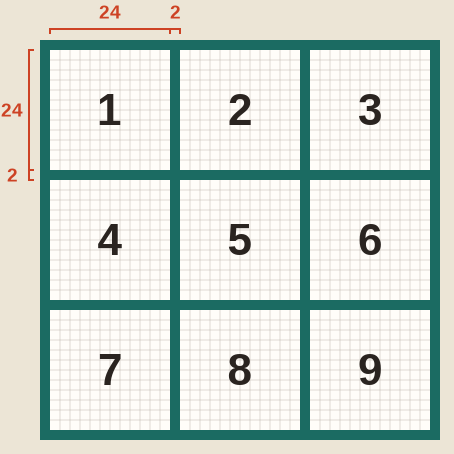
Steps
- Cut and bind the canvas. Tape its edges, and put it on stretcher bars.
- Find the top left corner. Measure in 2 inches (5 cm) from the top and the left. Mark that hole with a pin or a loop of sewing thread.
- Stitch the top band. From the marked hole work two rows of tent stitch to the right, one under the other, 80 stitches long for nine boxes. Count them in tens.
- Stitch the left band. Below the left end of the top band work two columns of tent stitch, 78 long: with the two rows of the top band that makes 80 from top to bottom.
- Stitch the bands across. Down the left band, count 24 threads from the top band. Work two rows of tent stitch from the left band across, 78 long, to end under the right end of the top band. Count 24 more and work two rows, and so on; the last one is the foot of the frame. Check each count twice: every box depends on it.
- Stitch the bands down. Along the top band, count 24 threads from the left band and work two columns of tent stitch down to the next band across, and go on below it. Count 24 more, and so on; the last one is the right side of the frame.
- Check. Each box should now measure 24 threads both ways.
- Fill a box. Begin at a corner of the box, unless the stitch's own page says otherwise, so that whole repeats run to the far side. Where the stitch allows, come up in the box and go down into the holes of the band.
- Finish the edges. A stitch that does not divide into 24 ends in part stitches at the edge.
- Write it down before the next box: see the notebook below.
- Block it, which is to dampen it and pin it square, when all the boxes are full, face up if any of them is raised.
Which stitches, and in what order
All of these suit a box of 24 threads, and each links to its own page. Those whose rows nest or run on a slant, such as brick, upright cross and Byzantine, need part stitches along the edges in a box of any size. For other stitches see the stitch chart, which gives the room for two repeats of each: for most of them one repeat is half of that.
| No. | The first nine | Seven more, for sixteen | Nine more, for twenty-five |
|---|---|---|---|
| 1 | Basketweave | Slanted Gobelin | Algerian eye |
| 2 | Mosaic | Parisian | Rhodes |
| 3 | Scotch | Hungarian | Framed Scotch |
| 4 | Brick | Smyrna cross | Byzantine |
| 5 | Cross stitch over two | Rice | Herringbone |
| 6 | Cashmere | Checkerboard | Woven |
| 7 | Upright Gobelin | T stitch | Kalem |
| 8 | Upright cross | Pavilion | |
| 9 | Skip tent | French knots |
Spread the kinds about: a flat box beside a textured one, an open one beside a full one, and the raised ones away from the edge.

Color
- One color shows texture best. Use it for a first sampler, with the dividing rows in a second.
- Shades of one color, from light in the middle to dark at the corners, or in rows, make a piece to frame.
- Two colors within a box show how a stitch is built: alternate boxes of Scotch, or rows of brick.
- An open stitch shows the canvas, so leave it white or stitch it in a thinner thread.
A practice canvas for a beginner
Cut 8 inches (20 cm) square of the mesh of your first project, tape it and rule nothing. Work these in order, each about an inch (2.5 cm) square.
- A waste knot, and a row of ten continental stitches.
- Three rows of continental, turning at the end of each.
- A square of basketweave, ten stitches by ten.
- A thread ended and a new one begun in the middle of a row.
- A circle of tent stitch, counted from a chart.
- Mosaic, two rows of five.
- Brick, with the edges filled.
- The same stitch in one strand fewer and one strand more, to see which covers.
- A line of backstitch across stitching that is done.
Keep it. Every new thread and stitch can be tried there before it goes on a good canvas, and one practice canvas will serve several small projects.
A stitch notebook
Keep a page for each stitch: a tiny patch of it on a scrap of canvas, a diagram on graph paper, and these lines.
| Write | Example |
|---|---|
| Stitch and its other names | Upright cross |
| Mesh, thread and number of strands | 13 mesh, floss, and how many strands covered |
| Repeat | 2 by 2 threads |
| Where it starts, and which hole is clean | Right edge, top; down in the shared hole |
| Coverage | Full, nubby |
| How it compensates | Half crosses at the edge |
| Good for | Beards, flower heads |
| Where it was used | Box 8 |
Number the boxes and the pages alike. Planning your own canvas from such a notebook is what a stitch guide does.
Finishing it
- A pillow: 25 boxes on 10 mesh make a front about 13 inches (34 cm) square. See how to finish a pillow. Leave out long stitches and knots, which snag.
- A frame: any size, and raised stitches are welcome: how to frame needlepoint.
- An ornament or a needle book: nine boxes on 18 mesh, about 4 1/2 inches (11 cm).
- A long one: boxes in two columns, to add to for years. Cut the canvas long and use a scroll frame.
What goes wrong
| What you see | Cure |
|---|---|
| A box is 23 or 25 threads | Count each box before the next band is stitched. If it is found late, compensate in that box and leave the band |
| The pattern runs out before the edge | Its repeat does not divide into the box. Compensate, or choose a box from the table |
| The sampler leans | Slanted stitches pull. Use a frame, and block it |
| Canvas shows in the upright boxes | Add a strand for straight stitches |
| The boxes all look alike | Put a raised or an open stitch between two flat ones |
Questions
Do I need a pattern? No. A plan of boxes and the stitch pages are enough.
How many stitches should a first sampler have? Nine. They cover tent, box, straight, crossed and open stitches, and everything else is built from those.
Can I use scraps of thread? Yes, if they fit the mesh. A box of 24 threads on 13 mesh is a little under 2 inches (4.7 cm) square, which tent stitch fills with 576 stitches: as an estimate, about 5 yards (4.7 m) of thread, at a yard and a half to the square inch.