Needlepoint guide
Pens, pencils and markers for needlepoint canvas
Use a fine waterproof pen with permanent or archival pigment ink, in a color close to the thread that will cover it, and only after it has passed a wet trial on a scrap of the same canvas. On dark canvas, mark with a line of basting (long stitches that are pulled out later) or a white paint pen. Never use a ballpoint.
On this page 9 parts
The answer first: which pen will not run
No label can promise it. The same pen can hold on one canvas and run on another, because the sizing, which stiffens canvas, differs from maker to maker. On some canvas the ink never reaches the threads: it lies on the sizing and comes off on your wool. So choose a kind from the table, then give it the trial.
Words used here. To baste is to run long stitches of sewing thread that are pulled out again later. A crossing is the place where an upright and a level canvas thread cross. To block is to dampen finished needlepoint, pull it square and let it dry pinned to a board. The damping is why a pen has to hold in water.
| You want to mark | Reach for |
|---|---|
| An outline on white or tan canvas | A fine pigment pen, gray or brown, or near the color of the thread |
| A line under white or pale wool | A pen in pale gray or tan, or basting thread |
| Black canvas, or any dark one | Basting thread; white paint pen; charcoal gray paint |
| Whole areas of color | Acrylic paint, or acrylic paint markers |
| Counting lines, a center, a corner | Basting thread |
| Notes: the top, a number | Any pen at all, on the tape and not on the canvas |
The trial: does this pen bleed?
It takes a scrap of the very canvas you will stitch. Cut it from the margin.
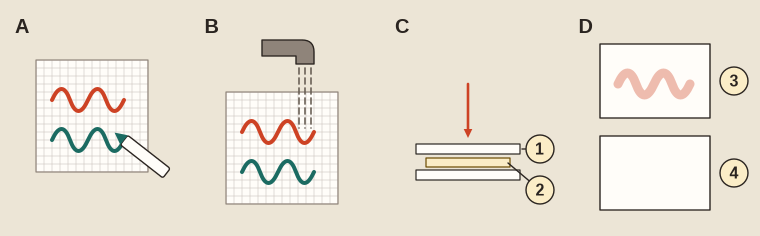
- Scribble (A). Draw hard, solid lines with each pen, an inch (2.5 cm) apart. Write the order of the pens on a piece of paper and not on the scrap: pencil would come off too, and spoil the trial.
- Let it dry for 10 to 15 minutes, and paint pens longer, as their makers say.
- Heat it, if its maker says to. Some fabric pens and paint markers are fixed with a dry iron on cloth over them. Do to the scrap exactly what you would do to the piece.
- Rub a strand over it, dry. Draw a length of white wool across each mark a few times, a fresh bit of wool for each pen.
- Wet it (B) well under cold running water, as finished needlepoint is dampened when it is blocked.
- Press it (C) hard between white cloths or paper towels.
- Look at the towel (D) and the strands. The least tint means that this pen is not for this canvas. If both are clean, use it, on this canvas and no other.
Pens, paint markers, pencils and thread compared
| Kind | Light canvas | Dark canvas | Waterproof? | What may go wrong | Good for |
|---|---|---|---|---|---|
| Permanent marker, alcohol ink | Yes | No | Often, but not always. It is made for hard surfaces | Thick line; may bleed, and can fade or yellow with age | Coloring bare canvas under dark stitches |
| Pigment pen, also sold as archival ink | Yes | No | Once dry, on most canvas | Its makers do not vouch for it on cloth that is washed; the finest tips scratch | Fine outlines. First choice |
| Fabric pen | Yes | A few | Once set, often by heat | Not fixed if the heat step is skipped | Outlines and small areas |
| Acrylic paint marker | Yes | Yes, in white and pale colors | Once dry, on canvas threads | Too much fills the holes; a thick line | White on black, color areas, corrections |
| Oil paint pen | Yes | Yes | Yes | Strong solvent smell: use it by an open window. Slow on sized canvas | Little. Take acrylic first |
| Gel and roller pens | No | White shows, for a while | No | They lie on top and rub off | Paper |
| Blue pen that water takes out | Take care | No | No: that is its purpose | Heat fixes it for good, even a hot car. The water that removes it can make thread run | Lines that will be gone before stitching |
| Purple pen that air takes out | Take care | No | No | May be gone in a day or far sooner | A line you will cover at once |
| Pen that an iron takes out | No | No | No | Comes back in the cold, and can leave a brown ghost | Paper |
| Graphite pencil | Poor | No | Smears | Comes off on pale thread, which looks dirty | If you must, a hard one (4H), under dark thread only |
| White or silver pencil | No | For a while | No | Soft: it brushes off as you work and can rub off on thread | Short lines on dark canvas, drawn as you reach them |
| Chalk, chalk pencil | No | For a while | No | Gone in a little handling. Brush off what is left | A center line, a quick guide |
| Ballpoint | Never | Never | No | Runs and spreads | Nothing here |
| Basting thread | Yes | Yes | Nothing to run | Must be pulled out before it is stitched over | Everything that is a line |
Draw a fine line that disappears
- Use the finest tip that does not scratch, about 0.2 to 0.3 mm. The very finest catch on the threads: draw slowly, with the pen at a slant.
- Choose the color of the thread, or one a little paler. Brown or gray is kinder than black.
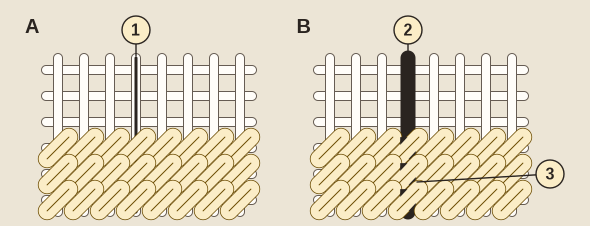
- Draw on a canvas thread, along the middle of the side that faces you, as in A. Keep out of the groove between two threads.
- Touch lightly and go once. Pressing widens the line and wears the tip.
- Follow the thread wherever the line is straight. On a curve, put a dot on each crossing the line passes, and draw nothing across the holes.
- Cover every mark. A line that stitches stop short of is a line you will see.
To trace a drawing, see how to transfer a picture; to fill areas with color, how to paint a canvas.
White lines on black canvas
- Baste it. Sewing thread, or a fine twisted cotton such as pearl cotton in size 8, in any color that shows. Run long stitches, up in one hole and down in another, along the outline. It is the surest way, because it leaves nothing behind.
- White or pale acrylic paint pen. Shake it, press out the first blot on paper, and dot the crossings, where two canvas threads meet, along the line. Let it dry, and dot again.
- Charcoal paint. A thin line of gray only a shade lighter than the canvas is enough to follow, and does not show through.
- A fine red pen can be followed on black in good light, under dark thread.
- White pencil or chalk for the inch or two you are about to stitch.
- To see the crossings of black canvas when the thread is black too, touch them lightly with a pale acrylic paint pen that has passed the trial. A lamp and a pale cloth under the work help as much.
Cover a wrong mark, or one that shows
| What has happened | What to do |
|---|---|
| A pencil line in the wrong place | A plain white eraser. Colored ones leave their color |
| A pen line in the wrong place, no stitches yet | Dot it over with opaque titanium white acrylic, hardly thinned, with a tiny brush. Let it dry, and do it again. Keep the holes open |
| A dark line shows through pale stitches | Take out the stitches along it and dot the line over as above. Under fine wool a faint gray may remain |
| You would rather not take it out | Make the line part of the design: work a row of crosses or Smyrna crosses along it, let two close shades meet there, or change the stitch at the line |
| White canvas shows between dark stitches | Color the canvas under them first, with a marker or paint that has passed, and use more strands |
| The ink has run into the thread | Do not let it dry. Press white cloth on it, with clean cold water, again and again until no more color comes. What has dried in seldom comes out: cut those stitches out, paint over the mark and work them again |
| The ink ran before anything was stitched | Let it dry and do not use that pen again. Paint the place white. If it still comes off on wet cloth, put that canvas aside |
| A blue line came back or will not go | If no thread is near, cold water on a cotton swab. If thread is near, leave it and cover it |
| The line vanished too soon | Baste it: you have the drawing still |
The outside of the design may be marked freely as long as it will be turned under or cut off, with one caution: ink that runs travels, margin or not. Do the trial for those pens too.
Marking counted lines
Straight lines, center lines and tens are better in thread than in ink, as they have to be right and then have to vanish. How to prepare a canvas has the steps and a picture. If you do draw them, use the pale color that the background will cover, draw along one canvas thread, and use a second color for any line you have to move, so that you can tell the right one from the wrong.
Keep the pens working
- Put the cap on the moment you lift the pen. Canvas is dry and rough, and dries a tip quickly.
- Shake a paint marker with the cap on, and start it on paper. A dried water-based tip can be softened in water.
- Keep one set for canvas. Sizing and paper dust clog a tip.
- Write on the cap the date of the trial and the canvas it passed on.
Questions people ask
Can I draw on canvas with an ordinary permanent marker? Only after the trial. Most are water resistant and not more, and their lines are thick. Keep them for places that dark thread will cover.
Are acrylic paint markers as good as paint? For small areas and lines, yes, if they pass the trial. Use little: the paint has to lie on the threads and leave the holes open. For a background a brush is quicker and thinner.
Do I have to set the ink with an iron? If the maker says so. Iron blank canvas dry, under a cloth. Where the maker says nothing, drying is enough, and the trial will tell.
Which pen for writing a name or a date on the canvas? Put it in the margin or count it in stitches. Nothing drawn on canvas should be left to show.
What do designers use? Mostly acrylic paint, with a fine waterproof pen for outlines. A painted canvas bought from someone else deserves the wet cloth too before it is blocked: touch each color, and look at the cloth.