Needlepoint guide
Lights and magnifiers for needlepoint
Put a bright light behind one shoulder, the one away from the hand that works on top of the canvas, and add a magnifier only if you still cannot see the holes. For canvas of 13 to 18 mesh (holes to the inch) a weak lens is enough. The stronger the lens, the closer it has to be and the less canvas it shows.
On this page 14 parts
- Start with the light
- What the words on a lamp mean
- Kinds of light
- Dark canvas
- What the numbers on a magnifier mean
- Which strength for which canvas
- Kinds of magnifier
- 5 times and 10 times: how strong is useful
- Glasses for needlepoint
- Floor lamps with a lens, gooseneck lamps and head lamps
- Never leave a magnifier in the sun
- Finding the holes on 18 mesh and finer
- What goes wrong
- Questions people ask
Start with the light
- Find your top hand, the one that works above the canvas. If one hand holds the work and the other stitches, it is the hand that stitches. If you stitch with both, one above and one below, it is whichever is above.
- Place the light just behind the opposite shoulder: see the table.
- Look for a shadow. Hold the needle over the canvas. If your hand darkens the hole, move the lamp until it does not.
- Aim it at the canvas, and not at your eyes. You should see the work bright and no bare bulb.
- Bring it nearer before you buy a brighter one. At half the distance a small lamp throws about four times the light on the canvas.
- Leave the room light on as well, so that you can see your thread, scissors and chart.
| How you stitch | Hand on top | Light behind |
|---|---|---|
| One hand, the right; the left holds the work | Right | Left shoulder |
| One hand, the left; the right holds the work | Left | Right shoulder |
| Two hands, the right below | Left | Right shoulder |
| Two hands, the left below | Right | Left shoulder |
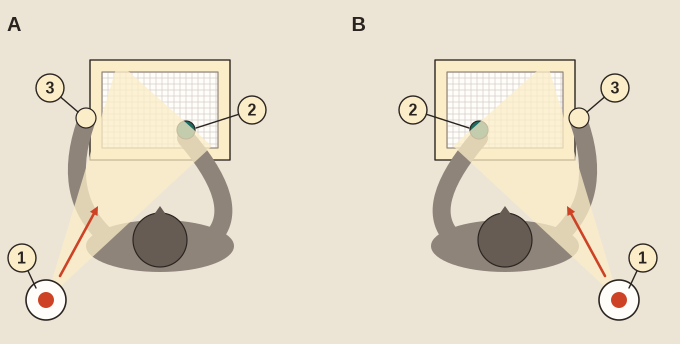
By day, sit with a window on the side of the lamp. Keep the work itself out of the sun: thread fades.
What the words on a lamp mean
| Word | What it says | For needlepoint |
|---|---|---|
| Lumens | How much light it gives | 800 or more for a lamp within arm's reach; less for one on your head or frame, because it is close |
| Watts | How much power it uses, not how bright it is | Ignore, or compare: see below |
| Kelvin (K) | The color of the light, from yellow to blue | 5000 to 6500 is sold as cool white or daylight, and shows colors much as a window does |
| CRI, color rendering index | How true colors look, up to 100 | As near 100 as you can get. Look for 90 and up |
| Dimmable | It can be turned down | Useful: pale canvas needs less than dark |
| LED | A cool, small light that shines one way | Right for anything near your hands or head |
| Old bulb | Lumens that replace it |
|---|---|
| 40 watts | About 450 |
| 60 watts | About 800 |
| 75 watts | About 1,100 |
| 100 watts | About 1,600 |
| Light | Kelvin, about | What it does to thread |
|---|---|---|
| Soft or warm white bulb | 2,700 to 3,000 | Yellows everything; dark blues and greens look alike |
| Cool white or daylight bulb | 5,000 | White, a little cold |
| Daylight LED, overcast sky | 6,500 | Bluish; navy, black and dark green come apart |
Choose colors by the light the finished piece will hang in. Stitch by the light you see best in. They need not be the same.
Kinds of light
| Kind | Where it goes | Good for | Watch for |
|---|---|---|---|
| Floor lamp with a jointed arm | Behind your shoulder | Every day, one chair | The arm should tilt, and the pole rise |
| Table or clamp lamp | On the table at your side | A table stand | It has to reach over the frame |
| Clip light | On the frame, away from your hand | Travel, a second light | A clip that opens over your bar, and a weight that thin bars will bear |
| Neck light | Round your neck, shining down | Hotel rooms, cars, someone asleep beside you | The strap slides; aim both ends at the canvas |
| Head lamp | On your head, or on spectacles | It goes wherever you look | It dazzles people you turn to |
| Magnifier lamp | A lens with light round it, on an arm | Fine mesh | Weight: it needs a firm clamp |
Many battery lamps dim slowly as they run down. If the holes get harder to see in the evening, change the battery before anything else.
Dark canvas
On black or navy canvas the threads and the holes are the same color, so make the holes pale.
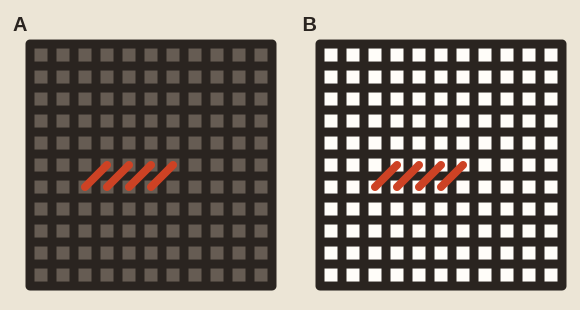
- Lay a white cloth in your lap, or over the table under the frame.
- Light the cloth. A lamp at your side, pointed at the cloth under the frame, makes it bright.
- Or light from below. If that is not enough, lay a small LED lamp on the cloth, facing up, and put a sheet of white paper over it, so that you see a pale glow and no bare bulb. The frame goes above. Use only a lamp that stays cool.
- Keep the light from above too, but dimmer than the one below.
For pale thread on pale canvas do the opposite: a dark cloth behind. Canvas and mesh sizes has more on colored canvas.
What the numbers on a magnifier mean
A lens is marked in diopters (3, or +3) or by power (1.75x, "one and three quarter times").
- Power is diopters divided by 4, plus 1. Three diopters: 3 divided by 4 is 0.75, plus 1 is 1.75x. Four diopters is 2x. Eight is 3x.
- The farthest the canvas can be, in inches, is 39 divided by the diopters. In centimeters, 100 divided by the diopters. Three diopters: 13 inches (33 cm).
- Two lenses together add. Plus 2 spectacles under a plus 3 lens work roughly as plus 5.
Where makers differ. Some print the power without the plus 1, so that four diopters is called 1x and eight is 2x. That is closer to what you see when the lens hangs well away from your eye. Some round up: a lens plate numbered 5 is sold as 2.5x, where the sum gives 2.25x. So compare lenses by diopters, or by the distance at which they focus, and treat the x as a rough guide.
| Diopters | Power | Focuses at | Width you see through a lens 4 in (10 cm) wide, eye 8 in (20 cm) above it |
|---|---|---|---|
| 2 | 1.5x | 20 in (50 cm) | 10 in (25 cm) |
| 3 | 1.75x | 13 in (33 cm) | 6 1/2 in (16.5 cm) |
| 4 | 2x | 10 in (25 cm) | 5 in (12.5 cm) |
| 5 | 2.25x | 8 in (20 cm) | 4 in (10 cm) |
| 8 | 3x | 5 in (12.5 cm) | 2 1/2 in (6 cm) |
| 10 | 3.5x | 4 in (10 cm) | 2 in (5 cm) |
The last column is worked out from the lens, and is an estimate. Move your eye closer to the lens and you see more; move away and you see less.
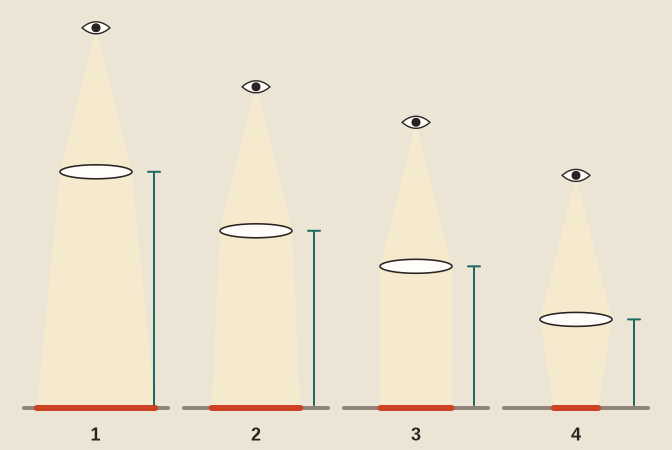
Your needle has to swing between lens and canvas. A tapestry needle and the fingers behind it want 6 inches (15 cm) or more, which is why 3 to 5 diopters suit most canvas. At 8 diopters the canvas is only 5 inches (12.5 cm) away: that is for looking and counting, not for stitching.
Which strength for which canvas
Mesh is the number of holes to the inch. Divide it by the power of the lens, and you know what the canvas looks like under it: the figures in the table are the mesh you seem to see. Eighteen mesh under a 2x lens looks like 9 mesh. Silk gauze is a very fine canvas woven of silk, for miniatures.
| Canvas | Under 1.75x, 3 diopters | Under 2x, 4 diopters | Under 2.25x, 5 diopters | Under 3x, 8 diopters, for counting |
|---|---|---|---|---|
| 13 mesh | 7 | 6 1/2 | 6 | 4 |
| 18 mesh | 10 | 9 | 8 | 6 |
| 24 mesh | 14 | 12 | 11 | 8 |
| 40 hole silk gauze | 23 | 20 | 18 | 13 |
These are the most you can expect. Start with the canvas you can see well with no lens, perhaps 10 or 13 mesh, and choose the strength that brings the finer one near it.
Kinds of magnifier
| Kind | Hands free? | Usual strength, in diopters | Good for | Watch for |
|---|---|---|---|---|
| On a floor or table stand | Yes | 3 to 5; some have a small, stronger lens set into the large one | One chair, long sittings | Focus moves when you lean |
| Round the neck, resting on the chest | Yes | 2 to 4 | Work in the hand | It swings, and its cord catches thread |
| Visor or headband | Yes | 2 to 10 | Frames, travel, over spectacles | You must lean to the right distance |
| Clip-on, flips down over spectacles | Yes | 2 to 4 | Looking up at a chart and back | Weight on your nose |
| Magnifying spectacles | Yes | 2 to 6 | Moving about | Everything far away is a blur |
| Clipped to the frame | Yes | 3 to 8 | Counting one spot | It covers little and has to be moved |
| Stick-on lens or thin sheet | Yes | 2 to 3 | Reading a chart | Distorts toward the edges |
| Hand glass | No | 3 to 10 | Checking a count | Not for stitching |
To set one up:
- Light first. Set the lamp as at the top of this page.
- Touch, then lift. Put the lens close to the canvas, and move it slowly away until the holes are sharp and as large as they get.
- Fix it there. Bring your chair to it, so that you do not bend to it.
- Center the eye. Look through the middle of the lens. Near the rim, squares bend.
5 times and 10 times: how strong is useful
For stitching under a plain lens, 2 times, or 2.25 (5 diopters) at the most. For looking and counting, up to 5 times. A 10 times lens is for examining one thread or one hole, and must almost touch the canvas.
| Marked | Diopters | Canvas from the lens | Can you stitch under it? | Use it to |
|---|---|---|---|---|
| 1.75x | 3 | 13 in (33 cm) | Yes | Stitch |
| 2x | 4 | 10 in (25 cm) | Yes | Stitch 18 mesh |
| 3x | 8 | 5 in (12.5 cm) | No | Count, take out stitches |
| 5x | 16 to 20 | 2 to 2 1/2 in (5 to 6 cm) | No | Count silk gauze, look at a worn spot |
| 10x | 36 to 40 | About 1 in (2.5 cm) | No | Look at one thread, a needle's eye, a mark on the edge of an old canvas |
The first figure of diopters is by the rule with the plus 1 above, and the second is by the rule without it. Both leave no room for a needle.
Is 10 the power, or the diopters? A lens marked +10, or 10 diopters, is a 3.5x lens that focuses at 4 inches (10 cm). A lens marked 10x is about four times as strong in diopters. If the package says only 10, measure: hold it over print, find the sharp view, and measure from lens to paper. Four inches is 10 diopters. One inch (2.5 cm) is 10x.
A microscope of the kind with two eyepieces and low power leaves 6 to 16 inches (15 to 40 cm) under it, so a hand fits. But it shows only a small piece of canvas, and it keeps your eyes at one fixed point. It is for examining, or for a miniature on gauze that fits inside its view. A pocket microscope has to be held against the canvas, and is no use for stitching.
For fine gauze add light before you add lens: petit point has what each count needs.
Glasses for needlepoint
- Sit as you stitch, frame at its usual height, and have someone measure from your eyes to the canvas.
- Divide 39 by the inches, or 100 by the centimeters. Sixteen inches (40 cm) gives about 2 1/2: the strength of ready-made readers, +2.50, whose sharp view lies there, for someone who sees far things well without glasses.
- Try the next weaker pair too. A stronger pair than that number makes you bend down to the work.
- Read the canvas through them, 18 mesh if that is what you stitch, for a few rows, before you settle.
| Kind | What it does | For whom | Watch for |
|---|---|---|---|
| Ready-made readers | Bring the sharp view nearer; in themselves they enlarge little | Eyes that see well far off, both alike | They do not suit two eyes that differ, or an eye with astigmatism, which needs a lens made for it |
| Glasses made for your stitching distance | The same, for each eye by itself | Anyone who wears glasses already | Give the optician your measure from step 1 |
| Half glasses | Clear below, and you look over them | Looking up at a chart or a screen | Small lenses: tilt the frame toward you |
| Magnifying spectacles, worn alone or over your own | Enlarge, 1.6x and the like | Moving about, both hands free | Everything far off is a blur |
| Flip-up lenses on a clip | Swing down when wanted | Counting now and then | Weight on the nose |
| Spectacles with two small barrels, loupes | 2.5x and more, with the hands free. They are made to focus at a set distance, so your hand has room where a plain lens of that power leaves none | Silk gauze | A small view at one distance, and weight on the face. Give the seller your measure from step 1 |
| Glasses with a light in the frame | A small lamp at each side, or between the lenses | Stitching in bed or a car, dark canvas | Aim: some light only straight ahead. See that the battery can be charged or changed |
Wearing readers of +2 under a lens of 3 diopters is roughly 5 diopters in all, so the lens must come nearer than you expect. If your sight has changed, see an eye doctor before you buy a lens.
Floor lamps with a lens, gooseneck lamps and head lamps
| Lamp | What to look for |
|---|---|
| Floor lamp with a lens | A lens of 3 to 5 diopters, 4 inches (10 cm) wide or more. Light all round it, with a dimmer. A heavy base. An arm long enough to reach the middle of your frame. A cover for the lens |
| Table lamp with a battery and a gooseneck, a neck you bend to where you want it | A wide or heavy base, or a clamp that opens over your table's edge. A neck that stays where it is bent. Two or three levels of light, and figures for how long each lasts. Charged by a cable while it is on |
| Clip light for the frame | A clip that opens over the bar, and little weight: on thin bars clip it to the stand. Its light is for close to: one may give no more than 35 lumens |
| Neck light | Each end bends by itself, dims, and changes from warm to white |
| Head lamp, or a lamp on spectacles | A head that tilts down, a wide soft beam, a low setting. A narrow bright spot leaves the rest of the work dark |
A lens is heavy, and pulls down a thin neck or a light frame. Where both a lamp and a lens are wanted, two separate things, each on its own arm, are easier to place.
Never leave a magnifier in the sun
A lens gathers sunlight into one hot spot, and can set cloth or paper alight with nobody in the room. Cover a magnifier lamp, or turn it to the wall, when you leave it. Keep it off window sills, and put a hand glass away in its case.
Finding the holes on 18 mesh and finer
- Feel for it. Slide the point of the needle along the canvas from below until it drops into the hole.
- Come up in empty holes. Bring the needle up where the canvas is bare, and go down where a stitch already is. The thread there opens as you go in.
- Use a blunt needle of the right size. A thick one hides the hole: needle sizes.
- Count on a line. Run a colored thread every ten holes and count from that.
- Stitch light colors by day and dark ones under the lamp, if you can choose.
- Turn the frame so that the light comes low from one side. The threads then throw small shadows, and the holes show.
What goes wrong
| Problem | Cure |
|---|---|
| My hand is in the way of the light | Move the lamp behind the other shoulder, or straight overhead |
| White canvas glares | Turn the lamp down or farther off, or bounce it from a pale wall |
| The lens is sharp in the middle only | It is too near or too far. Find the focus again, then look through the middle |
| I cannot get my hand under it | Use a weaker lens, which stands farther off |
| The lens fogs or shows a lamp | Tilt it a little, and move the lamp to the side |
| Colors looked wrong in the morning | They were chosen by a yellow lamp. Choose by a window |
Questions people ask
How strong a magnifier for needlepoint? Begin with 3 diopters, or 1.75x. Four for 18 mesh if you need it, and 5 for silk gauze: 40 holes to the inch then look like 18. Keep 8 for looking at the work and counting.
Is a magnifier with a light better than two separate ones? It saves room. Two separate ones can be placed better, and one can be replaced without the other.
What mesh can I stitch with none? Whichever you can count. Larger mesh is always there: easier to see and hold starts with it. Needlepoint stands shows how to keep the frame at one distance, which matters more under a lens than anywhere.