Needlepoint guide
Needlepoint stands: floor, lap, table and clamp
A stand holds the frame so that both your hands can stitch, one above the canvas and one below. Choose it by the chair you stitch in, the size of your frame, and whether it has to travel. You do not need one for a small piece held in the hand.
On this page 13 parts
Do you need one?
Canvas is held flat in one of two ways. Stretcher bars are four wooden strips that lock together at the corners, with the canvas tacked on. A scroll frame has a rod at the top and one at the bottom, which the canvas is rolled on, and two side pieces that hold the rods apart. Frames and stretcher bars shows both.
| Your piece | Stand? |
|---|---|
| Up to about 8 inches (20 cm), in the hand or on thin stretcher bars | No. Hold it, or rest the edge on a table |
| 8 to 14 inches (20 to 36 cm) on stretcher bars | Handy. A lap stand is enough, or a frame weight, which is a heavy bag laid on the frame: see "Without a stand" |
| 14 inches (36 cm) and up, or any scroll frame | Yes, or a table and a weight |
| 24 to 27 inches (61 to 69 cm) | Two posts, if their widest setting is more than your frame, or two arms |
| Over 27 inches (69 cm) | Two arms, or a pair of trestles, as in F and G below |
The sizes are a rule of thumb. What decides is your hand: if holding the frame is the part that tires, or if you want to stitch with two hands, a stand earns its place.
What to do next. Sit in the chair you will stitch in, and measure it and your frame as in "Measure first" below. Then read the table of kinds.
The kinds
A stand has two ends. The foot decides where it can go. The head decides which frames it holds.
| Kind | Suits | Frame it takes | Room it needs | Travels? | Watch for |
|---|---|---|---|---|---|
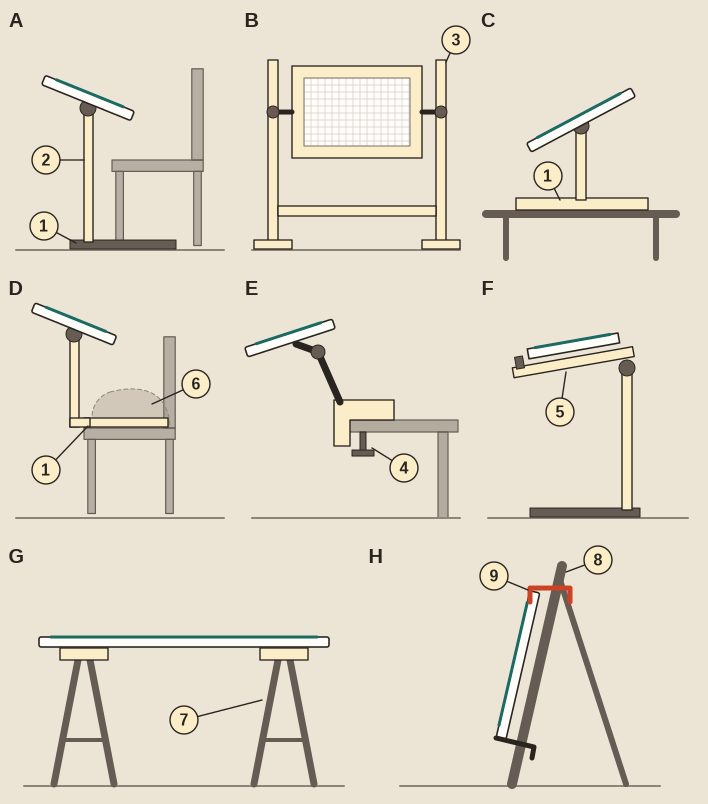
| Floor, one post (A) | An armchair or sofa; most pieces | Small to medium bars, held on one side | A gap under the seat, or a chair leg on the base | Folding ones | A wide frame turns or droops |
| Floor, two posts (B) | Large or heavy frames | Up to the width between the posts, often 24 to 27 in (61 to 69 cm) | The width of the posts, in front of your knees | Seldom | Getting in and out of your chair |
| Two arms (F) | Any kind of frame, quickly lifted and turned over | About 16 in (41 cm) wide and up | A long base under the seat | No, it is heavy | Low chairs with a solid base |
| Table stand (C) | Stitching at a table | Small to medium | A table top | Yes | It tips with a large frame |
| Lap stand (C, on your knees) | Sofa, bed, car seat | The scroll frame it comes with, about 18 to 24 in (46 to 61 cm) wide, or bars | None | Yes | It moves when you do |
| Sit-on (D) | Any chair with a firm seat | Small to medium | None | Yes | You lift off it each time you get up |
| Table clamp (E) | A desk, a shelf, a chair arm | Small | An edge about 3/8 to 2 in (1 to 5 cm) thick | Yes | Thin or rounded edges |
| Trestles (G) | Very long scroll frames | As long as you like | A room | No | A pair must be the same height |
Floor stands commonly set from about 16 inches (41 cm) to between 37 and 40 inches (95 and 100 cm) high.
An easel (H) made for painting props a frame upright and does not grip it. The needle coming from behind pushes the frame off. If you use one, clamp the top bar of the frame (9) to the mast, the upright post at the back (8). Otherwise keep it for displaying the piece.
Trestles are supports with legs, like those under a plank table. One stands under each end of the frame, which lies across the two and is steady by its own weight.
How the head holds the frame
- Side clamp. Two jaws close on one bar of the frame. It suits stretcher bars. The jaws must open wider than the bar is thick, and bite on wood and bare margin, never on stitches.
- Head for a scroll frame. The two rods of the scroll frame fit into side pieces on the stand itself. Rods of another make may not fit.
- Two clamps, one at each end. They hold most frames whose width lies between the stand's smallest and largest setting.
- Two arms with pegs. The frame simply lies there. Lift it and turn it over to end a thread.
- A pivot. Whatever the head, it should tilt, and it is far better if it also turns right over, so that you can reach the back.
Measure first
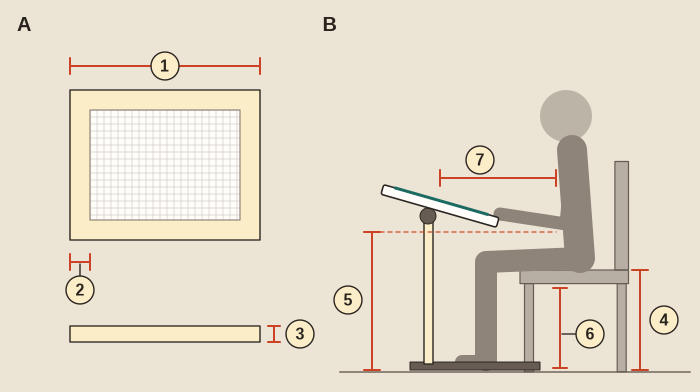
- Frame width (1). Outside to outside. Take your largest frame, not your smallest.
- Bar (2 and 3). Its width and thickness. The clamp has to open more than the thickness, about 3/4 to 1 inch (2 to 2.5 cm) for needlework bars. Thicker bars that tighten with screws need more.
- Seat height (4). From the floor to the top of the seat with you on it. You need it in the next step.
- Elbow height (5). Sit straight, arms bent, and measure from the floor up to your elbow. The middle of the frame should be able to come to about this height, so a floor stand must reach it. For a sit-on stand, take the seat height (4) away from the elbow height: that is how far above the seat it must lift the frame.
- Gap under the seat (6). A base slides in here. A sofa with a solid front has none: look for a base that goes beside it, or under a leg.
- Reach (7). Hold a hand out as if to stitch. The stand has to bring the middle of the frame there.
- The way in. Leave room to swing or slide the stand away and stand up.
If you can, take your frame to the stand before you buy, or sit at one that belongs to somebody else.
Choosing a floor stand
A good floor stand does four things. It does not move when you push the canvas, it holds your largest frame, it brings the work to your hands, and it lets you reach the back. Choose in this order:
- The chair. Sit in it and look under the seat. A gap takes a flat base. A solid front needs a base that goes under one leg of the chair, or two posts in front of you.
- The frame. Take your largest and measure its width and the thickness of a bar, as in "Measure first", above.
- The head. It must suit what you use: jaws for stretcher bars, a holder for the rods of a scroll frame, or a clamp at each end for both. On some stands the head is bought by itself, so you can have two.
- The moves. Height, lean, tilt of the frame, and a full turn to the back. Try each with a frame in the head.
- The push. Press the middle of the frame with two fingers. Then press one corner. The frame may spring, but it should not turn, sink or rock.
- The way out. See that you can swing the frame aside and stand up.
| Part | Look for | Leave it if |
|---|---|---|
| Base | Broad, flat and heavy, or thin enough to go under a chair leg | It rocks, or stops you pulling the chair in |
| Post | A lock that holds at any height, from about 16 in to 37 in (41 to 95 cm) | It sinks a little each time you press |
| Arm | Long enough to bring the middle of the frame in front of you, from the side | You have to lean to reach the canvas |
| Clamp | Opens wider than your thickest bar, with cloth or leather in its jaws | Its jaws reach past the bare margin onto the stitching |
| Width, on two posts | More than your widest frame | Your frame lies in the last inch (2.5 cm) of it |
| Tilt | Stops at any slope and stays | It has only a few notches and none suits you |
| Turn | The frame goes right over | You must unclamp it to end each thread |
| Joints | Knobs large enough to grip, that can be replaced | Small screws that need a tool every day |
| Finish | Smooth wood or metal where thread passes | Splinters, sharp edges, loose plating |
Travel stands that fold
| Kind | Folds to | Takes |
|---|---|---|
| Sit-on stand | A post and a flat board | Small frames, up to about 12 in (30 cm) |
| Table clamp | A short arm and a clamp | Small frames, on most tables: the edge has to be 3/8 to 2 in (1 to 5 cm) thick |
| Lap stand with side pieces that come off | A flat bundle | Its own scroll frame, or one of the same make |
| Folding floor stand | A bundle of tubes or bars | Small to medium. It is lighter than a stand that stays at home, so put its base under a chair leg |
Before you pack one, take off the scissors, the tacks and the needle. On a plane has what may go in a cabin.
A frame that stands by itself, or an arm that holds the canvas
A freestanding frame is a frame and stand in one: rods held between two posts, or a scroll frame on its own lap stand. It needs no clamp, but you cannot change to bars, and the rods set the widest canvas. An old one that wobbles can be steadied by tightening every joint and weighting the foot.
An arm carries the frame out from a post or a table edge. It holds wood and not canvas: put the canvas on bars or rods first. The longer the arm, the more it bounces, so keep it as short as your reach allows, and clamp it to something that cannot slide.
Set it up
- Seat. Sit back with a fairly straight back and both feet on the floor or a low stool.
- Foot. Put the foot of the stand where the table under these steps says. Rock it: it should not move.
- Frame. Fix the frame in the head, or lay it there, as the table says. Where jaws grip one side, let it be the side away from the hand that works on top. Put a scrap of felt between the jaws and the canvas if the wood is smooth.
- Height. Raise or lower it until your hands reach the canvas without lifting your shoulders.
- Tilt. Slope the far edge up until you look straight at the canvas. The near edge should clear your knees.
- Distance. Reach below to the middle of the canvas. If you stretch, bring the stand in or turn the frame end for end for the far half.
- Light. Let it fall from the side of the hand that is not stitching on top: lights and magnifiers.
- Press. Push the middle of the canvas with two fingers, as a needle would. Tighten whatever gives.
| Your stand | Step 2: the foot | Step 3: the frame |
|---|---|---|
| One post (A) | Slide the base under the seat, or set one leg of the chair on it. From the side of a sofa it goes under the sofa's front edge | Jaws on the middle of one side, with as much frame above them as below |
| Two posts (B) | One foot on each side of your knees, the frame between the posts in front of you | One clamp on the middle of each side. Set the posts as far apart as the frame, then tighten both |
| Table stand (C) | Flat on the table, near its edge, so that your hand can come up under the frame | Jaws on one side, or the rods of the scroll frame in the stand's own sides |
| Lap stand (C) | Across both thighs, or on the seat with a side on each side of you | The scroll frame that belongs to it, its knobs tightened |
| Sit-on (D) | Flat on the seat under one thigh, the post in front. Your weight holds it, so sit down before you put the frame in | Jaws on the middle of one side |
| Table clamp (E) | Over the edge of a table, shelf or chair arm. Turn the screw until it cannot shift | Jaws on the middle of one side |
| Two arms (F) | The long base under your seat, the arms toward you | Nothing to tighten. Lay the frame on the arms with its near edge against the pegs |
| Trestles (G) | One under each end of the frame, the same height | Nothing to tighten. The frame lies across both |
Trestles, and some table stands and table clamps, do not go up or down or tilt. With those, skip steps 4 and 5, and raise or lower your chair.
Stitch with both hands
- Place your hands. Your stronger hand goes below the canvas, the other above. It feels odd for the first rows. If it stays odd, change them over.
- Send the needle up. The hand below finds the hole and pushes straight up.
- Pull through. The hand above takes the needle and draws the thread up, until the stitch lies flat.
- Send it down. The hand above drops the needle straight into the next hole.
- Draw down. The hand below takes it and pulls.
Every stitch is two moves, up and down, which keeps the canvas square. Scooping in and out in one move is for work held in the hand.
Without a stand
A table and a weight. Lay the frame on a table with the part you are stitching over the edge, and set something heavy on a far corner, the part that lies on the table, on the wood or the bare margin and never on stitches. A frame weight is a heavy bag made for this, filled with something such as coins or small metal balls: how to make a frame has the steps for one, and for a table stand.
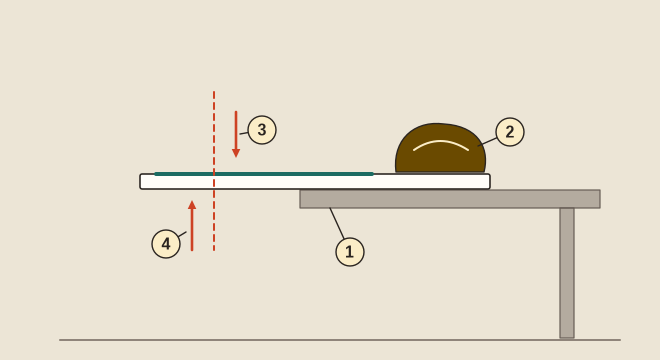
Keep more than half of the frame on the table if the weight is light. Two frame edges on two stools, with your knees between, will hold a long frame in the same way. A frame can also be leaned against a table with its lower edge in your lap: one hand above, one behind.
Keep it from slipping and tipping
| What happens | Why | What to do |
|---|---|---|
| The frame droops | The clamp holds one edge of a wide frame | Clamp the long side, or turn the piece so that the part you stitch is near the jaws |
| It creeps round | Jaws smooth, or bars too thin for them | Felt or leather in the jaws; a thin strip of wood to fill them |
| A wooden joint will not stay | Wood swells, shrinks and wears | Tighten again in each new season; a washer under the knob |
| The whole stand rocks | A light base | Put it under the chair leg, or lay a frame weight or a heavy book on it |
| A table stand tips toward you | More frame in front of the post than behind | Move the frame back on the head, and weight the back of the base |
| It hits your knees | Too much slope, so the near edge hangs low, or the post too short | Raise it, and let the far edge down a little |
| You bend over it | Frame too low or too far | Raise it or bring it in, until you look at the canvas and not down at it |
| The clamp marked the stitches | It gripped the worked part | Keep the jaws on bare margin: leave 2 inches (5 cm) all round |
The chart on the stand
Set the chart beside the canvas and not below it, so that your eyes move sideways and your head stays up. A strong needle magnet pins a folded chart to the frame. Some stands take an arm for a chart board. A chart of several pages is easier with the one page you are on.
Rack, easel and lighted frame: what each word means
| If you are looking for | It is called | Go to |
|---|---|---|
| A rack to hold the canvas while you stitch | A frame, on a stand | "The kinds", above, and frames and stretcher bars |
| A rack to keep frames or threads on | Pegs, rails or shelves | How to store needlepoint and how to organize threads |
| A rack to show finished pieces | A display easel, a rail or a stand | How to display needlepoint |
| An easel to stitch at | A floor stand. A painter's easel only props | The steps below |
| A lighted frame | A frame with a lamp clipped on it | The steps below |
To keep frames between sittings, hang each by its top bar on two pegs, or stand it on edge with its face to the wall and a clean cloth over it. Slacken a scroll frame first. Do not stack frames face to face: tacks on one catch the threads of the other.
To stitch at an easel
- Choose one with a ledge and a mast, the upright at the back. A small table easel is too light to push against.
- Leave it at its own slope, which on most easels is about 20 degrees back from upright. That is nearly straight up and down, and it puts the canvas in front of your eyes.
- Stand the frame on the ledge, and fasten its top bar to the mast with a clamp. The ledge alone does not hold it when the needle comes from behind.
- Set the height so that the part you stitch is level with your chest.
- Leave the back open. Your other hand has to get behind the frame. If the mast is in the way, move the frame to one side.
To put a light on a frame
Some stands take a lamp on the same post. On any other frame, use a small lamp with a clip.
- Measure the bar. Needlework bars are about 3/4 to 1 inch (2 to 2.5 cm) thick, and bars that tighten with screws are thicker. The clip has to open wider than that: some open 1 1/4 to 1 1/2 inches (3 to 4 cm).
- Clip it to the bare bar, never over the design, on the side away from the hand that works on top.
- Aim it across the canvas from that side, so that your hand throws no shadow on the next hole.
- Let go of the frame. If the lamp turns it or tips it, the lamp is too heavy for it. Clip it to the table or the post.
- For dark canvas, set a second small light behind the frame. It shows up the holes.
A lens on the same arm adds weight. Lights and magnifiers says which strength suits which mesh.
Stands of other days
Stands are as old as frames. A museum in London has a Paris embroidery stand of the 1770s, inlaid like a cabinet, that was turned into a writing stand before 1855. A handbook of 1842 describes the same kinds that are sold now: a "knee, or table frame" on a flat board with two uprights and thumbscrews to set the angle, and a "standing frame" on feet, from 20 inches (51 cm) to a yard and a quarter (114 cm), sometimes with a basket at each side. The largest frames lay on trestles.
Questions people ask
Which side should the post be on? On the side away from the hand that works on top, so that its arm does not meet the post. Many heads change sides.
Can I use a stand for work that is not on a frame? No. A stand holds wood. Mount the canvas first: frames and stretcher bars.
Will a stand help if I stitch with one hand? Yes: the clamp does the work of the other. Easier to see and hold has the steps.
Wood or metal? Either. A heavy base steadies it, joints that lock keep it there, and smooth edges do not catch thread.