Easy sunflower quilt block needlepoint pattern
Beginner · 7 colors · 5 × 5 in · 18 mesh · 8,100 stitches
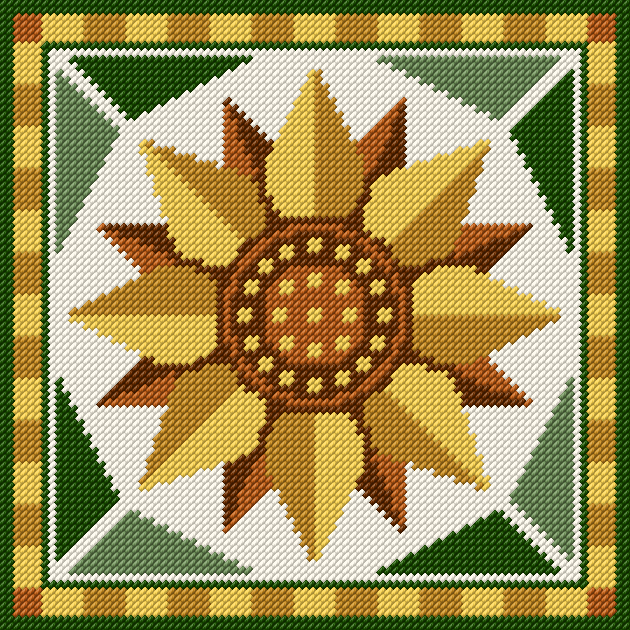
Download free PDFPDF, US Letter · 48 KBFor your own stitching, gifts and handmade pieces you sell. Do not resell or share this PDF or copies of it. Selling, classes and kits: the rules
You will need
On 13 mesh, the easier canvas for a first piece: 6.9 × 6.9 in
- Size: the piece comes out 6.9 × 6.9 in
- Canvas: 13 mesh, cut 10.9 × 10.9 in
- Needle: tapestry, size 20
- Thread: 7 colors of tapestry wool in the nearest shades, 1 strand in the needle, about 12 skeins in all (an estimate)
- Or 7 colors of pearl cotton size 3, 1 strand in the needle, about 8 skeins in all (an estimate)
- Or 7 colors of six-strand floss, 7 or 8 strands in the needle, about 14 skeins in all (an estimate)
- Wool by color, after DMC’s own table of nearest shades: 712 is wool ECRU, 3 skeins; 726 is wool 7078, 2 skeins; 895 is wool 7346, 2 skeins; 783 is wool 7473, 2 skeins; 300 is wool 7479, 1 skein; 3347 is wool 7341, 1 skein; 921 is wool 7922, 1 skein.
Or on 18 mesh, smaller and finer: 5 × 5 in. Its file is the download at the top of this page.
- Canvas: 18 mesh, cut 9 × 9 in
- Needle: tapestry, size 22
- Thread: 7 colors of six-strand floss, 4 to 6 strands in the needle, about 11 skeins in all (an estimate)
- Thread: 7 colors of pearl cotton size 5, 1 strand in the needle, about 7 skeins in all (an estimate)
- Thread: 7 colors of Persian wool, 1 strand in the needle, about 7 skeins in all (an estimate)
Fit it into a lid. The box or tray, acid-free board and backing. Measure the opening first, and add two extra rows all round in DMC 895, the color at its edge to sit under its edge. They are in neither the chart nor the counts of thread. How to fit it into a lid
Another thread. Stitch it in pearl cotton or Persian wool: the skeins follow
A pieced sunflower with eight split petals in yellow and gold turns around a seeded rust and brown center, with rust points between. The ground is cream, with green leaf pieces in the corners, inside a yellow and gold patchwork border.
Size and details
The chart is 90 × 90 stitches: a tray insert on 18 mesh canvas, a square of needlepoint that is set into a tray made with an opening for it.
Worked in tent stitch throughout.
Beginner. Few colors and long stretches of one: a good first piece. Start on 13 mesh, which is easier to see: there it comes out 6.9 × 6.9 in.
How the level is set
Beginner: 7 colors. Changes of color are about 5 stitches apart, leaving out the border. With up to 7 colors, 3.5 or more apart is Beginner and closer is Intermediate.
| Mesh | Stitched size | Canvas to cut |
|---|---|---|
| 10 | 9 × 9 in 22.9 × 22.9 cm | 13 × 13 in 33 × 33 cm |
| 12 | 7.5 × 7.5 in 19.1 × 19.1 cm | 11.5 × 11.5 in 29.2 × 29.2 cm |
| 13 | 6.9 × 6.9 in 17.6 × 17.6 cm | 10.9 × 10.9 in 27.7 × 27.7 cm |
| 14 | 6.4 × 6.4 in 16.3 × 16.3 cm | 10.4 × 10.4 in 26.5 × 26.5 cm |
| 18 | 5 × 5 in 12.7 × 12.7 cm | 9 × 9 in 22.9 × 22.9 cm |
Mesh is the number of canvas threads to the inch; the row in bold is the mesh this chart is sized for. Canvas to cut includes a margin of 2 in (5.1 cm) of bare canvas on every side. Leave at least that much.
On plastic canvas: 6.4 × 6.4 in on 14 mesh, 9 × 9 in on 10 and 12.9 × 12.9 in on 7, from one sheet. Take worsted yarn and a size 16 needle on 7 mesh; sport yarn or 12 strands of floss and a size 18 needle on 10; 6 strands of floss and a size 22 needle on 14. Yarn is matched to the list by eye. How to stitch a chart on plastic canvas
Paper for the PDF
Threads and canvas
Six-strand floss: 4 to 6 strands in the needle on 18 mesh, counted at 6, and a skein is 8.7 yd. The numbers in the list are its DMC numbers.
- DMC 712 Cream 2,036 stitches about 14 yards 2 skeins
- DMC 726 Light Topaz 1,600 stitches about 11 yards 2 skeins
- DMC 895 Very Dark Hunter Green 1,516 stitches about 11 yards 2 skeins
- DMC 783 Medium Topaz 1,344 stitches about 10 yards 2 skeins
- DMC 300 Very Dark Mahogany 604 stitches about 5 yards 1 skein
- DMC 3347 Medium Yellow Green 504 stitches about 4 yards 1 skein
- DMC 921 Copper 496 stitches about 4 yards 1 skein
8,100 stitches in the chart, about 59 yards in all. The yards are estimates for 18 mesh. The skeins are estimates too, about 11 in all.
Thread colors are approximate screen matches to DMC numbers. Check against real thread before you buy.
The numbers are DMC color numbers, which its six-strand cotton and its pearl cotton share. Wool and silk are numbered differently: match those by eye. For how many strands and which needle, see which thread suits which mesh.
You also need blank needlepoint canvas (mono canvas) in the mesh you choose (see mesh sizes), cut to the size in the table above, and a tapestry needle.
About the yards and skeins
The yards are of thread as it is threaded in the needle: stitched with several strands together, a thread takes that many yards of single strand for every yard listed. For six-strand cotton on 18 mesh, the thread and needle chart gives 4 to 6 strands.
An estimate. The length of thread one stitch uses on the front and back of the canvas, times the number of stitches, plus 30 percent for starting, ending and the tail left in the needle. Each count is estimated as basketweave or continental and rounded up to a whole yard, so the yards in all are a little more than the thread calculator gives for every stitch at once. The 30 percent is this site's own choice. The thread calculator works the same estimate for any count and mesh.
Getting it onto your canvas
This is a counted chart: one square of the chart is one stitch. Find the center of your canvas and the center of the chart (the red arrows above and to the left of the chart), and count out from there, a color at a time.
Nothing is printed on the canvas, so no transfer is needed. How to needlepoint covers the first stitches.
See the chart on this page
The chart is drawn when this is opened.
It opens in the pattern maker, with your colors and your name on it.
Downloads
- Chart for US Letter paper PDF · 3 pages
- Chart for A4 paper PDF · 3 pages
The same chart in squares of about 6 mm, on more pages.
Each file has the thread key, with an estimate of the yards and skeins of each color, and the sizes on its first page, then the chart with a symbol in every square and a heavier line every ten. A chart too large for one page is divided over several, with two rows or columns repeated in gray where the pages join; a page may be turned on its side for a part that is wider than it is tall.
More patterns like this
Advanced 8,100 stitches 5 × 5 in · 11 colors
Folk art sunflower
Advanced 8,100 stitches 5 × 5 in · 16 colors
Preppy sunflower
Intermediate 5,184 stitches 4 × 4 in · 8 colors
Sunflower coasters, four make a bloom
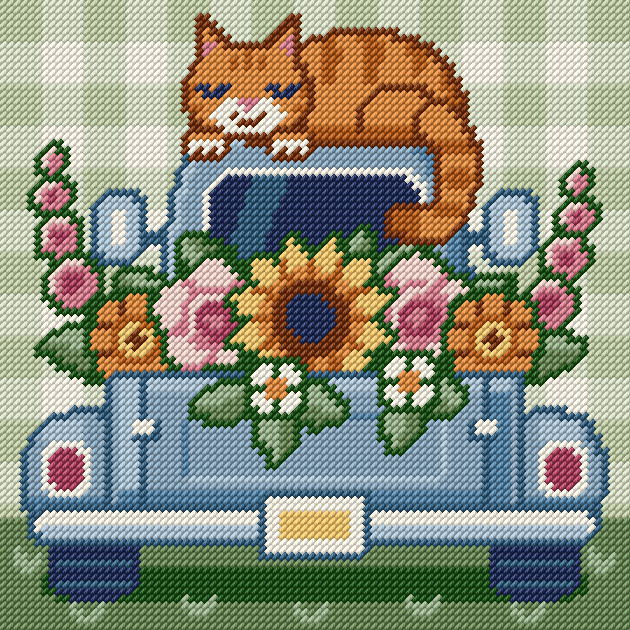
Advanced 8,100 stitches 5 × 5 in · 18 colors
Whimsical blue pickup with flowers
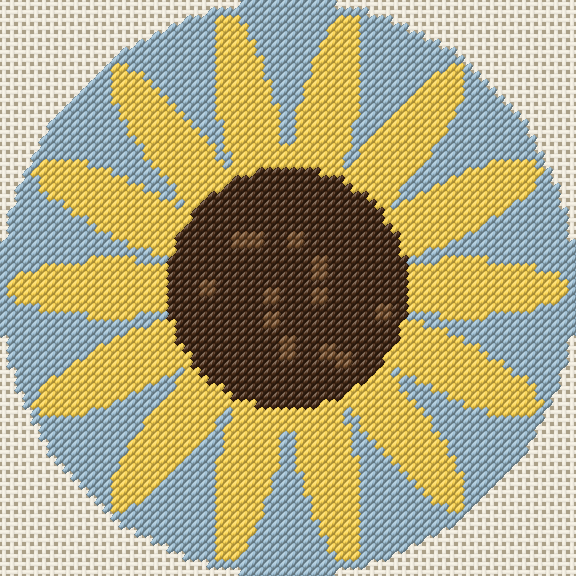
Beginner 4 × 4 in · 4 colors
Sunflower ornament
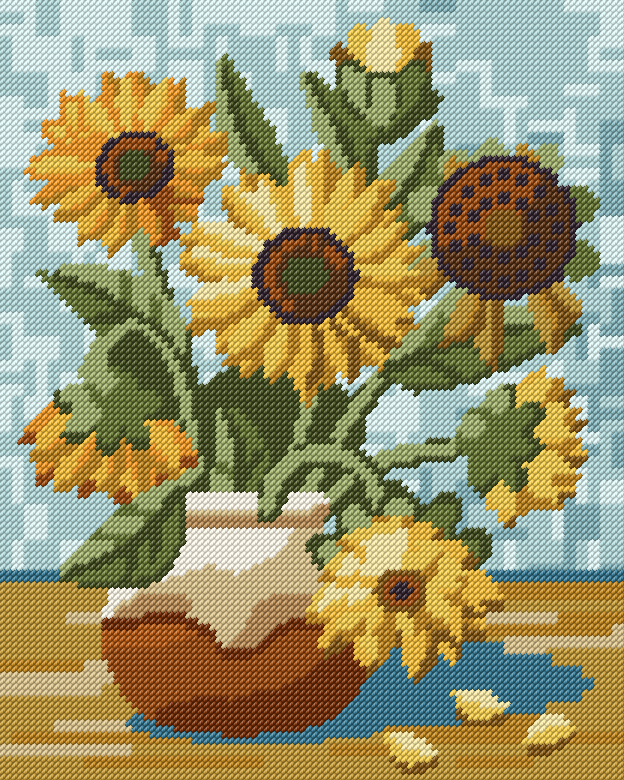
Advanced 13,520 stitches 8 × 10 in · 22 colors
Sunflowers in a jar after Van Gogh
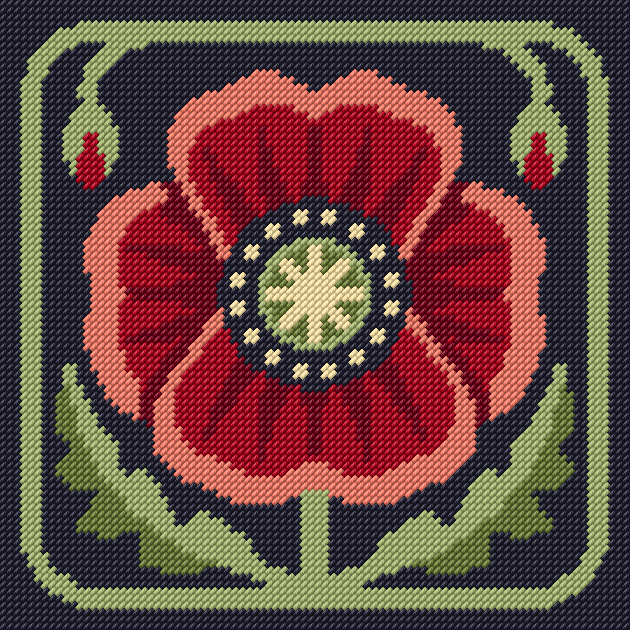
Beginner 8,100 stitches 5 × 5 in · 7 colors
Easy red poppy flower
Beginner 8,100 stitches 5 × 5 in · 7 colors
Blue and white Thumbelina
New to needlepoint? How to needlepoint