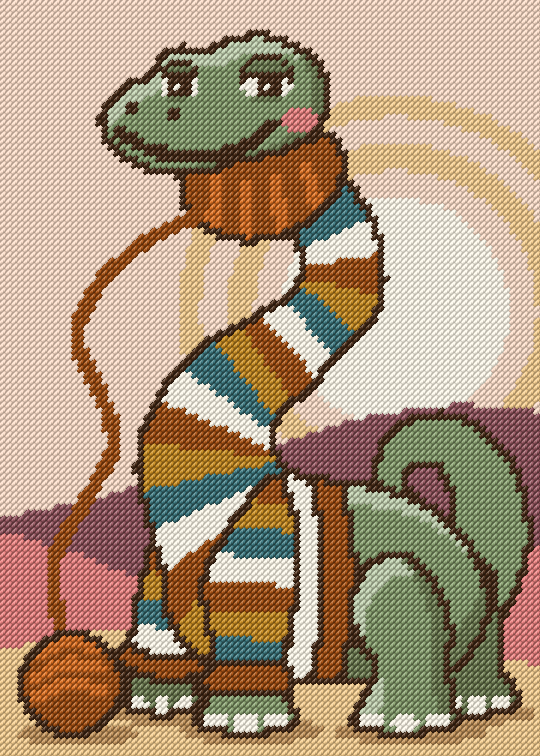
Dinosaur in a turtleneck sweater needlepoint pattern
Intermediate · 14 colors · 5 × 7 in · 18 mesh · 11,340 stitches
Download free PDFPDF, US Letter · 69 KBFor your own stitching, gifts and handmade pieces you sell. Do not resell or share this PDF or copies of it. Selling, classes and kits: the rules
You will need
- Canvas: 18 mesh, cut 9 × 11 in
- Needle: tapestry, size 22
- Thread: 14 colors of six-strand floss, 4 to 6 strands in the needle, about 17 skeins in all (an estimate)
- Thread: 14 colors of pearl cotton size 5, 1 strand in the needle, about 14 skeins in all (an estimate)
- Thread: 14 colors of Persian wool, 1 strand in the needle, about 14 skeins in all (an estimate)
On 13 mesh, easier to see: 6.9 × 9.7 in
- Size: the piece comes out 6.9 × 9.7 in
- Canvas: 13 mesh, cut 10.9 × 13.7 in
- Needle: tapestry, size 20
- Thread: 14 colors of tapestry wool in the nearest shades, 1 strand in the needle, about 22 skeins in all (an estimate)
- Or 14 colors of pearl cotton size 3, 1 strand in the needle, about 15 skeins in all (an estimate)
- Or 14 colors of six-strand floss, 7 or 8 strands in the needle, about 24 skeins in all (an estimate)
- Wool by color, after DMC’s own table of nearest shades: 951 is wool 7171, 4 skeins; 712 is wool ECRU, 2 skeins; 898 is wool 7938, 2 skeins; 920 is wool 7360, 2 skeins; 989 is wool 7041, 2 skeins; 3855 is wool 7055, 2 skeins; 3726 is wool 7226, 1 skein; 3809 is wool 7595, 1 skein; 3712 is wool 7759, 1 skein; 783 is wool 7473, 1 skein; 3363 is wool 7427, 1 skein; 164 is wool 7041, 1 skein; 436 is wool 7455, 1 skein; 922 is wool 7919, 1 skein.
Frame it. Acid-free board and a frame. How to frame needlepoint
Another thread. Stitch it in pearl cotton or Persian wool: the skeins follow
A long-necked green dinosaur smiles in a striped turtleneck of mustard, rust, cream and teal, a loose strand of yarn falling from its collar to a ball. The ground is a pale peach sky with a cream sun over plum, coral and sand hills.
Size and details
The chart is 90 × 126 stitches: a picture on 18 mesh canvas.
Worked in tent stitch throughout.
Intermediate. The color changes often enough that you count as you go.
How the level is set
Intermediate: 14 colors. Over the whole chart, changes of color are about 6 stitches apart. With 10 colors or more, 4.5 or more apart is Intermediate, closer is Advanced, and a design with this many colors is never Beginner.
| Mesh | Stitched size | Canvas to cut |
|---|---|---|
| 10 | 9 × 12.6 in 22.9 × 32 cm | 13 × 16.6 in 33 × 42.2 cm |
| 12 | 7.5 × 10.5 in 19.1 × 26.7 cm | 11.5 × 14.5 in 29.2 × 36.8 cm |
| 13 | 6.9 × 9.7 in 17.6 × 24.6 cm | 10.9 × 13.7 in 27.7 × 34.8 cm |
| 14 | 6.4 × 9 in 16.3 × 22.9 cm | 10.4 × 13 in 26.5 × 33 cm |
| 18 | 5 × 7 in 12.7 × 17.8 cm | 9 × 11 in 22.9 × 27.9 cm |
Mesh is the number of canvas threads to the inch; the row in bold is the mesh this chart is sized for. Canvas to cut includes a margin of 2 in (5.1 cm) of bare canvas on every side. Leave at least that much.
Paper for the PDF
Threads and canvas
Six-strand floss: 4 to 6 strands in the needle on 18 mesh, counted at 6, and a skein is 8.7 yd. The numbers in the list are its DMC numbers.
- DMC 951 Light Tawny 3,448 stitches about 24 yards 3 skeins
- DMC 712 Cream 1,332 stitches about 10 yards 2 skeins
- DMC 898 Very Dark Coffee Brown 1,200 stitches about 9 yards 1 skein
- DMC 920 Medium Copper 1,072 stitches about 8 yards 1 skein
- DMC 989 Forest Green 1,037 stitches about 8 yards 1 skein
- DMC 3855 Light Autumn Gold 949 stitches about 7 yards 1 skein
- DMC 3726 Dark Antique Mauve 461 stitches about 4 yards 1 skein
- DMC 3809 Very Dark Turquoise 382 stitches about 3 yards 1 skein
- DMC 3712 Medium Salmon 379 stitches about 3 yards 1 skein
- DMC 783 Medium Topaz 346 stitches about 3 yards 1 skein
- DMC 3363 Medium Pine Green 255 stitches about 2 yards 1 skein
- DMC 164 Light Forest Green 168 stitches about 2 yards 1 skein
- DMC 436 Tan 156 stitches about 2 yards 1 skein
- DMC 922 Light Copper 155 stitches about 2 yards 1 skein
11,340 stitches in the chart, about 87 yards in all. The yards are estimates for 18 mesh. The skeins are estimates too, about 17 in all.
Thread colors are approximate screen matches to DMC numbers. Check against real thread before you buy.
The numbers are DMC color numbers, which its six-strand cotton and its pearl cotton share. Wool and silk are numbered differently: match those by eye. For how many strands and which needle, see which thread suits which mesh.
You also need blank needlepoint canvas (mono canvas) in the mesh you choose (see mesh sizes), cut to the size in the table above, and a tapestry needle.
About the yards and skeins
The yards are of thread as it is threaded in the needle: stitched with several strands together, a thread takes that many yards of single strand for every yard listed. For six-strand cotton on 18 mesh, the thread and needle chart gives 4 to 6 strands.
An estimate. The length of thread one stitch uses on the front and back of the canvas, times the number of stitches, plus 30 percent for starting, ending and the tail left in the needle. Each count is estimated as basketweave or continental and rounded up to a whole yard, so the yards in all are a little more than the thread calculator gives for every stitch at once. The 30 percent is this site's own choice. The thread calculator works the same estimate for any count and mesh.
Getting it onto your canvas
This is a counted chart: one square of the chart is one stitch. Find the center of your canvas and the center of the chart (the red arrows above and to the left of the chart), and count out from there, a color at a time.
Nothing is printed on the canvas, so no transfer is needed. How to needlepoint covers the first stitches.
See the chart on this page
The chart is drawn when this is opened.
It opens in the pattern maker, with your colors and your name on it.
Downloads
- Chart for US Letter paper PDF · 3 pages
- Chart for A4 paper PDF · 3 pages
The same chart in squares of about 6 mm, on more pages.
Each file has the thread key, with an estimate of the yards and skeins of each color, and the sizes on its first page, then the chart with a symbol in every square and a heavier line every ten. A chart too large for one page is divided over several, with two rows or columns repeated in gray where the pages join; a page may be turned on its side for a part that is wider than it is tall.
More patterns like this
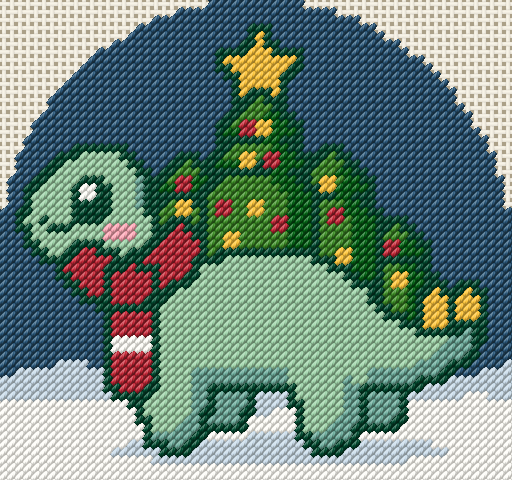
Advanced 3.6 × 3.3 in · 11 colors
Christmas ornament for kids, dinosaur
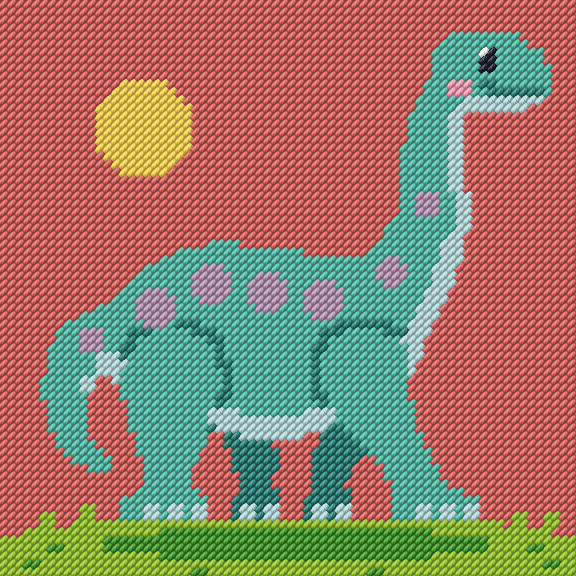
Intermediate 5,184 stitches 4 × 4 in · 11 colors
Whimsical brontosaurus
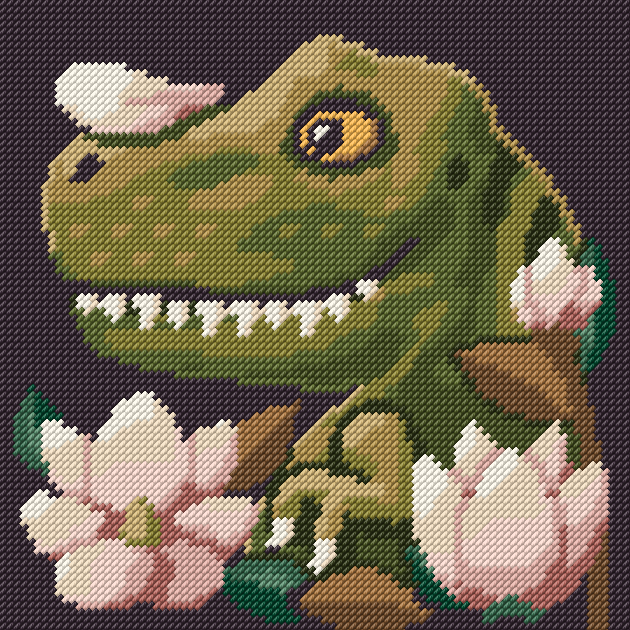
Advanced 8,100 stitches 5 × 5 in · 18 colors
T. rex dinosaur with magnolias
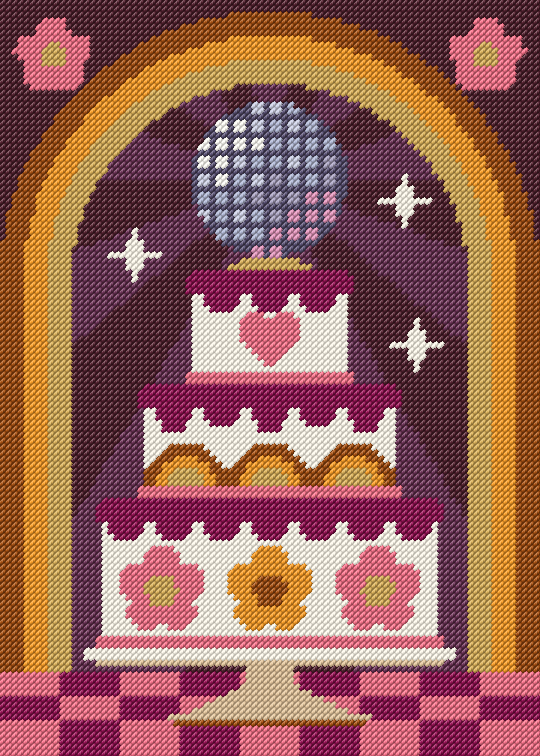
Intermediate 11,340 stitches 5 × 7 in · 15 colors
Retro wedding cake
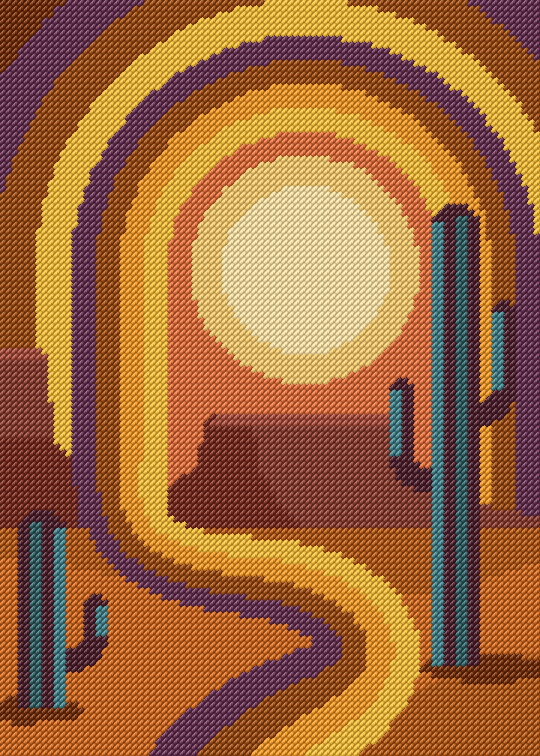
Intermediate 11,340 stitches 5 × 7 in · 16 colors
Retro sun at sunset in Arizona
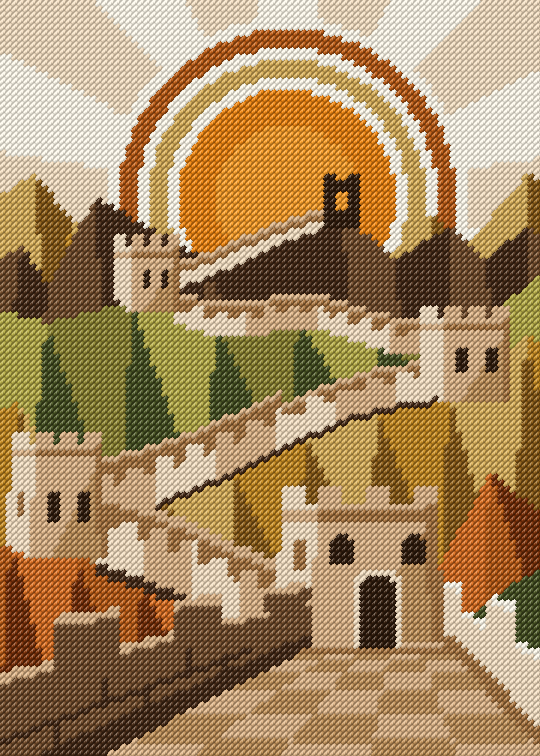
Intermediate 11,340 stitches 5 × 7 in · 19 colors
Retro Great Wall of China
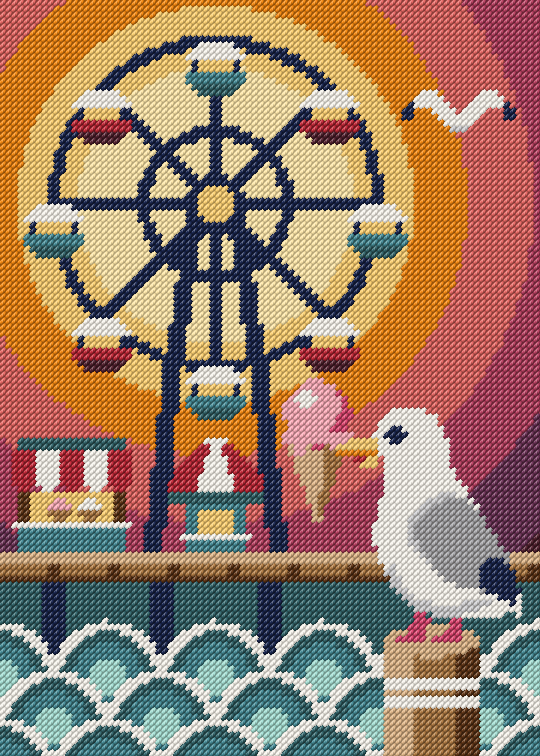
Intermediate 11,340 stitches 5 × 7 in · 20 colors
Retro New Jersey shore boardwalk
Advanced 13,520 stitches 8 × 10 in · 21 colors
Adult coloring book hipster fox
New to needlepoint? How to needlepoint