How to crochet a scarf
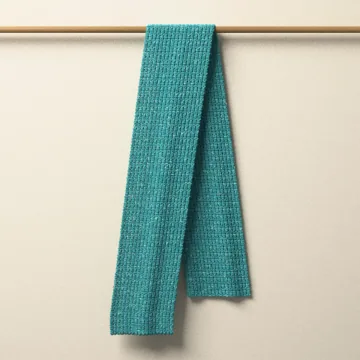
A plain crochet scarf is a long, narrow rectangle in rows of one stitch. Decide how wide and how long it will be, choose which way the rows run, make the chain and keep the same number of stitches in every row. This guide takes those decisions in order.
On this page
Before you start
A first scarf needs a chain and one stitch. If you have not crocheted before, begin with how to crochet, which teaches the chain and single crochet (double crochet in United Kingdom patterns), and come back. If single crochet is the one stitch you know, make the easy first scarf, which has no other, in three sizes. The stitches most first scarves use are a little taller, and step 3 links to their moves.
Read it in one of two ways. To choose your own yarn, size and stitch, take the numbered steps in order. To be told every number, go straight to "A first scarf, written out": there one plain scarf is worked in two widths, with its yarn, chain, stitches, rows and fringe counted for you. For other scarves row by row, see the scarf patterns.
Stitch names on this page are United States terms, with the United Kingdom name in brackets where it differs.
1. Decide the width and the length
A scarf for an adult is usually 60 to 70 in (152 to 178 cm) long and 6 to 8 in (15 to 20 cm) wide. An old rule for the length is to make the scarf about as long as its wearer is tall.
None of this has to be exact. A scarf still fits when its length or its width comes out a little different. The scarf size chart gives sizes for children too.
2. Choose which way the rows run
A scarf can be worked in two directions.
| End to end | Lengthwise | |
|---|---|---|
| The starting chain | Short: as wide as the scarf | Long: as long as the scarf |
| The rows | Many short rows, until the scarf is long enough | A few long rows, until the scarf is wide enough |
| Stripes | Run across the scarf | Run along the scarf |
| The long edges | Made of the ends of the rows | Made of the chain and the last row |
| The length | Decided as you go | Fixed by the chain |
End to end is the plainer start: the chain is short, and you stop when the scarf is long enough. Lengthwise gives stripes that run the length of the scarf, but the length is fixed once the chain is made.
3. Pick a stitch, a yarn and a hook
One basic stitch is enough. Double crochet (UK treble crochet) and half double crochet (UK half treble crochet) are both used in scarves written for beginners. If you know only single crochet, choose half double crochet: it has one yarn over more.
Both sides of a scarf show when it is worn. A piece in rows of one basic stitch looks nearly the same on both sides, and so does moss stitch. Which crochet stitch to use has more on stitches for scarves.
A thick yarn with a large hook covers the same size in fewer stitches. Start with the hook named on the yarn's label. The hook size by yarn weight chart gives the usual range of hooks.
How much yarn to buy depends on the size, the stitch and the yarn. As an estimate in medium yarn, buy 450 yd (411 m) for the plain scarf below and 600 yd (549 m) for the wide one. For another yarn or size, get one ball, make the swatch of step 4 and weigh it: the yarn calculator turns it into an estimate. Then buy all the yarn at once from one dye lot, the number on the label, so that the color matches.
4. Make the starting chain
First find out how many stitches you need. Make a swatch, a small square made only to be measured, about 6 in (15 cm) each way. In medium yarn that is about 20 stitches: chain 21 for single crochet and 22 for the two taller stitches. (The table below says where the first one goes.) Work rows until it is square.
- Count the stitches in 4 in (10 cm) across the middle.
- Divide by 4. That is your stitches to the inch.
- Multiply by the inches the row has to be: the width of the scarf if you work end to end, the length if you work lengthwise.
For example, 13 stitches in 4 in are 3¼ to the inch, and 6 in × 3¼ = 19½, so 20 stitches. In centimeters divide the count by 10 and multiply by the centimeters: 13 ÷ 10 × 15 = 19½.
Then add the chains for your stitch. They stand up at the edge and bring the yarn to the height of row 1, and you add them whichever way the rows run.
| Stitch | First stitch goes into | Chains to add |
|---|---|---|
| Single crochet (UK double crochet) | The second chain from the hook | 1 |
| Half double crochet (UK half treble) | The third chain from the hook | 2 |
| Double crochet (UK treble) | The fourth chain from the hook | 2: the three chains you skip are the first stitch |
A pattern may add another number, and then its number is the one to follow. Every later row begins with a turning chain: 1 for single crochet, 2 for half double crochet, 3 for double crochet. Turning chain says which count as a stitch, and the starting chain calculator does the sum from your swatch.
A long chain for a lengthwise scarf can be replaced by foundation stitches, in which the chain and row 1 are made together. They are for later, and a first scarf does not need them: see foundation half double crochet.
Either way, make the chain loosely. If your chains come out tight, make them with a larger hook and change back for the rows.
5. Keep the width even
Every row must have the same number of stitches. Count at the end of every row. A lost or an added stitch then shows in the row where it happened, before the scarf gets narrower or wider. The stitches to watch are the first and the last of each row. See straight edges.
6. Join a new ball
When 4 to 6 in (10 to 15 cm) of the old yarn are left, bring in the new ball, at the end of a row if you can. Work the last stitch until only its last pull is left: that is the pull that leaves a single loop on the hook. Lay the new yarn over the hook, with a tail as long, and make that pull with it. The picture shows it on a single crochet, with two loops waiting on the hook. In half double crochet three are waiting. See joining new yarn.

7. Finish
Fasten off after the last stitch and weave in the ends. A fringe on the two short ends is a matter of choice, and the short ends can also be seamed to make an infinity scarf. Finishing a scarf shows the ends and the fringe, and joining an infinity scarf shows the seam.
A first scarf, written out
This scarf is worked end to end in half double crochet (UK half treble), in medium yarn (weight 4) with a 5.5 mm (I-9) hook, or the hook that gives you the gauge, which is the number of stitches and rows in a measure: 13 half double crochet and 11 rows in 4 in (10 cm). Choose a width and keep to its line. Half double crochet shows the stitch move by move: yarn over, put the hook in, draw up a loop, then yarn over once more and draw it through all three loops.
You need: the yarn and the hook above, a yarn needle for the ends, scissors and a tape measure.
| Plain scarf | Wide scarf | |
|---|---|---|
| Size | about 6 by 64 inches (15 by 163 cm) | about 8 by 64 inches (20 by 163 cm) |
| Starting chain | 22 | 28 |
| Stitches in every row | 20 | 26 |
| Rows | about 176 | about 176 |
| Yarn to buy, an estimate | about 450 yd (411 m) | about 600 yd (549 m) |
The lines below are for the plain scarf. For the wide one, chain 28 and count 26. In the lines ch is chain, st is stitch, hdc is half double crochet and RS is the right side.
Make the chain
Make a slip knot and 22 chains, loosely. Do not count the slip knot or the loop on the hook.
Work row 1
Yarn over and work the first half double crochet into the third chain from the hook. Work one into each chain to the end. The two chains you skipped are not a stitch.

Foundation: Ch 22.
Row 1 (RS): Hdc in 3rd ch from hook and in each ch across (20 hdc).
Begin row 2
Chain 2 and turn. The chain is not a stitch: work the first half double crochet into the very first stitch, the one the chain stands beside.

End row 2
Work one half double crochet in each stitch, the last one in the last stitch of the row below. Leave the two chains beside it alone. Count 20.

Repeat row 2
Every row from here is row 2 again.
Rows 2 to 176: Ch 2, turn; hdc in each st across (20 hdc).
Measure after row 8
Lay the piece flat and measure across the middle of the rows: about 6 in (15 cm), or 8 in (20 cm) for the wide scarf. If you do not like the width, begin again with more chains or fewer. Every three stitches are a little under 1 in (2.5 cm).
Change the ball
Near the end of a ball, finish the row with it if you can. In the last stitch stop with three loops on the hook, lay the new yarn over the hook and draw it through all three. Leave both tails 4 to 6 in (10 to 15 cm) long, and go on. Step 6 has a picture.
Work the last row
Stop when the scarf is as long as you want. At the gauge that is after about 176 rows for 64 in (163 cm); 11 more rows add 4 in (10 cm). Any row can be the last. Fasten off and weave in the ends.
Add a fringe, if you want one
Put a knot in every second stitch of each short end, with three strands in a knot, each strand cut 12 in (30 cm) long.
| Plain scarf | Wide scarf | |
|---|---|---|
| Knots at each end | 10 | 13 |
| Strands at each end | 30 | 39 |
| Strands in all | 60 | 78 |
| Extra yarn | about 20 yd (18 m) | about 26 yd (24 m) |
Cut the fringe before you use up the last ball. Fringe and tassels shows the knot.
The yarn for the scarf is an estimate: the yarn in one stitch at this gauge times the number of stitches, with the chains, and then 30 percent more. It may still come out short or long. Divide by the yards on your label and round up to whole balls, all from one dye lot.
The same scarf another way
- Lengthwise. Chain 210, loosely. Row 1 has 208 half double crochet and the scarf is 64 in (163 cm) long. Work 17 rows for a width of about 6 in (15 cm).
- In a bulky yarn (weight 5). Work a small swatch with the hook on the label and count. If 9 half double crochet measure 4 in (10 cm), 14 stitches are about 6 in (15 cm): chain 16. The rows are taller, so there are fewer of them. Stop by the length.
- As a loop. Work it 48 to 60 in (122 to 152 cm) long, and seam the two short ends: see joining an infinity scarf.
- With two strands. Hold two strands together as if they were one: yarn over with both and draw both through. Two strands of medium yarn are about as thick as a bulky or a super bulky yarn, so begin with a hook of 6.5 to 8 mm (K-10½ to L-11), make a swatch and count as in the line above. At 9 stitches to 4 in (10 cm) that is again a chain of 16. Look at each stitch to see that the hook caught both: crocheting with two strands has more.
- In treble crochet (UK double treble), at 13 stitches to 4 in (10 cm) as here. Chain 23. Work the first treble in the fifth chain from the hook: the four chains you skipped are the first stitch, so the row has 20. Begin every later row with chain 4, which is its first stitch. Skip the stitch at its foot, work one treble in each stitch and the last one in the top of the chain 4: 20. The rows are tall, so stop by the length.
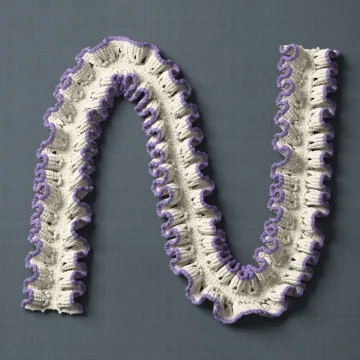
- As a ruffle. Any yarn will do. Work it lengthwise: chain 210 and work row 1 as above, 208 stitches. In row 2 put two stitches in each stitch, 416, and in row 3 two in each again, 832. That is about 1 in (2.5 cm) deep, and every plain row of 832 after it adds a little over ⅓ in (1 cm). The edge has more stitches than it has room for, and the scarf curls round itself. Ruffles explains it, and the ruffle scarf is a pattern. To crochet with a ribbon in place of yarn, see ribbon.
- Chain 5 and a slip stitch. Along a finished short end of 20 stitches this makes a fringe of loops: join the yarn in the first stitch, then chain 5 and slip stitch in the next stitch, 19 times, for 19 loops. All over, arches of 5 chains make a net, with a single crochet to hold each one: trellis stitch.
- Tiny, for a stuffed animal. Make it as long as the toy is tall, and about an eighth as wide. For a toy of 10 in (25 cm) that is 1¼ in (3 cm): chain 6 for 4 stitches, and work 28 rows.
- In stripes. Change the yarn at the end of a row, on the last pull of the last stitch: see changing colors.
When it goes wrong
| What you see | What to do |
|---|---|
| It gets wider | A stitch was added, most often in the chain 2 at an edge. Pull back to the last row with the right count |
| It gets narrower | The first or the last stitch was missed. Pull back to the last row with the right count |
| The start is narrower than the rest | The chain was tighter than the rows. Make it with a larger hook |
| It leans to one side | Look at both ends of the rows: see straight edges |