Half double crochet
To half double crochet, take the yarn over the hook, push the hook into the next stitch and pull up a loop, then yarn over and pull through all three loops on the hook. The stitch stands between single crochet (UK double crochet) and double crochet (UK treble) in height, and United Kingdom patterns call it half treble.
- Abbreviation
- hdc
- In UK terms
- half treble (htr)
- Chart symbol
 an upright line with a bar across the top
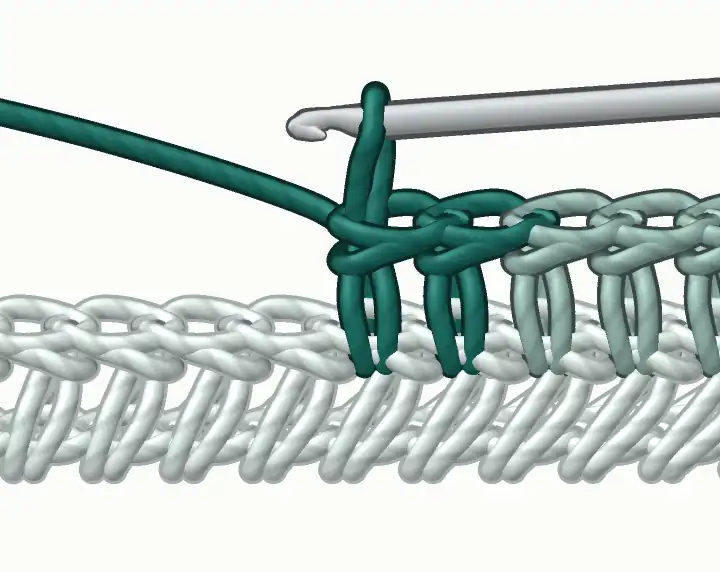
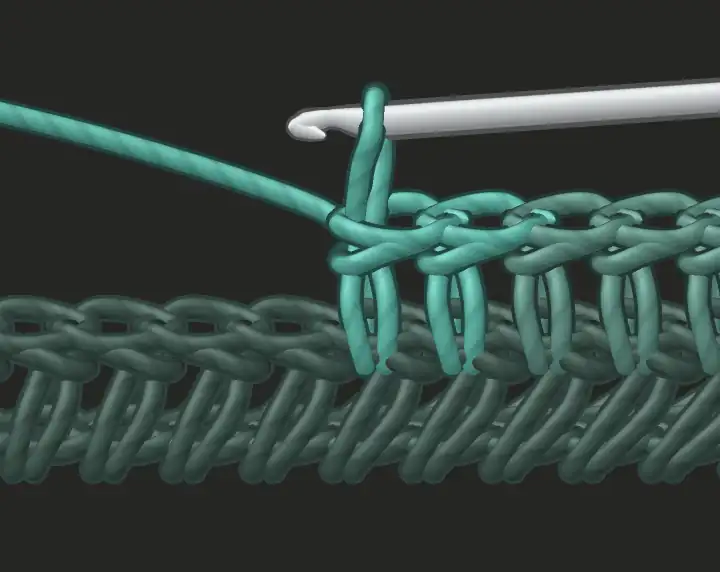
- Yarn over first, before the hook goes in.
- Hook under both top strands of the next stitch, front to back.
- Yarn over.
- Pull it back through the stitch. Three loops.
- Yarn over again.
- Pull through all three. One half double crochet; one loop remains.
- The next stitch is the same.
How to work it
Never held a hook? How to crochet. Red is what is new. Left-handed? Press Left-handed, and every picture turns.
Yarn over

These four steps are the stitch, shown part way along a row. (With nothing but a chain on the hook, see steps 5 and 6 as well.) Take the yarn that leads to the ball over the hook from back to front: up behind the hook and over its top toward you. The yarn over stays on the hook beside the loop you started with, and counts as a loop: there are two loops on the hook.
Hook in

Keep both on the hook. Find the next stitch of the row below, the first one you have not yet worked into. Its top is two strands that lie side by side like a V. Push the hook under both strands, from the side that faces you through to the back. There are still two loops on the hook.
Pull up a loop

The head of the hook is now at the back of the work. There, take the yarn over the hook again, the same way, and draw it back through the stitch, to the side that faces you. There are three loops on the hook.
Close it

Take the yarn over the hook once more, the same way, and draw it through all three loops at once. One loop is left on the hook and the stitch is made.
The first row: count back from the hook

A piece begins with a starting chain: a slip knot and a line of chain stitches. For 20 stitches chain 22 where the pattern does not count the skipped chains as a stitch, and 21 where it does. Count back from the hook. The loop on the hook is not a chain; the chain just below it is number 1. Skip 1 and 2. The first half double crochet goes into number 3, red in the picture.
The first row: put the hook into a chain

Yarn over first, as in step 1. Keep the side of the chain that looks like a row of Vs toward you. Put the hook under the upper strand of the V (1 in the picture), or under that strand and the bump behind it (2). Some patterns ask for the bump alone, with the chain turned over (3). Where the pattern does not say, way 1 will do; choose one and keep to it all along. Then finish as in steps 3 and 4, and work one stitch into each chain.
The next row: chain 2, turn, begin

At the end of a row make two chains: yarn over and pull through the loop on the hook, twice. Keep the hook in the loop and turn the work sideways, so that the hook is at the right end of the row. Where the chain 2 is not counted, the first half double crochet goes into stitch 1 of the picture, the one the chains stand on. Where it is counted, the two chains are the first stitch, and the next goes into stitch 2.
The end of that row

Not counted: the last stitch goes into the last half double crochet of the row below, and nothing into the chains beside it. Counted: the edge has one more place, the two chains that began the row below (in row 2, the two you skipped in the starting chain). They stand one link above the other. Put the hook into the upper link, under one or two of its strands as in step 6, and work the last half double crochet there, red in the picture.
Where the third loop is

Needed only when a pattern says third loop. Look at a row from the side that faced you as you made it, and tip its top edge toward you. Behind the two strands of the V lies one strand more, red and ringed in the picture: the third loop, made by the yarn over of step 1. Once you have turned, it is on the side that faces you, just below the V.
Steps 1 to 3 begin a double crochet too. Step 4 is where the two part: half double crochet has one pull, through all three loops.
Count the first row and every row after it. A chain of 22 whose skipped chains are not counted gives 20 stitches. A chain of 21 whose two skipped chains are counted as one stitch gives 20 as well: 19 worked, and the one.
Some patterns work into the third loop in place of the top loops. The V is then pushed over to the other side, where it shows.
When it goes wrong
- My rows are getting wider, or narrower.
- The edges are where it goes wrong. If the chain 2 does not count, working into it adds a stitch, and skipping the first stitch loses one. If the chain 2 counts, working into the stitch at its base adds a stitch, and leaving out the stitch in the top of the turning chain loses one.
- I do not know whether to work into the turning chain.
- Look in the pattern's notes for whether the chain 2 counts as a stitch. In single crochet (UK double crochet) the turning chain never counts as a stitch. In double crochet (UK treble) and treble crochet (UK double treble) it counts unless the pattern says otherwise. In half double crochet (UK half treble) patterns differ, so go by the pattern, and where the pattern is silent choose one way and keep to it.
Left-handed
The pictures show the hook held in the right hand. Press Left-handed, under the moving drawing, and every picture here turns for the left hand. In the words, read left for right.
Patterns that use it
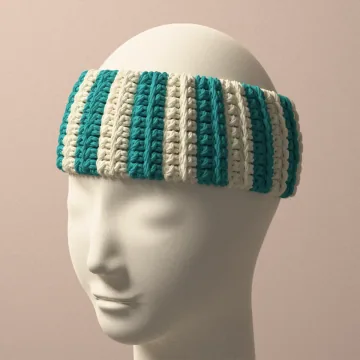
Easy ribbed headband
Beginner Baby to man
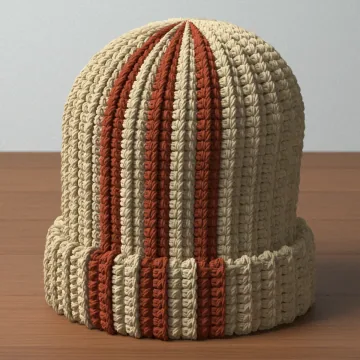
Tall ribbed beanie with a double fold
Beginner Teen to man
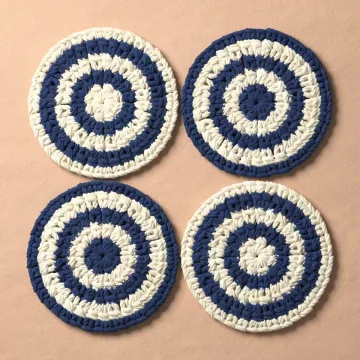
Easy two-color coaster
Beginner 4 in across
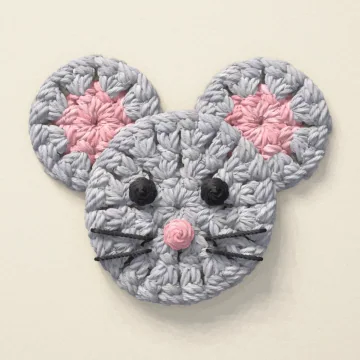
Mouse face applique
Beginner 4 in wide
Classic hair bowEasy chunky poncho
1,271 patterns use this stitch; these are some of the easiest. All crochet patterns
At a glance
- Level
- Beginner
- Kind
- Basic stitches
- Used for
- a solid, fairly close fabric, as for blankets
- Height
- Taller than a single crochet, shorter than a double crochet
- To turn
- Chain 2, as in steps 7 and 8. Patterns differ on whether it counts as a stitch, so go by the pattern.
- On a starting chain
- The first stitch goes in the third chain from the hook. The loop on the hook is not counted.
Tips and variations
Tips
- Count your stitches each time you finish a row.
- In turned rows, every other row shows the back of its stitches, which does not look quite like the front. The pictures here draw every row alike.
Variations
- In the third loop. Half double crochet worked into the third loop of the stitch below, which pushes the two top loops forward so that they show on the face of the fabric. This is often called camel stitch.
- In the back loop. Work every row into the back loop only, the strand of the V that is farther from you. The front loops left free make ridges that lie along the rows, the ribbing of cuffs and brims.
- Slanted half double crochet. The look-alike that leans: herringbone half double crochet. The loop pulled up through the stitch goes straight on through the yarn over, and the last pull takes two loops.
- Extended single crochet. A look-alike of nearly the same height, with no yarn over before the hook goes in, so it has no third loop.
- With chain spaces. Half double crochet, chain 1, skip one, and repeat. On a row of 21 stitches this makes 11 half double crochets with 10 spaces between. On the next row work into the stitches for holes that line up, or into the spaces for holes that stand by turns: then count every row, because the edges need a stitch of their own.
Questions
- Is half double crochet the same as half treble?
- Yes. Half double crochet (hdc) is the United States name, and half treble (htr) is the name in United Kingdom patterns.
- How many loops are on the hook before the last pull?
- Three: the loop that was on the hook, the yarn over made before the hook went in, and the loop pulled up through the stitch. The last pull goes through all three.
- What is the third loop of a half double crochet?
- The strand that the first yarn over leaves in the stitch, just behind the two loops at its top. It is the yarn over made before the hook goes in.
- How do I start a row of half double crochet with no chain?
- With new yarn, by a standing stitch: a slip knot on the hook, yarn over, and work the stitch into the first place. In rounds in the same yarn, join and work the first half double crochet into the same stitch with no chain at all. At the start of a project, a foundation half double crochet makes the chain and the stitch together.
- What does 2 hdc mean, and is it hdc2tog?
- No. 2 hdc in next st is two stitches in one place: the row gains one. hdc2tog is two stitches worked into one: the row loses one. (2 hdc, ch 1, 2 hdc) in a space is a group of four with a chain in its middle.
- Is half triple crochet the same stitch?
- Not always. In UK terms the stitch between a double crochet (US single) and a treble or triple is this one, and some books call it half triple. In US books half triple (htr) is a taller stitch: yarn over twice before the hook goes in. If the pattern begins with yarn over twice, it is the taller one.
- Can I use half double crochet in place of double crochet?
- Yes, where the pattern is not shaped. A half double crochet is about three quarters as tall and about as wide, so keep the stitches and work about 4 rows for every 3. Make a small piece first, and turn with the chain of the shorter stitch.
- Is there a moving picture of half double crochet?
- Yes. The drawing at the top of this page shows the stitch one move at a time.