How to crochet two rows at once
An ordinary hook makes one stitch at a time, so two plain rows are worked one after the other. But one row can look like two, and one stitch can reach down over two. Find what you want to do in the table. The two at the top of it are worked through below, in United States terms.
On this page
Which kind of two rows at once do you want?
| You want | What to do | Where it is taught |
|---|---|---|
| One row that looks like two, or is as tall as two | Linked double crochet, or plain double crochet | Linked: worked below. Plain: double crochet |
| A stitch that reaches down over two rows | A long spike stitch | Worked below |
| A tall stitch lying over rows of another color | Mosaic: a double crochet dropped in front of them | Mosaic crochet |
| A raised stitch that grips a row further down | A front post stitch two rows below | Alpine stitch |
| Each row hooked into the two rows under it | Thermal stitch: thick, and good for potholders | Thermal stitch |
| Two colors, worked one through the other | Two open meshes, a row of each in turn | Interlocking crochet |
| The starting chain and row 1 together | Foundation single crochet | Foundation single crochet |
| Two layers closed as one, as for a pocket | Single crochet with the hook through a stitch of both edges | Joining pieces and pockets |
| A border along the ends of the rows | Space the stitches by the height of the rows | Below, and picking up stitches |
Is it a shortcut?
In part. One double crochet (UK treble) is about as tall as two single crochets (UK double crochet), so one row does the height of two. Plain double crochet goes into the work half as often. In yarn overs there is no saving.
| For one stitch's width, two rows tall | Times the hook goes into the work | Yarn overs |
|---|---|---|
| Two single crochets, one above the other | 2 | 4 |
| One double crochet | 1 | 4 |
| One linked double crochet | 2 | 4 |
One row that looks like two: linked double crochet
A linked double crochet (UK linked treble) is joined to the stitch before it, halfway up. That closes the gaps between the uprights and makes a line along the middle of the row. So one row looks like two rows of single crochet.
Each stitch, written ldc:
- Find the bar. It is the strand that runs across the middle of the stitch you have just made.
- Link. Do not yarn over. Put the hook down under the bar, yarn over, pull up a loop. Two loops.
- Into the stitch. Go to the next stitch of the row below; pull up a loop there. Three loops.
- Finish. Yarn over, pull through two loops, twice.
At the start of a row there is no bar yet. The second chain from the hook takes its place; do not count the loop on the hook. With the V of that chain facing you, put the hook under its upper strand, yarn over and pull up a loop. Then go on at step 3.
A swatch to compare them
Use any yarn, and the hook its label names. Ch is chain, sc single crochet (UK double crochet), st stitch. Four rows of single crochet should be about as tall as two rows of linked double crochet.
| Row | What to work | Count |
|---|---|---|
| Start | Ch 17 | 17 ch |
| 1 | Sc in 2nd ch from hook and in each ch across | 16 sc |
| 2 to 4 | Ch 1 (not a stitch), turn; sc in each st across | 16 sc |
| 5 | Turn, ch 3 (counts as the first st); first ldc: link in 2nd ch from hook, then work into the 2nd st of the row below; ldc in each of the next 14 sts | 16: ch 3 and 15 ldc |
| 6 | Turn, ch 3 and first ldc as in row 5; ldc in each of the next 13 sts, ldc in top (third chain) of ch 3 | 16: ch 3 and 15 ldc |
| 7 | Ch 1 (not a stitch), turn; sc in each of the next 15 sts, sc in top of ch 3 | 16 sc |
Measure rows 1 to 4, then rows 5 and 6.
- Rows 5 and 6 are shorter. Draw the loop from the next stitch, in step 3, a little higher.
- They are taller. Keep that loop lower.
The two sides look a little different.
Can I swap it into a pattern?
In a plain piece with straight sides, yes. Keep the stitches across and halve the rows: 20 rows of single crochet become 10. The chains change:
- Starting chain. Two more than your stitches, so one more than for single crochet: ch 22 for 20 stitches. In row 1, link in the 2nd chain from the hook and work the first ldc into the 4th. Then 1 ldc in each chain. The 3 chains you passed count as a stitch.
- Later rows. Begin and end as row 6.
Plain double crochet uses the same chains, without the link.
Where the color or the number of stitches changes from one row to the next, keep the pattern's stitch. How tall each stitch is has the other swaps.
How to crochet over two rows: the long spike
A spike is a stitch worked into a lower row, so that a long loop lies over the rows between. This one is a single crochet.
- Find the place. Look at the next stitch, the one you would work into. Go straight down, past it and the one under it. Put the hook into the top of the third, where the second one stands: under both its loops, from front to back.
- Pull up a long loop. Yarn over, draw the loop through and up until it is level with the row you are working. Leave it slack.
- Finish. Yarn over, pull through both loops.
- Skip the stitch behind. The spike takes the place of the next stitch of the row.
Two rows below or three?
Patterns count in two ways: see which yours uses.
| Where the hook goes | Counted from the row you are making | Counted from the next stitch | Rows the spike lies over |
|---|---|---|---|
| The next stitch, as usual | 1 row below | The next stitch | None |
| The stitch under it | 2 rows below | 1 row below | 1 |
| The stitch under that | 3 rows below | 2 rows below | 2 |
The swatch uses the last line.
A two-color swatch, 19 stitches by 14 rows
Colors A and B, two rows of each in turn. Odd rows are the right side. The ch 1 at the start of a row is not a stitch.
| Row | Color | What to work | Count |
|---|---|---|---|
| Start | A | Ch 20 | 20 ch |
| 1 | A | Sc in 2nd ch from hook and in each ch across | 19 sc |
| 2 | A | Ch 1, turn; sc in each st across | 19 sc |
| 3 and 4 | B | Ch 1, turn; sc in each st across | 19 sc |
| 5 | A | Ch 1, turn; sc in next 3 sts, [long spike, sc in next 3 sts] 4 times | 15 sc, 4 spikes |
| 6 | A | Ch 1, turn; sc in each st across | 19 sc |
| 7 | B | Ch 1, turn; sc in next st, [long spike, sc in next 3 sts] 4 times, long spike, sc in last st | 14 sc, 5 spikes |
| 8 | B | Ch 1, turn; sc in each st across | 19 sc |
| 9 to 12 | A, A, B, B | Work rows 5 to 8 again | As rows 5 to 8 |
| 13 and 14 | A | Work rows 5 and 6 again; fasten off | As rows 5 and 6 |
Where each spike lands. In row 5 the spikes are stitches 4, 8, 12 and 16, and they go into row 2. In row 7 they are stitches 2, 6, 10, 14 and 18, and they go into row 4. Both are the last row of the same color.
What is left unworked. The stitch behind each spike, in the row just below.
What shows. On the front, bars of one color cross the stripe of the other, two stitches over from stripe to stripe.
Colors. Change in the last yarn over of the last stitch of every even row but row 14. Do not cut the yarn: let it wait at that edge and bring it up loosely.
Wider. Chain a multiple of 4. You will have one stitch fewer than chains: 24 chains give 23. Work the brackets as often as they fit.
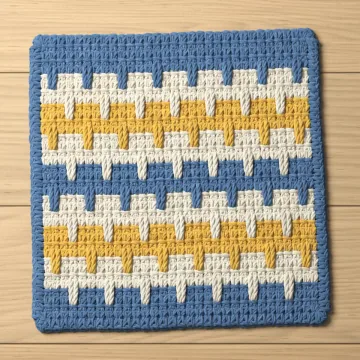
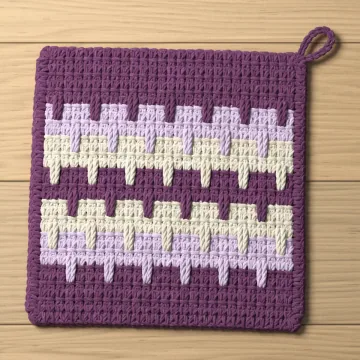
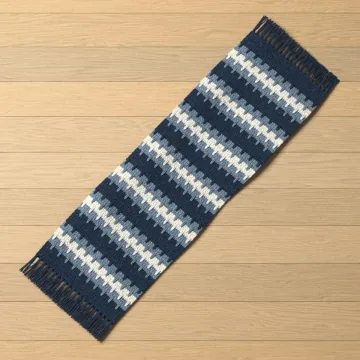
The dishcloth, potholder and table runner in spike stitch use this long kind. Spike stitch shows the shorter one.
What goes wrong
| What you see | Why | What to do |
|---|---|---|
| The fabric bunches under a spike | The long loop is tight | Pull it level with the row before you finish |
| One stitch too many after a spike row | The stitch behind a spike was worked too | Take the row out and skip it |
| A spike reaches only one row | The hook went in one stitch too high | Go to the last row of the same color |
| A linked row loses a stitch | The top of the ch 3 was missed | Make the last stitch there, and count to 16 |
Questions people ask
Does one row of double crochet count as two? No. It is one row, about as tall as two.
How many stitches go along the side, over two rows? The common advice is two single crochets to two rows of single crochet, and four to two rows of double crochet. Some teachers start with fewer. Lay the edge flat: if it ripples use fewer, if it pulls in more.