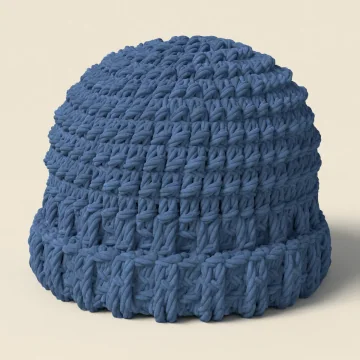
Chunky ribbed cowl crochet pattern
Easy · 1 color · 2 sizes
Size: Standard Change size
PDF · US Letter · 3 pages · Change paper
For your own stitching, gifts and handmade pieces you sell. Do not resell or share this PDF. What you may do, in full
- Size
- About 9 × 26¾ in (23 × 68 cm)
- Skill
- EasyBack loop only
Size 2 choices · Standard is pictured
Paper for the PDF
Go to the instructions Row counter
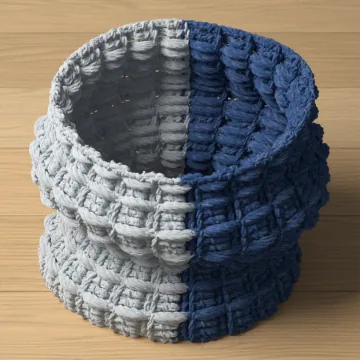
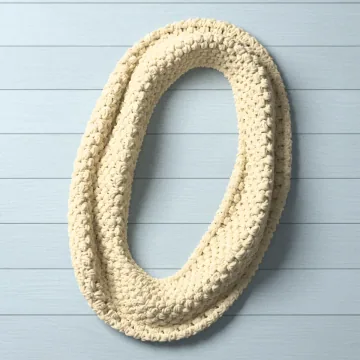
Half double crochet (UK half treble) worked in the back loop only, so the loop left free draws a ridge along every row and the fabric stretches like ribbing. It is worked flat as a long strip and the two short ends are sewn together.
Sizes
Gauge
7 stitches and 6 rows to 4 in (10 cm) in back loop rib.
How to measure it
To count your gauge in the middle of the test piece: let it lie flat and do not pull the ribs apart.
The pattern also stops you to measure after row 4.
Work a test square first (9 rows)
A test piece to measure and pull out. It is not the start of the pattern.
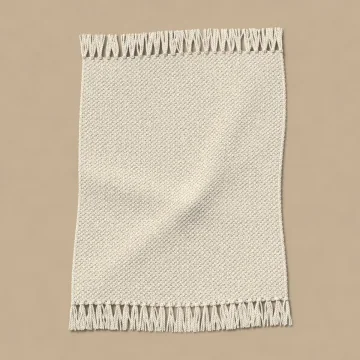
The test piece is about 6¼ in (16 cm) wide and 6 in (15 cm) tall, so that you can count over 4 in (10 cm) in the middle of it.
- Swatch foundationCh 13.
- Swatch row 1 (RS)Hdc in 3rd ch from hook and in each ch across(11 hdc)
- Swatch rows 2 to 9Ch 2, turn; hdc in BLO of each st across(11 hdc)
For another width: how many chains to add
For another width, make the chain longer or shorter: each chain is one more stitch. Measure your own gauge first.
Before you start
- The ch 2 at the start of a row does not count as a stitch: the first stitch of the row goes into the first st of the row below.
- Row 1 is the right side.
- The back loop is the loop of the stitch that is farther from you as you work.
- Whip stitch: bring the needle through both edges from front to back, over the top and through from front to back again, all in the same direction.
- The number of rows is our estimate: yours may differ, and the length does not change the stitch count.
- Leave a tail of about 6 in (15 cm) when you begin, and weave it in at the end with the others. Join a new ball at the end of a row, with the same tails: each join adds two ends.
Instructions
Size: Standard Change sizeUS termsUK terms
- The count at the end is what the row leaves.
- Tick a row when it is done. Your place is kept in this browser.
How to read these rows
In UK terms hdc is half treble.
- FoundationCh 18.
- Row 1RSHdc in 3rd ch from hook and in each ch acrossleaves (16 hdc)
- Stop and measure when you have worked row 4.Width, across the middle of the rows and not along the chain edge: about 9 in (23 cm). If it is wider, start again with a smaller hook; if it is narrower, with a larger one. If only the chain edge is tight, make the chain with a larger hook.
- Rows 2 to 40Ch 2, turn; hdc in BLO of each st acrossleaves (16 hdc)Repeat until the piece measures about 26¾ in (68 cm): at our gauge that is row 40. Go by the tape measure, not the count.Next: row 2 of 40
- EndFasten off, leaving a 6 in (15 cm) tail.
Putting it together
Lay the strip flat, wrong side up, with no twist in it, and bring the two short ends over to meet, so that the right side is outside and the 16 places of the foundation edge meet the 16 places of the last row. With a 30 in (76 cm) length of the yarn, whip stitch through both edges, one stitch to each place, from corner to corner.
Finishing
- Weave in the ends.
- Lay the piece flat, pull it gently to its size, dampen it and let it dry.
In all: 40 rows; 640 stitches; 4 ends to weave in.