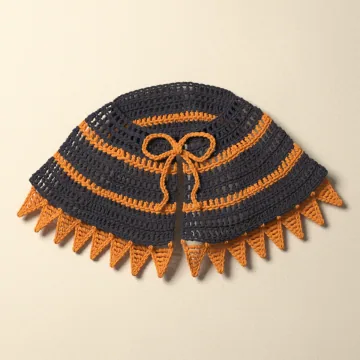
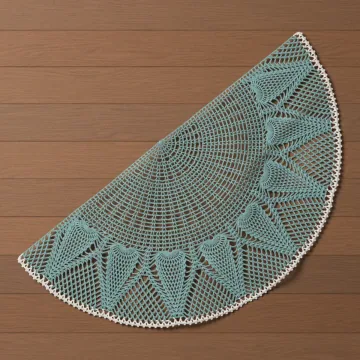
Fringed evening capelet crochet pattern
Intermediate · 2 colors · 3,388 stitches · 3 sizes
Size: S to M Change size
PDF · US Letter · 5 pages · Change paper
Go to the instructions Row counter
- Size
- About 57¼ in (145.5 cm) round and about 12½ in (31.5 cm) deep
- Skill
- IntermediateShells, chain spaces, an eyelet row, fringe
- Yarn
- Fine (2), about 560 yd (512 m), an estimate
- Hook
- 4.5 mm (US 7)
Size 3 choices · S to M is pictured
Paper for the PDF
For your own crochet, gifts and handmade pieces you sell. Do not resell or share this PDF or copies of it. Selling, classes and kits: the rules
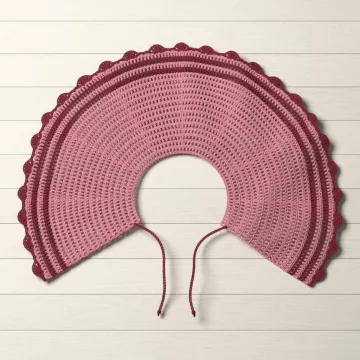
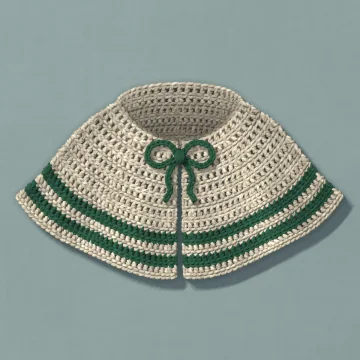
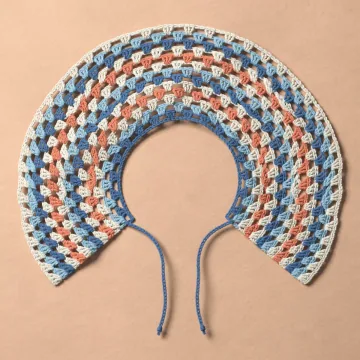
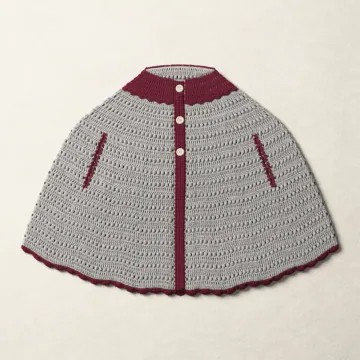
An evening capelet shawl in ivory shell lace, worked from the neck down, with a satin ribbon tie and a dense silver fringe. Intermediate, sport, three sizes. The shells stand one above the other, and the panels of double crochet (UK treble) between them grow by a stitch every few rows, so the capelet widens over the shoulders without a seam. The lower edge is a row of silver and a fine fringe of both yarns.
Sizes
Gauge
17 stitches and 9 rows to 4 in (10 cm) in double crochet.
How to measure it
Check your gauge on the piece. Begin the pattern and measure the piece itself as you go.
After row 1 the piece, laid flat, is about 21.4 in (54.4 cm) across the width. If yours is smaller, use a larger hook; if it is larger, use a smaller one.
In a thinner or a thicker yarn: how many stitches you need, and how large it comes out.
To make it larger or smaller
For another neck and width add or take away 6 stitches, which is one shell: begin with any multiple of 6 chains plus 3, and for each shell work the bracket 3 times more or fewer in rows 2 and 3 and once more or once less in every row after them. Each shell is about 1.4 in (3.6 cm) of the neck edge and about 3.8 in (9.7 cm) of the lower edge. For another depth work more or fewer rows like row 27 (4 dc in every panel) before the row of yarn B; each is about 0.4 in (1 cm). Each shell is 16 knots of the fringe. With an even number of shells there is an even number of eyelets, and the ribbon goes through all of them, the middle ones too.
Before you start
How it is worked: Changing colors
Read the 12 notes
- A shell is the stitches in round brackets: 2 dc, ch 2 and 2 dc, all in one place. In row 4 it goes into a stitch, in every later row into the ch-2 sp in the middle of the shell below.
- Between two shells stands one dc, worked in every row into the same dc of the row below, with a ch 1 on each side of it from row 7 on. The dc of a panel go into the dc of the panel below, one in each; in a row in which the panels grow, the new dc of each goes into the dc of the shell below that is nearest to the panel. The rest of the shell is skipped, as the row says.
- The ch 3 at the start of a row counts as a dc; the last stitch of the next row is worked into the top of it. The chain stands on the first stitch of the row, so "next st" right after it is the second stitch.
- The ch 4 at the start of a row counts as a dc and a ch-1 sp. The stitch that closes over it goes into its 3rd chain. The chain stands on the first stitch of the row, so "next st" right after it is the second stitch.
- A stitch worked into a chain space goes into the open space under the chain, not into a chain stitch.
- In row 2 the turning ch is the skipped chs at the start of row 1: its top is the one that was next to the hook.
- Stitches in round brackets with a place after them are all worked into that one place. The brackets at the end of a row hold its count.
- What is in square brackets is worked as many times as the number after them says, in all.
- Row 1 is a right side row. Turn once between rows: the word "turn" near the start of each row is that turn.
- The neck edge is about 21.4 in (54.4 cm) before the ribbon is drawn up, the lower edge about 57.2 in (145.3 cm) along its curve, and the piece about 12.4 in (31.5 cm) deep from the neck edge to row 28, without the fringe.
- 28 rows. Every row from row 4 on has 15 shells of 2 dc, ch 2 and 2 dc, one above the other. From row 11 on a panel of dc stands on each side of every shell; the panels grow from 1 dc to 4. Row 28, the last, is in yarn B.
- The piece is worked flat from the neck down and is open at the front. The right side is the side you see in row 1.
Instructions
Size: S to M Change sizeUS termsUK terms
First read the 12 notes just above.
- “[ ]” is a repeat.
- “( )” goes into one place.
- The count at the end is what the row leaves.
- Tick a row when it is done. Your place is kept in this browser.
- Left-handed? Work everything as it is written, the other way: rows from left to right, rounds clockwise. Left-handed crochet
How to read these rows
Square brackets “[ ]” hold a repeat: work what is inside as many times as it says. Round brackets “( )” inside a line hold stitches that all go into one place. In UK terms dc is treble.
Yarns in order of use: A, ivory; B, silver.
- FoundationCh 93.
- Row 1RSDc in 4th ch from hook (skipped chs count as dc) and in each ch acrossleaves (91 dc)
- Row 2WSCh 4 (counts as dc and ch-1 sp), turn; sk next st, repeat: dc in next st, ch 1, sk next st 44 times, dc in top of turning chleaves (46 dc, 45 ch-1 sps)
- Row 3RSCh 3 (counts as dc), turn; repeat: dc in next ch-1 sp, dc in next st 44 times, dc in next ch-1 sp, dc in 3rd ch of turning chleaves (91 dc)
- Row 4WSCh 3 (counts as dc), turn; repeat: sk next 2 sts, (2 dc, ch 2, 2 dc) in next st, sk next 2 sts, dc in next st 14 times, sk next 2 sts, (2 dc, ch 2, 2 dc) in next st, sk next 2 sts, dc in top of turning chleaves (76 dc, 15 ch-2 sps)
- Rows 5 to 6Ch 3 (counts as dc), turn; repeat: sk next 2 sts, (2 dc, ch 2, 2 dc) in next ch-2 sp, sk next 2 sts, dc in next st 14 times, sk next 2 sts, (2 dc, ch 2, 2 dc) in next ch-2 sp, sk next 2 sts, dc in top of turning chleaves (76 dc, 15 ch-2 sps)Next: row 5 of rows 5 to 6
- Row 7RSCh 3 (counts as dc), turn; repeat: sk next 2 sts, (2 dc, ch 2, 2 dc) in next ch-2 sp, sk next 2 sts, ch 1, dc in next st, ch 1 14 times, sk next 2 sts, (2 dc, ch 2, 2 dc) in next ch-2 sp, sk next 2 sts, dc in top of turning chleaves (76 dc, 15 ch-2 sps, 28 ch-1 sps)
- Rows 8 to 10Ch 3 (counts as dc), turn; repeat: sk next 2 sts, (2 dc, ch 2, 2 dc) in next ch-2 sp, sk next 2 sts, ch 1, sk next ch-1 sp, dc in next st, ch 1, sk next ch-1 sp 14 times, sk next 2 sts, (2 dc, ch 2, 2 dc) in next ch-2 sp, sk next 2 sts, dc in top of turning chleaves (76 dc, 15 ch-2 sps, 28 ch-1 sps)Next: row 8 of rows 8 to 10
- Row 11RSCh 3 (counts as dc), turn; repeat: dc in next st, sk next st, (2 dc, ch 2, 2 dc) in next ch-2 sp, sk next st, dc in next st, ch 1, sk next ch-1 sp, dc in next st, ch 1, sk next ch-1 sp 14 times, dc in next st, sk next st, (2 dc, ch 2, 2 dc) in next ch-2 sp, sk next st, dc in next st, dc in top of turning chleaves (106 dc, 15 ch-2 sps, 28 ch-1 sps)
- Rows 12 to 15Ch 3 (counts as dc), turn; repeat: dc in next st, sk next 2 sts, (2 dc, ch 2, 2 dc) in next ch-2 sp, sk next 2 sts, dc in next st, ch 1, sk next ch-1 sp, dc in next st, ch 1, sk next ch-1 sp 14 times, dc in next st, sk next 2 sts, (2 dc, ch 2, 2 dc) in next ch-2 sp, sk next 2 sts, dc in next st, dc in top of turning chleaves (106 dc, 15 ch-2 sps, 28 ch-1 sps)Next: row 12 of rows 12 to 15
- Row 16WSCh 3 (counts as dc), turn; repeat: dc in next 2 sts, sk next st, (2 dc, ch 2, 2 dc) in next ch-2 sp, sk next st, dc in next 2 sts, ch 1, sk next ch-1 sp, dc in next st, ch 1, sk next ch-1 sp 14 times, dc in next 2 sts, sk next st, (2 dc, ch 2, 2 dc) in next ch-2 sp, sk next st, dc in next 2 sts, dc in top of turning chleaves (136 dc, 15 ch-2 sps, 28 ch-1 sps)
- Rows 17 to 20Ch 3 (counts as dc), turn; repeat: dc in next 2 sts, sk next 2 sts, (2 dc, ch 2, 2 dc) in next ch-2 sp, sk next 2 sts, dc in next 2 sts, ch 1, sk next ch-1 sp, dc in next st, ch 1, sk next ch-1 sp 14 times, dc in next 2 sts, sk next 2 sts, (2 dc, ch 2, 2 dc) in next ch-2 sp, sk next 2 sts, dc in next 2 sts, dc in top of turning chleaves (136 dc, 15 ch-2 sps, 28 ch-1 sps)Next: row 17 of rows 17 to 20
- Row 21RSCh 3 (counts as dc), turn; repeat: dc in next 3 sts, sk next st, (2 dc, ch 2, 2 dc) in next ch-2 sp, sk next st, dc in next 3 sts, ch 1, sk next ch-1 sp, dc in next st, ch 1, sk next ch-1 sp 14 times, dc in next 3 sts, sk next st, (2 dc, ch 2, 2 dc) in next ch-2 sp, sk next st, dc in next 3 sts, dc in top of turning chleaves (166 dc, 15 ch-2 sps, 28 ch-1 sps)
- Rows 22 to 25Ch 3 (counts as dc), turn; repeat: dc in next 3 sts, sk next 2 sts, (2 dc, ch 2, 2 dc) in next ch-2 sp, sk next 2 sts, dc in next 3 sts, ch 1, sk next ch-1 sp, dc in next st, ch 1, sk next ch-1 sp 14 times, dc in next 3 sts, sk next 2 sts, (2 dc, ch 2, 2 dc) in next ch-2 sp, sk next 2 sts, dc in next 3 sts, dc in top of turning chleaves (166 dc, 15 ch-2 sps, 28 ch-1 sps)Next: row 22 of rows 22 to 25
- Row 26WSCh 3 (counts as dc), turn; repeat: dc in next 4 sts, sk next st, (2 dc, ch 2, 2 dc) in next ch-2 sp, sk next st, dc in next 4 sts, ch 1, sk next ch-1 sp, dc in next st, ch 1, sk next ch-1 sp 14 times, dc in next 4 sts, sk next st, (2 dc, ch 2, 2 dc) in next ch-2 sp, sk next st, dc in next 4 sts, dc in top of turning chleaves (196 dc, 15 ch-2 sps, 28 ch-1 sps)
- Row 27RSCh 3 (counts as dc), turn; repeat: dc in next 4 sts, sk next 2 sts, (2 dc, ch 2, 2 dc) in next ch-2 sp, sk next 2 sts, dc in next 4 sts, ch 1, sk next ch-1 sp, dc in next st, ch 1, sk next ch-1 sp 14 times, dc in next 4 sts, sk next 2 sts, (2 dc, ch 2, 2 dc) in next ch-2 sp, sk next 2 sts, dc in next 4 sts, dc in top of turning chleaves (196 dc, 15 ch-2 sps, 28 ch-1 sps)
- Row 28WSYarn B. Ch 3 (counts as dc), turn; repeat: dc in next 4 sts, sk next 2 sts, (2 dc, ch 2, 2 dc) in next ch-2 sp, sk next 2 sts, dc in next 4 sts, ch 1, sk next ch-1 sp, dc in next st, ch 1, sk next ch-1 sp 14 times, dc in next 4 sts, sk next 2 sts, (2 dc, ch 2, 2 dc) in next ch-2 sp, sk next 2 sts, dc in next 4 sts, dc in top of turning chleaves (196 dc, 15 ch-2 sps, 28 ch-1 sps)
- EndFasten off.
Finishing
- Fringe: cut 239 pieces of yarn A and 239 pieces of yarn B, each 10 in (25.4 cm) long. With the right side facing you, set one knot in every stitch and one in every chain space of the last row, the ch-1 sps and the ch-2 sps alike, 239 knots. For each knot hold 1 piece of A and 1 piece of B together and fold them in half, draw the fold through the stitch or the space from back to front, pass the 4 ends through the fold and pull snug. Trim the fringe level at about 4 in (10.2 cm).
- Ribbon: with the right side facing you, thread the ribbon through the eyelets of row 2, from one front edge to the other: over the dc at the front edge and down through the first eyelet, under the next dc and up through the second eyelet, over the next dc and down through the third, and so on. Leave the middle eyelet empty and pass straight on at it, so that the ribbon goes over two dc there, or under two, instead of one. After it go on as before. Both ends of the ribbon then come out on the right side, over the two edge dc. Draw the ribbon up until the neck edge is as wide as you want it, and tie a bow.
- Weave in the ends. Every time a new ball of yarn is begun there are two more than those counted.
In all: 28 rows; 3,388 stitches.