Mouse with a wedge of cheese crochet pattern
Crochet, 6¼ in, 6 colors, intermediate
PDF. Prints on US Letter and A4.
What you need
Each amount is an estimate.
- Yarn A butter yellowabout 125 yd (114 m)side strip, top, bottom and the details
- Yarn B russetabout 20 yd (18 m)rind
- Yarn C deep goldabout 40 yd (37 m)pocket, large hole and small hole
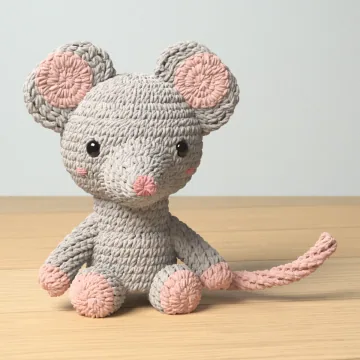
- Yarn D dove grayabout 50 yd (46 m)mouse body, mouse ear and paw
- Yarn E pinkabout 10 yd (9 m)mouse body, inner ear and mouse tail
- Yarn F blackabout 5 yd (5 m)the details
- Yarn in all
- About 250 yd (229 m) or 130 g
- Weight
- Medium weight, 4 on the label (UK aran)
- Hook
- 3.5 mm (US E-4), or the size that gives you the gauge
- Also
- Toy stuffing, a yarn needle, a stitch marker, pins, scissors and two black plastic eyes with washers, 8 mm
- Eyes
- Plastic, with washers, 8 mmFor a child under three, or a pet, embroider them instead
- Gauge
- 20 stitches and 22 rounds to 4 in (10 cm) in single crochet, in a spiral. How to check it
Instructions
How to read these rounds
US terms · Show UK terms
- ch chain, sl st slip stitch, sc single crochet (UK double crochet), MR magic ring.
- sc2tog 2 sc made into one, yo yarn over the hook, RS right side, the one that shows.
- 3 sc in next st: all in one stitch. sc in next 3 sts: one in each.
- [ ] 4 times: work what is inside 4 times in all.
- (32 sc): the stitches you have when the round is done. How to read a pattern.
- How to wash crochet.
- Every piece that has rounds is worked in a continuous spiral with the right side facing you: do not join and do not turn. Put the marker in the first stitch of each round and move it up. Square brackets hold a repeat; work it as many times as the line says. The number in parentheses is the count at the end of the round.
- Center line: places on a piece are given by round and by stitches from a center line. It is half way round from where the rounds begin. Mark it with a pin or a scrap of yarn as listed here, run it straight from round 1 to the last round by eye, and count out from it along the round, in stitches and half stitches.
Go to: Rind · Side strip · Top · Bottom · Pocket · Large hole · Small hole · Mouse body · Mouse ear · Inner ear · Paw · Mouse tail · Assembly
Rind
Yarn B, russet.
- A square with a round hole in it. Where a round says 3 sc in one stitch, the middle one of the three is a corner stitch. In the next round the 3 sc in one stitch come in that corner stitch.
- StartWith B, ch 32; being careful not to twist the chain, sl st in the first ch to form a ring. Round 1 begins in that same ch.
- Rnd 1RSSc in each ch aroundleaves (32 sc)
- Rnd 2repeat: sc in next 3 sts, 3 sc in next st, sc in next 4 sts 4 timesleaves (40 sc)
- Rnd 3repeat: sc in next 4 sts, 3 sc in next st, sc in next 5 sts 4 timesleaves (48 sc)
- Rnd 4repeat: sc in next 5 sts, 3 sc in next st, sc in next 6 sts 4 timesleaves (56 sc)
- Rnd 5repeat: sc in next 6 sts, 3 sc in next st, sc in next 7 sts 4 timesleaves (64 sc)
- EndSl st in the next st to level the edge. Fasten off and weave in the ends: the rind is sewn on with new lengths of yarn. Each side of the square has 15 stitches between two corner stitches: 17 with both corner stitches. Press it flat with the right side up.
Side strip
Yarn A, butter yellow.
- Worked flat, to and fro in rows, 17 stitches wide. The ch 1 at the start of a row does not count as a stitch.
- StartWith A, ch 18.
- Row 1RSSc in second ch from hook and in each ch acrossleaves (17 sc)
- Rows 2 to 68Ch 1, turn, sc in each st acrossleaves (17 sc)Next: row 2 of rows 2 to 68
- EndFasten off and weave in the ends: the strip is sewn on with new lengths of yarn. This strip makes both long sides of the wedge. Mark the fold half way, between rows 34 and 35, with a pin at each edge: there it is folded, and the fold is the point of the wedge.
Top
Yarn A, butter yellow.
- Worked flat, to and fro in rows, 17 stitches wide at the start. The ch 1 at the start of a row does not count as a stitch.
- StartWith A, ch 18.
- Row 1RSSc in second ch from hook and in each ch acrossleaves (17 sc)
- Rows 2 to 4Ch 1, turn, sc in each st acrossleaves (17 sc)Next: row 2 of rows 2 to 4
- Row 5Ch 1, turn, sc2tog, sc in next 13 sts, sc2togleaves (15 sc)
- Rows 6 to 8Ch 1, turn, sc in each st acrossleaves (15 sc)Next: row 6 of rows 6 to 8
- Row 9Ch 1, turn, sc2tog, sc in next 11 sts, sc2togleaves (13 sc)
- Rows 10 to 12Ch 1, turn, sc in each st acrossleaves (13 sc)Next: row 10 of rows 10 to 12
- Row 13Ch 1, turn, sc2tog, sc in next 9 sts, sc2togleaves (11 sc)
- Rows 14 to 16Ch 1, turn, sc in each st acrossleaves (11 sc)Next: row 14 of rows 14 to 16
- Row 17Ch 1, turn, sc2tog, sc in next 7 sts, sc2togleaves (9 sc)
- Rows 18 to 20Ch 1, turn, sc in each st acrossleaves (9 sc)Next: row 18 of rows 18 to 20
- Row 21Ch 1, turn, sc2tog, sc in next 5 sts, sc2togleaves (7 sc)
- Rows 22 to 24Ch 1, turn, sc in each st acrossleaves (7 sc)Next: row 22 of rows 22 to 24
- Row 25Ch 1, turn, sc2tog, sc in next 3 sts, sc2togleaves (5 sc)
- Rows 26 to 28Ch 1, turn, sc in each st acrossleaves (5 sc)Next: row 26 of rows 26 to 28
- Row 29Ch 1, turn, sc2tog, sc in next st, sc2togleaves (3 sc)
- Rows 30 to 31Ch 1, turn, sc in each st acrossleaves (3 sc)Next: row 30 of rows 30 to 31
- Row 32Ch 1, turn, sc in next st, sc2togleaves (2 sc)
- Row 33Ch 1, turn, sc2togleaves (1 sc)
- EndFasten off, leaving a 40 in (102 cm) tail for sewing.
Bottom
Yarn A, butter yellow.
- Worked flat, to and fro in rows, 17 stitches wide at the start. The ch 1 at the start of a row does not count as a stitch.
- StartWith A, ch 18.
- Row 1RSSc in second ch from hook and in each ch acrossleaves (17 sc)
- Rows 2 to 4Ch 1, turn, sc in each st acrossleaves (17 sc)Next: row 2 of rows 2 to 4
- Row 5Ch 1, turn, sc2tog, sc in next 13 sts, sc2togleaves (15 sc)
- Rows 6 to 8Ch 1, turn, sc in each st acrossleaves (15 sc)Next: row 6 of rows 6 to 8
- Row 9Ch 1, turn, sc2tog, sc in next 11 sts, sc2togleaves (13 sc)
- Rows 10 to 12Ch 1, turn, sc in each st acrossleaves (13 sc)Next: row 10 of rows 10 to 12
- Row 13Ch 1, turn, sc2tog, sc in next 9 sts, sc2togleaves (11 sc)
- Rows 14 to 16Ch 1, turn, sc in each st acrossleaves (11 sc)Next: row 14 of rows 14 to 16
- Row 17Ch 1, turn, sc2tog, sc in next 7 sts, sc2togleaves (9 sc)
- Rows 18 to 20Ch 1, turn, sc in each st acrossleaves (9 sc)Next: row 18 of rows 18 to 20
- Row 21Ch 1, turn, sc2tog, sc in next 5 sts, sc2togleaves (7 sc)
- Rows 22 to 24Ch 1, turn, sc in each st acrossleaves (7 sc)Next: row 22 of rows 22 to 24
- Row 25Ch 1, turn, sc2tog, sc in next 3 sts, sc2togleaves (5 sc)
- Rows 26 to 28Ch 1, turn, sc in each st acrossleaves (5 sc)Next: row 26 of rows 26 to 28
- Row 29Ch 1, turn, sc2tog, sc in next st, sc2togleaves (3 sc)
- Rows 30 to 31Ch 1, turn, sc in each st acrossleaves (3 sc)Next: row 30 of rows 30 to 31
- Row 32Ch 1, turn, sc in next st, sc2togleaves (2 sc)
- Row 33Ch 1, turn, sc2togleaves (1 sc)
- EndFasten off, leaving a 60 in (152 cm) tail for sewing.
Yarn C, deep gold.
- StartMake a magic ring.
- Rnd 1RS6 sc in MR. Pull the tail to close the ring.leaves (6 sc)
- Rnd 22 sc in each st aroundleaves (12 sc)
- Rnd 3repeat: sc in next st, 2 sc in next st 6 timesleaves (18 sc)
- Rnd 4repeat: 2 sc in next st, sc in next 2 sts 6 timesleaves (24 sc)
- Rnd 5repeat: sc in next 3 sts, 2 sc in next st 6 timesleaves (30 sc)
- Rnd 6repeat: sc in next 7 sts, 2 sc in next st, sc in next 7 sts 2 timesleaves (32 sc)
- Rnds 7 to 12Sc in each st aroundleaves (32 sc)Next: round 7 of rounds 7 to 12
- EndFasten off, leaving a 26 in (66 cm) tail for sewing. Do not stuff. Turn it inside out, so that the right side is on the inside.
Large hole make 3
Yarn C, deep gold.
- StartMake a magic ring.
- Rnd 1RS6 sc in MR. Pull the tail to close the ring.leaves (6 sc)
- Rnd 22 sc in each st aroundleaves (12 sc)
- Rnd 3repeat: sc in next st, 2 sc in next st 6 timesleaves (18 sc)
- EndFasten off, leaving an 18 in (46 cm) tail for sewing. Do not stuff. Press it flat with the right side up.
Small hole make 3
Yarn C, deep gold.
- StartMake a magic ring.
- Rnd 1RS6 sc in MR. Pull the tail to close the ring.leaves (6 sc)
- Rnd 22 sc in each st aroundleaves (12 sc)
- EndFasten off, leaving a 14 in (36 cm) tail for sewing. Do not stuff. Press it flat with the right side up.
Mouse body
Yarns in order of use: E, pink; D, dove gray.
- StartMake a magic ring.
- Rnd 1RS5 sc in MR. Pull the tail to close the ring.leaves (5 sc)
- Rnd 2With D, sc in next st, 2 sc in next st, sc in next 2 sts, 2 sc in next stleaves (7 sc)
- Rnd 32 sc in next st, sc in next st, 2 sc in next st, sc in next 2 sts, 2 sc in next st, sc in next stleaves (10 sc)
- Rnd 4repeat: 2 sc in next st, sc in next 2 sts 2 times, 2 sc in next st, sc in next 3 stsleaves (13 sc)
- Rnd 5repeat: sc in next 3 sts, 2 sc in next st 2 times, sc in next 4 sts, 2 sc in next stleaves (16 sc)
- Rnd 6Sc in next 2 sts, repeat: 2 sc in next st, sc in next 4 sts 2 times, 2 sc in next st, sc in next 3 stsleaves (19 sc)
- Rnd 7repeat: 2 sc in next st, sc in next 5 sts 2 times, 2 sc in next st, sc in next 6 stsleaves (22 sc)
- Rnd 8repeat: sc in next 6 sts, 2 sc in next st 2 times, sc in next 7 sts, 2 sc in next stleaves (25 sc)
- Rnd 9Sc in next 5 sts, 2 sc in next st, sc in next 12 sts, 2 sc in next st, sc in next 6 stsleaves (27 sc)
- Rnds 10 to 16Sc in each st aroundleaves (27 sc)Next: round 10 of rounds 10 to 16
- Rnd 17repeat: sc2tog, sc in next 7 sts 3 timesleaves (24 sc)
Fix the eyes now: two 8 mm black plastic eyes, on the mouse body on round 7, one to each side, 4 stitches from the center line (8 stitches apart). For a child under three, or a pet, leave them out and embroider them later. Then stuff firmly, and keep adding stuffing until the last round.
- Rnd 18repeat: sc in next 2 sts, sc2tog 6 timesleaves (18 sc)
- Rnd 19repeat: sc in next st, sc2tog 6 timesleaves (12 sc)
- Rnd 20repeat: sc2tog 6 timesleaves (6 sc)
- EndFasten off, leaving an 8 in (20 cm) tail. Thread the tail through the front loop of each of the last 6 stitches, pull it tight to close the hole and bury the end inside.
Mouse ear make 2
Yarn D, dove gray.
- StartMake a magic ring.
- Rnd 1RS6 sc in MR. Pull the tail to close the ring.leaves (6 sc)
- Rnd 22 sc in each st aroundleaves (12 sc)
- Rnd 3repeat: sc in next st, 2 sc in next st, sc in next st 4 timesleaves (16 sc)
- Rnd 4repeat: 2 sc in next st, sc in next 7 sts 2 timesleaves (18 sc)
- Rnd 5Sc in each st aroundleaves (18 sc)
- Rnd 6repeat: sc in next 4 sts, sc2tog 3 timesleaves (15 sc)
- Rnd 7repeat: sc2tog, sc in next 2 sts 3 times, sc2tog, sc in next stleaves (11 sc)
- EndFasten off, leaving a 14 in (36 cm) tail for sewing. Do not stuff. Press it flat, so that the last round makes a straight double edge of 5½ stitches. The odd stitch lies at one fold.
Inner ear make 2
Yarn E, pink.
- StartMake a magic ring.
- Rnd 1RS6 sc in MR. Pull the tail to close the ring.leaves (6 sc)
- Rnd 22 sc in each st aroundleaves (12 sc)
- EndFasten off, leaving a 14 in (36 cm) tail for sewing. Do not stuff. Press it flat with the right side up.
Paw make 2
Yarn D, dove gray.
- StartMake a magic ring.
- Rnd 1RS6 sc in MR. Pull the tail to close the ring.leaves (6 sc)
- Rnd 2repeat: sc in next st, 2 sc in next st 3 timesleaves (9 sc)
- Rnds 3 to 4Sc in each st aroundleaves (9 sc)Next: round 3 of rounds 3 to 4
- EndFasten off, leaving a 12 in (30 cm) tail for sewing. Stuff lightly up to the open edge.
Mouse tail
Yarn E, pink.
- StartMake a magic ring.
- Rnd 1RS4 sc in MR. Pull the tail to close the ring.leaves (4 sc)
- Rnds 2 to 15Sc in each st aroundleaves (4 sc)Next: round 2 of rounds 2 to 15
- EndFasten off, leaving a 10 in (25 cm) tail for sewing. Do not stuff.
Assembly
A number is the step below that puts it on; a letter is put on under Finishing. Each line is a round, counted as the rounds are worked. The upright broken line is the center line. A place with a broken edge is on the far side.
- Hold the rind with its right side toward you and put the pocket behind its hole, so that you look into the pocket. Sew the open edge of the pocket (32 sts) to the 32 chains of the hole, stitch to chain, all the way round, with the tail of the pocket.
- Sew down the three large holes, right side out, each with its tail, all 18 stitches of the edge. Lay the side strip with its right side toward you, row 1 at the left and row 68 at the right, so that its rows stand upright and its width (17 stitches) runs up and down; the long edge at the top is the upper edge of the wedge. One large hole goes on row 8 and one on row 60, the middle of each 3 stitches above the middle of the row. The third goes on the top: lay the top with its right side toward you, row 1 at the bottom and row 33 at the top. The middle of the hole lies on row 8, 2 stitches to the left of the middle of the row.
- Sew down the three small holes, right side out, each with its tail, all 12 stitches of the edge. Lay the side strip as in step 2: right side toward you, row 1 at the left. One small hole goes on row 20 and one on row 48, the middle of each 3½ stitches below the middle of the row. The third goes on the top. Lay the top as in step 2: right side toward you, row 1 at the bottom. The middle of the hole lies on row 16, 2 stitches to the right of the middle of the row.
- The seams of the cheese are whip stitch: hold the two edges side by side, right sides out, and take the needle over both edges and through one stitch, or the end of one row, of each. Stand the rind up with its right side toward you, any side at the bottom. Sew row 68 of the side strip (17 stitches) to the left side of the rind (17 stitches with both corner stitches), stitch to stitch, the upper edge of the strip at the top, with a new length of A (butter yellow), 24 in (61 cm) long. Sew the chain edge of the strip (17 chains) to the right side of the rind (17 stitches) in the same way, with another new length of A. Fold the strip at its two pins. Rind and strip now make a wall with three corners, and the fold is the point behind the rind.
- Set the bottom on the lower edge of the wall, right side out, its chain edge (17 chains) along the lower side of the rind (17 stitches with both corner stitches), chain to stitch, and its last row (1 stitch) at the fold of the strip. Each long side of the bottom (the ends of its 33 rows) goes along one half of the lower edge of the strip (the ends of 34 rows), eased to fit. With the tail of the bottom, begin at the fold and sew all the way round: one long side, the edge at the rind, the other long side. Set the top on the upper edge of the wall in the same way. With the tail of the top, begin at the fold and sew the one long side, as far as the rind, and let the rest of this tail hang there. With a new length of A (butter yellow), 28 in (71 cm) long, begin at the fold again and sew the other long side, and fasten off. Stuff the wedge through the edge that is still open, a little at a time: first the point, then round the pocket, with two fingers in the pocket so that it stays open. Then sew the 17 chains of the top to the upper side of the rind (17 stitches) with the tail that hangs there.
- Pin the two mouse ears to the mouse body: the middle of each flat edge lies between rounds 10 and 11, one to each side, 5 stitches from the center line (10 stitches apart). The flat edge runs along the round, half of it on each side of that place. They point up and out to the side. Sew through both layers of the 5½-stitch edge with the tail.
- Sew one inner ear flat to the side of each mouse ear that will face forward, right side out, centered on that side, its middle over round 4 of the mouse ear, all 12 stitches of the edge.
- Pin the two paws to the mouse body: the middle of each open edge lies between rounds 11 and 12, one to each side, 9½ stitches from the center line (8 stitches apart across the side opposite the center line). The edge (9 sts) covers about rounds 10 to 13 of the mouse body. They point toward the nose and down. Sew all the way round with the tail, adding a little stuffing before the last few stitches if the edge is still soft.
- Sew the open edge of the mouse tail (4 sts) over the closed hole at the end of the mouse body, all the way round, with its tail of yarn. It hangs loose. Put the mouse into the pocket, its closed end and its tail first, so that rounds 1 to 14 look out, and turn its nose a little to one side and a little up.
Finishing
- Put in the plastic eyes when the words of a piece say so, or embroider eyes in the same places with the other details. Embroider with one strand of yarn and the yarn needle when the pieces round the place are sewn on; begin and end each strand inside the toy. Satin stitch is straight stitches side by side until the shape is filled. Backstitch is a line of short stitches end to end: bring the needle up one stitch ahead, put it down at the end of the stitch before, and repeat.
- Eyes: two 8 mm black plastic eyes, on the mouse body on round 7, one to each side, 4 stitches from the center line (8 stitches apart).
- Mouth: with F (black), in backstitch, a smile, one curve, on the underside of the snout. Its two ends are on round 3 of the mouse body, one to each side of the line opposite the center line, 1½ stitches from it, so that 3 stitches lie between them along the round. Its middle is on that line on round 4, farther from the nose than the ends.
- Weave every tail through the toy and trim it. For a toy that will be played with, go round each seam a second time with a new length of yarn. Check the seams and small parts from time to time.
About
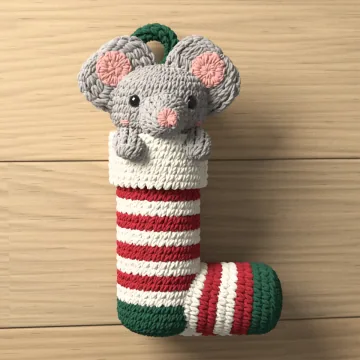
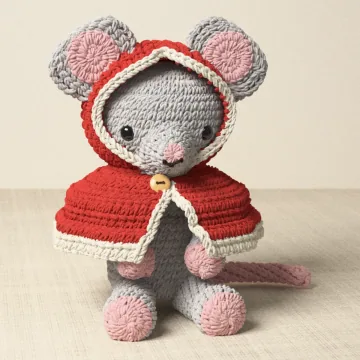
A wedge of cheese with a round hole in its rind, and a small gray mouse that looks out of it.