Ribbed skillet handle cover crochet pattern
Easy · 2 colors · 898 stitches in 2 pieces · 2 sizes, Short to long
Size: Long Change size
PDF · US Letter · 4 pages · Change paper
Go to the instructions Row counter
- Size
- About 2¼ × 5¼ in (6 × 13 cm)About 5¼ in (13.5 cm) long and 2¼ in (5.5 cm) wide laid flat, without the loopTo fit a handle about 6 in (15 cm) long or longer
- Skill
- EasyIt is one flat ribbed piece, sewn into a tube, gathered at both ends and pushed into itself.
- Yarn
- Medium (4), about 70 yd (64 m), an estimate
- Hook
- 4 mm (US G-6)
Size 2 choices · Long is pictured
Paper for the PDF
For your own crochet, gifts and handmade pieces you sell. Do not resell or share this PDF or copies of it. Selling, classes and kits: the rules
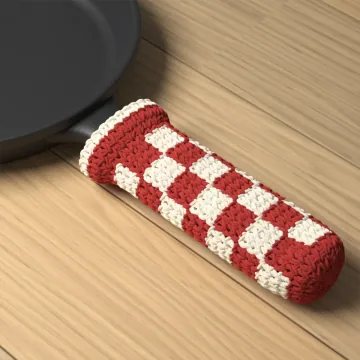
A thick cover for a cast iron skillet handle in mustard and cream cotton rib, all in single crochet (UK double crochet), with a hanging loop. One flat piece worked through the back loop is sewn into a tube, gathered at both ends and pushed into itself, so that the cover is double all over, with a round tip and no raw edge at the mouth.
Sizes
- Size
- Long
- Fits
- a handle about 6 in (15 cm) long or longer
- Finished size, about
- 2¼ × 5¼ in (6 × 13 cm)
- Yarn, an estimate
- about 70 yd (64 m)
Scroll the table sideways to see every column.
Gauge
16 stitches and 17 rows to 4 in (10 cm) in single crochet.
How to measure it
Work a test square first (21 rows)
A test piece to measure and pull out. It is not the start of the pattern.
Lay it flat and count the stitches and rows over 4 in (10 cm) in its middle.
There should be 16 stitches and 17 rows. If you count more stitches than that, change to a larger hook; if you count fewer, change to a smaller hook. The swatch can be pulled out and its yarn used again.
- Swatch foundationCh 21.
- Swatch row 1 (RS)Sc in 2nd ch from hook and in each ch across(20 sc)
- Swatch rows 2 to 21Ch 1, turn; sc in BLO of each st across(20 sc)
Before you start
How it is worked: Back loop and front loop · Changing colors · Joining and seaming pieces
Read the 8 notes
- The chain of 1 at the start of a row does not count as a stitch. Leave a starting tail of about 6 in (15 cm) at the beginning of each foundation chain.
- Where the pattern says BLO, put the hook under the back loop only. The piece is turned at every row, so the front loops left free make ridges on both sides of it.
- Measure round the handle at its thickest. The cover goes on a handle of 3 in (7.5 cm) to 3¾ in (9.5 cm) round: the double fabric takes up some of the room, and the rib gives a little. For a thicker handle work 4 rows more before you fasten off, 2 rows of A and 2 rows of B, which add about 1 in (2.5 cm) round: cut A after row 22, read row 24 for row 20 and 24 row ends for 20 in the steps of putting it together, and buy about a quarter more of both yarns.
- For a longer or shorter cover make the foundation chain 2 chains longer or shorter for every ¼ in (0.5 cm) of the finished cover, one for each layer. The seam then has 2 stitches more or fewer for each time, and its yarn is 1½ in (4 cm) longer or shorter; the fold stays at the middle of the tube.
- Cotton is used because it does not melt. The cover is for lifting a warm pan and for a better hold: take it off while the pan is over a flame or in the oven, keep it dry, and where a handle is very hot use a thick potholder as well.
- Whip stitch: put the needle through both edges from back to front, one stitch for each stitch or row, and draw the yarn snug.
- To change color, draw the new yarn through as the last yarn over of the stitch before. Join B at the end of row 2. Do not cut the color not in use: carry it loosely up the side of the two rows of the other color. Cut A after row 18, leaving a tail of 6 in (15 cm).
- Colors, row by row. Rows 1 to 2: A. Rows 3 to 4: B. Rows 5 to 6: A. Rows 7 to 8: B. Rows 9 to 10: A. Rows 11 to 12: B. Rows 13 to 14: A. Rows 15 to 16: B. Rows 17 to 18: A. Rows 19 to 20: B.
Instructions
Size: Long Change sizeUS termsUK terms
- The count at the end is what the row leaves.
- Tick a row when it is done. Your place is kept in this browser.
How to read these rows
In UK terms sc is double crochet.
Row 2 in full words: Chain 1, turn; single crochet in back loop only of each stitch across.
Piece
Yarns in order of use: A, mustard; B, cream.
- FoundationCh 45.
- Row 1RSSc in 2nd ch from hook and in each ch acrossleaves (44 sc)
- Row 2Ch 1, turn; sc in BLO of each st acrossleaves (44 sc)
- Row 3With B, ch 1, turn; sc in BLO of each st acrossleaves (44 sc)
- Row 4Ch 1, turn; sc in BLO of each st acrossleaves (44 sc)
- Row 5With A, ch 1, turn; sc in BLO of each st acrossleaves (44 sc)
- Rows 6 to 20Repeat rows 2 to 5 in order, over and over. The last row, row 20, is worked as row 4.leaves (44 sc)Next: row 6 of 20, worked as row 2
- EndFasten off, leaving a tail of 6 in (15 cm).
Hanging loop
Yarn B, cream.
- FoundationCh 19.
- Row 1RSSc in 2nd ch from hook and in each ch acrossleaves (18 sc)
- EndFasten off, leaving a tail of 12 in (30.5 cm) for sewing.
Assembly
- Weave in the tails of the piece on the wrong side, the side that faces you in the even rows. For the seam, cut a length of A about 48 in (122 cm) long. Fold the piece along its length, its right side inside, so that row 20 lies on the foundation chain, and whip stitch the two together from one end to the other, each stitch of row 20, under both its loops, to the free loops of the chain opposite, 44 in all. Fasten off and weave in both tails on the wrong side. The piece is a tube 11 in (28 cm) long, open at both ends. Turn it so that its right side is outside.
- Gather the end of the tube where the odd rows begin and the yarn not in use was carried up; it will be the inner tip. Cut a length of A about 24 in (61 cm) long and begin at the seam, with a tail of 6 in (15 cm). Run the needle in and out through the ends of the rows, one row after another, all 20 of them, once round to the seam. Pull the yarn until the end closes, run it through the same 20 row ends a second time, pull it tight, and tie it to its own tail with a double knot. Draw both tails through the closed tip to the inside of the tube and cut them to about 2 in (5 cm).
- Both tails of the hanging loop hang at the same short end, where row 1 ends. Bend the loop round, flat on the table with its right side up, the foundation chain on the inside of the bend, so that its two short ends lie side by side. Thread the 12 in (30.5 cm) tail, run it through the end of row 1 down to the foundation chain, and sew the two ends together along their inner edges with two whip stitches, each through a chain of one end and the chain opposite it of the other end. Use the two chains nearest the short end that have a single crochet worked in them. Fasten off, leave both tails hanging at the ends and cut them to about 2 in (5 cm).
- Gather the other end of the tube, the outer tip, in the same way as the inner tip, with a length of A about 30 in (76 cm) long, but before you pull the yarn put the two ends of the loop, now sewn together, with both tails, about ½ in (1.5 cm) into the opening. Pull the tip closed round them, run the yarn through the row ends a second time and tie it as before. With the long end take three stitches from one side of the tip to the other, each through the gathers and through both ends of the loop. Draw the short tail to the inside and leave the long end on the needle.
- Make the cover double: push the inner tip into the tube with the wooden spoon, through the whole length, until it meets the outer tip. The tube folds at the middle of its length, 22 stitches from each tip, and the fold is the mouth of the cover. The seam of the inner layer lies against the seam of the outer one, and the wrong sides are hidden between the two layers. Hold the inner tip against the outer tip with the handle of the spoon and, with the long end of A, take three small stitches beside the loop, each through the outer tip and into the inner one. Fasten off and draw the end in between the layers.
Finishing
- Stroke the fold of the mouth smooth with the fingers. Push the cover on from the end of the handle.
In all: 2 pieces; 898 stitches (880 in the piece, 18 in the hanging loop).