For another width, make the chain longer or shorter: each chain is one more stitch. Measure your own gauge first. The width of the strip is the depth of the cowl. A deeper cowl may take more than one ball.
To begin: make a slip knot about 6 in (15 cm) from the end of the yarn, put it on the hook and pull it snug. The loop on the hook is never counted as a chain or a stitch.
The foundation: for each chain, yarn over and pull the yarn through the loop on the hook. The 24 chains are 23 for the stitches and one to turn on.
One single crochet (UK double crochet): insert the hook, yarn over, pull up a loop (2 loops on the hook), yarn over, pull through both loops.
Row 1, in full words: the chain nearest the hook is the 1st; skip it. Insert the hook under the top strand of the 2nd chain and finish one single crochet. Then work one single crochet in each chain after it, to the end of the chain. Count 23 stitches: the skipped chain is not one of them.
In the child size the chain is 20 and each row has 19 stitches.
To know the right side: with the foundation edge toward you and the beginning tail at the left corner (at the right corner if you work left-handed), the right side faces you.
Whip stitch: pass the needle from right to left under the first place of the edge at the right and, in the same movement, under the first place of the edge at the left, and pull the yarn through. Every stitch begins again at the right, in the next pair of places, so that the yarn slants over the seam.
Leave a tail of about 6 in (15 cm) when you begin, and weave it in at the end with the others. Join a new ball at the end of a row, with the same tails: each join adds two ends.
Buy whole balls from one dye lot.
One yarn is used throughout: a variegated, self-striping or cake yarn of the same weight and length can take its place, and its colors fall where the yarn has them.
The size is of the flat strip. Sewn, the cowl is about 26 in (66 cm) around and 8 in (20 cm) deep.
Left-handed. Work everything as it is written, the other way: rows from left to right, rounds clockwise. Left-handed crochet
Abbreviations
Written in US terms. Where the UK name differs it is given beside the US one.
To find how many balls: divide by the length on your yarn's label and round up. Buy them from one dye lot.
The estimate is from the stitches and chains of this size at this gauge, with 30 percent added.
To measure your own: work the swatch and measure it, mark the yarn where the swatch begins and ends, pull the swatch out and measure the yarn it took; divide by the area of the swatch and multiply by the area of the piece. Add 2 yd (2 m) for the seam and the tails.
The number of rows is our estimate: yours may differ, and the length does not change the stitch count.
Row 2, in full words: make one chain. This is the turning chain: it lifts the yarn to the height of the new row and is not a stitch. Turn the work over, like a page. Work one single crochet in the very first stitch, right below the turning chain, under both of its top strands, then one in each of the 22 stitches after it. Nothing is worked in the turning chain of the row before. Count 23 stitches.
Every row after that is row 2 again. The sides stay straight as long as every row has 23 stitches: put a marker in the first stitch of each row as soon as it is made, and work the last stitch of the next row in the stitch with that marker.
A slip knot, snug on the hook
Chain: catch the yarn and draw it through the loop
Row 1: the hook goes into the 2nd chain
Single crochet: draw up a loop, then draw the yarn through both loops
Row 1RSSc in 2nd ch from hook and in each ch acrossleaves (23 sc)
Rows 2 to 9Ch 1,turn;sc in each st acrossleaves (23 sc)Next: row 2 of rows 2 to 9
Stop and measure now, after row 9.Width, across the middle of the rows and not along the chain edge: about 8 in (20 cm). If it is wider, start again with a smaller hook; if it is narrower, with a larger one. If only the chain edge is tight, make the chain with a larger hook.
Rows 10 to 81Ch 1,turn;sc in each st acrossleaves (23 sc)Repeat until the piece measures about 26 in (66 cm): at our gauge that is row 81. Go by the tape measure, not the count.Next: row 10 of rows 10 to 81
Count first: the last row has 23 stitches, and the foundation edge has 23 chains with a stitch in them (the skipped chain is not one of them). On the last row a place is a stitch: the needle goes under both of its top strands. On the foundation edge a place is a chain that has a stitch in it: the needle goes under the strands of it that lie free below row 1.
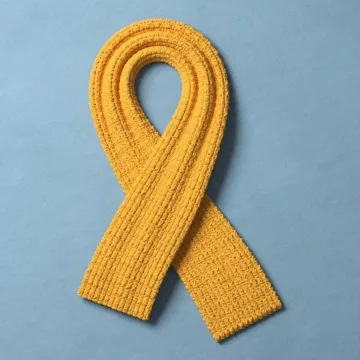
Lay the strip flat, wrong side up and with no twist in it. Fold both short ends in over the middle until they meet edge to edge, the last row beside the foundation edge. The right side is outside, and each long edge runs on into itself.
Turn the work so that the two edges run away from you side by side, the last row at the right and the foundation edge at the left, and whip stitch them together. With a 34 in (86 cm) length of the yarn, leaving a 6 in (15 cm) tail at the start, work 23 stitches, one to each pair of places, the first at the near corner and the last at the far one. Pull each stitch just snug, so that the seam lies flat. Work one more stitch over the last one and cut the yarn, leaving a 6 in (15 cm) tail.
Lay the piece flat, pull it gently to its size, dampen it and let it dry.
About
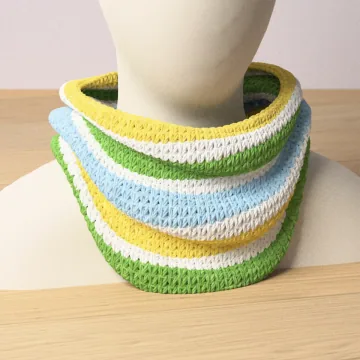
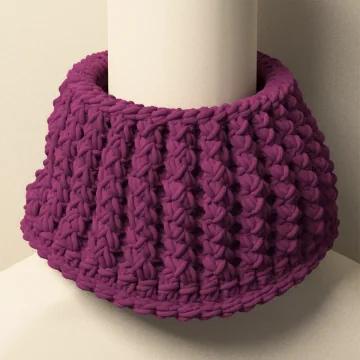
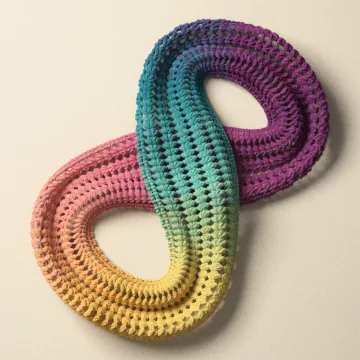
A first cowl in plain single crochet (UK double crochet): one stitch, one color, one hook and one ball of medium yarn, if it holds 165 yards (151 meters) or more. It is one flat strip, every row the same, and its two short ends are sewn together into a ring. The first two rows are told in full words, and so is the seam.
 A slip knot, snug on the hook
 Chain: catch the yarn and draw it through the loop
 Row 1: the hook goes into the 2nd chain
 Single crochet: draw up a loop, then draw the yarn through both loops