Tunisian honeycomb scarf crochet pattern
Crochet, 8½ × 59 in, 3 colors, easy
Size: Standard Change size
Which size? Scarf size chart
PDF. Prints on US Letter and A4.
What you need
- Yarn A deep honeyabout 250 yd (229 m), an estimatemain color
- Yarn B chestnutabout 80 yd (73 m), an estimatestripe
- Yarn C creamabout 15 yd (14 m), an estimatestripe
- Yarn in all
- About 345 yd (315 m) or 380 g, an estimate
- Weight
- Super bulky weight, 6 on the label (UK super chunky)
- Hook
- 10 mm (US N/P-15), or the size that gives you the gauge
- Also
- A Tunisian (afghan) hook or a hook with a cable, 10 mm, long enough for about 10 in (25 cm) of loops, a yarn needle, scissors and a tape measure
- Gauge
- 9 stitches and 8 rows to 4 in (10 cm) in Tunisian honeycomb, which is simple and purl stitch by turns. How to check it
Instructions Standard
How to read these rows
US terms · Show UK terms
- ch chain, sc single crochet (UK double crochet).
- yo yarn over the hook, RS right side, the one that shows.
- [ ] 8 times: work what is inside 8 times in all.
- (19 tss): the stitches you have when the row is done. How to read a pattern.
- Changing colors.
Special stitches
- tss Tunisian simple stitch
- Insert hook from right to left behind the front vertical bar of the st, yo, pull up a loop and leave it on the hook. In row 1 it is worked into the chain, as the notes say. In UK terms it has the same name.
- tps Tunisian purl stitch
- Bring the yarn to the front of the work and let it lie there, insert hook from right to left behind the front vertical bar of the st, then take the yarn to the back and over the hook, pull up a loop and leave it on the hook. In UK terms it has the same name.
Yarns in order of use: B, chestnut; C, cream; A, deep honey.
- StartWith B, ch 19.
- Row 1RSLoop on hook counts as tss, tss in 2nd ch from hook and in each ch across; returnleaves (19 tss)
- Row 2Loop on hook counts as tss, repeat: tps in next st, tss in next st 8 times, tps in next st, tss in last st; returnleaves (10 tss, 9 tps)
- Row 3Loop on hook counts as tss, repeat: tss in next st, tps in next st 8 times, tss in next st, tss in last st; returnleaves (11 tss, 8 tps)
- Rows 4 to 10Repeat rows 2 and 3 in turn: every even-numbered row is worked as row 2, every odd-numbered row as row 3.Row 2: Loop on hook counts as tss, [tps in next st, tss in next st] 8 times, tps in next st, tss in last st; returnRow 3: Loop on hook counts as tss, [tss in next st, tps in next st] 8 times, tss in next st, tss in last st; returnNext: row 4 of rows 4 to 10, worked as row 2
Line in C, cream
- Row 11With C, loop on hook counts as tss, repeat: tss in next st, tps in next st 8 times, tss in next st, tss in last st; returnleaves (11 tss, 8 tps)
- Row 12Loop on hook counts as tss, repeat: tps in next st, tss in next st 8 times, tps in next st, tss in last st; returnleaves (10 tss, 9 tps)
The long part in A, deep honey
- Row 13With A, loop on hook counts as tss, repeat: tss in next st, tps in next st 8 times, tss in next st, tss in last st; returnleaves (11 tss, 8 tps)
- Row 14Loop on hook counts as tss, repeat: tps in next st, tss in next st 8 times, tps in next st, tss in last st; returnleaves (10 tss, 9 tps)
- Row 15Loop on hook counts as tss, repeat: tss in next st, tps in next st 8 times, tss in next st, tss in last st; returnleaves (11 tss, 8 tps)
- Rows 16 to 106Repeat rows 14 and 15 in turn: every even-numbered row is worked as row 14, every odd-numbered row as row 15.Row 14: Loop on hook counts as tss, [tps in next st, tss in next st] 8 times, tps in next st, tss in last st; returnRow 15: Loop on hook counts as tss, [tss in next st, tps in next st] 8 times, tss in next st, tss in last st; returnNext: row 16 of rows 16 to 106, worked as row 14
Line in C, cream
- Row 107With C, loop on hook counts as tss, repeat: tss in next st, tps in next st 8 times, tss in next st, tss in last st; returnleaves (11 tss, 8 tps)
- Row 108Loop on hook counts as tss, repeat: tps in next st, tss in next st 8 times, tps in next st, tss in last st; returnleaves (10 tss, 9 tps)
Block in B, chestnut
- Row 109With B, loop on hook counts as tss, repeat: tss in next st, tps in next st 8 times, tss in next st, tss in last st; returnleaves (11 tss, 8 tps)
- Row 110Loop on hook counts as tss, repeat: tps in next st, tss in next st 8 times, tps in next st, tss in last st; returnleaves (10 tss, 9 tps)
- Row 111Loop on hook counts as tss, repeat: tss in next st, tps in next st 8 times, tss in next st, tss in last st; returnleaves (11 tss, 8 tps)
- Rows 112 to 117Repeat rows 110 and 111 in turn: every even-numbered row is worked as row 110, every odd-numbered row as row 111.Row 110: Loop on hook counts as tss, [tps in next st, tss in next st] 8 times, tps in next st, tss in last st; returnRow 111: Loop on hook counts as tss, [tss in next st, tps in next st] 8 times, tss in next st, tss in last st; returnNext: row 112 of rows 112 to 117, worked as row 110
Last row
- Row 118RSCh 1, sc in first st, sc in next 17 sts, sc in last stleaves (19 sc)
- EndFasten off.
Putting it together
Fringe: cut 60 lengths of B, each about 13 in (33 cm) long. For each knot fold three lengths in half together, pull the fold through the edge with the hook from front to back, pull the ends through the fold and draw it tight. Make 10 knots along each short end: one in the first stitch (or chain), then one in every second one, the last one in the last. At the last row go under both top strands of the sc, at the foundation under the two strands of the V of the ch. Trim the ends level, about 5½ in (14 cm) long.
Finishing
- Weave in the ends with the yarn needle, changing direction once or twice.
- Dampen the scarf, lay it out flat with the right side up, smooth the fringe, and leave it to dry.
About
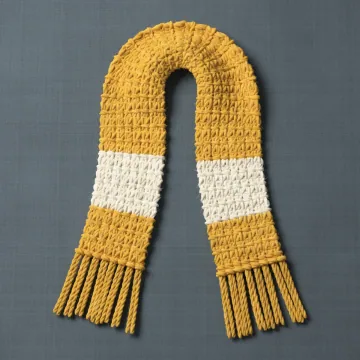
A chunky scarf in Tunisian honeycomb: Tunisian simple stitch and Tunisian purl stitch (both have the same name in UK terms) by turns, and the other way round in the next row, so that the bars and the bumps make a honeycomb. It is deep honey with a chestnut block, a cream line and a chestnut fringe at each end.