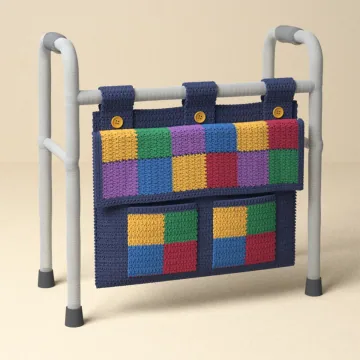
Wheelchair side bag crochet pattern
Crochet, 13¼ in wide, 5 colors, easy
PDF. Prints on US Letter and A4.
What you need
Each amount is an estimate.
- Yarn A charcoalabout 250 yd (229 m)the panel, the straps and the edges
- Yarn B marigoldabout 40 yd (37 m)patches and the flap
- Yarn C coralabout 35 yd (32 m)patches
- Yarn D roseabout 45 yd (41 m)patches
- Yarn E plumabout 60 yd (55 m)the phone pocket and patches
- Yarn in all
- About 430 yd (393 m) or 220 g
- Weight
- Medium weight, 4 on the label (UK aran), acrylic
- Hook
- 5 mm (US H-8), or the size that gives you the gauge
- Also
- Two buttons, ⅞ in (22 mm) across, for the straps, two buttons, ⅝ in (16 mm) across, for the flap and the bottle loop, sewing thread in the color of the buttons and a sewing needle, pins, a yarn needle and scissors
- Gauge
- 15 stitches and 17 rows to 4 in (10 cm) in single crochet (UK double crochet). How to check it
Instructions
How to read these rows
US terms · Show UK terms
- The chain of 1 at the start of a row does not count as a stitch.
Go to: Panel · Tall pocket · Middle pocket · Low pocket · Top edge of a pocket · Phone pocket · Flap · Strap · Bottle loop · Assembly
Panel
Yarn A, charcoal.
- The foundation chain is the lower edge. The right side is the side that shows.
- StartCh 51.
- Row 1RSSc in 2nd ch from hook and in each ch acrossleaves (50 sc)
- Rows 2 to 46Ch 1, turn; sc in each st acrossleaves (50 sc)Next: row 2 of rows 2 to 46
- EndFasten off, leaving a tail of 6 in (15 cm).
Tall pocket
Yarns in order of use: E, plum; D, rose; C, coral.
- The three pockets are worked sideways, so their rows stand upright on the bag: the stitches of a row are the height of the pocket and the three blocks of color its patches.
- StartCh 29.
- Row 1RSSc in 2nd ch from hook and in each ch acrossleaves (28 sc)
- Rows 2 to 10Ch 1, turn; sc in each st acrossleaves (28 sc)Next: row 2 of rows 2 to 10
- Row 11With D, ch 1, turn; sc in each st acrossleaves (28 sc)
- Rows 12 to 20Ch 1, turn; sc in each st acrossleaves (28 sc)Next: row 12 of rows 12 to 20
- Row 21With C, ch 1, turn; sc in each st acrossleaves (28 sc)
- Rows 22 to 30Ch 1, turn; sc in each st acrossleaves (28 sc)Next: row 22 of rows 22 to 30
- EndFasten off, leaving a tail of 6 in (15 cm).
Middle pocket
Yarns in order of use: B, marigold; C, coral; D, rose.
- StartCh 20.
- Row 1RSSc in 2nd ch from hook and in each ch acrossleaves (19 sc)
- Rows 2 to 10Ch 1, turn; sc in each st acrossleaves (19 sc)Next: row 2 of rows 2 to 10
- Row 11With C, ch 1, turn; sc in each st acrossleaves (19 sc)
- Rows 12 to 20Ch 1, turn; sc in each st acrossleaves (19 sc)Next: row 12 of rows 12 to 20
- Row 21With D, ch 1, turn; sc in each st acrossleaves (19 sc)
- Rows 22 to 30Ch 1, turn; sc in each st acrossleaves (19 sc)Next: row 22 of rows 22 to 30
- EndFasten off, leaving a tail of 6 in (15 cm).
Low pocket
Yarns in order of use: D, rose; E, plum; B, marigold.
- StartCh 11.
- Row 1RSSc in 2nd ch from hook and in each ch acrossleaves (10 sc)
- Rows 2 to 10Ch 1, turn; sc in each st acrossleaves (10 sc)Next: row 2 of rows 2 to 10
- Row 11With E, ch 1, turn; sc in each st acrossleaves (10 sc)
- Rows 12 to 20Ch 1, turn; sc in each st acrossleaves (10 sc)Next: row 12 of rows 12 to 20
- Row 21With B, ch 1, turn; sc in each st acrossleaves (10 sc)
- Rows 22 to 30Ch 1, turn; sc in each st acrossleaves (10 sc)Next: row 22 of rows 22 to 30
- EndFasten off, leaving a tail of 6 in (15 cm).
Top edge of a pocket make 3
Yarn A, charcoal.
- Work one on each of the three pockets. Hold the pocket with its right side facing you and row 1 at the right, so that the edge along the top is made of row ends, the ends where the odd rows begin. (In the tall pocket it is the shorter edge of the two, in the others the longer.) Join A with a slip stitch in the end of row 1; the first single crochet goes into that same place. Go along the edge to the left, 1 single crochet in the end of each row, but pass over the ends of rows 10, 20 and 30.
Phone pocket
Yarns in order of use: E, plum; A, charcoal.
- StartCh 15.
- Row 1RSSc in 2nd ch from hook and in each ch acrossleaves (14 sc)
- Rows 2 to 24Ch 1, turn; sc in each st acrossleaves (14 sc)Next: row 2 of rows 2 to 24
- Row 25With A, ch 1, turn; sc in each st acrossleaves (14 sc)
- Row 26Ch 1, turn; sc in each st acrossleaves (14 sc)
- EndFasten off, leaving a tail of 6 in (15 cm).
Flap
Yarn B, marigold.
- The space in row 11 is the buttonhole. The foundation edge is sewn to the panel.
- StartCh 15.
- Row 1RSSc in 2nd ch from hook and in each ch acrossleaves (14 sc)
- Rows 2 to 10Ch 1, turn; sc in each st acrossleaves (14 sc)Next: row 2 of rows 2 to 10
- Row 11RSCh 1, turn; sc in next 6 sts, ch 2, sk next 2 sts, sc in next 6 stsleaves (12 sc, 1 ch-2 sp)
- Row 12Ch 1, turn; sc in next 6 sts, 2 sc in next ch-2 sp, sc in next 6 stsleaves (14 sc)
- Row 13Ch 1, turn; sc2tog, sc in next 10 sts, sc2togleaves (12 sc)
- Row 14Ch 1, turn; sc2tog, sc in next 8 sts, sc2togleaves (10 sc)
- EndFasten off, leaving a tail of 6 in (15 cm).
Strap make 2
Yarn A, charcoal.
- The spaces in rows 24, 29 and 34 are the buttonholes.
- StartCh 8.
- Row 1RSSc in 2nd ch from hook and in each ch acrossleaves (7 sc)
- Rows 2 to 23Ch 1, turn; sc in each st acrossleaves (7 sc)Next: row 2 of rows 2 to 23
- Row 24Ch 1, turn; sc in next 2 sts, ch 3, sk next 3 sts, sc in next 2 stsleaves (4 sc, 1 ch-3 sp)
- Row 25Ch 1, turn; sc in next 2 sts, 3 sc in next ch-3 sp, sc in next 2 stsleaves (7 sc)
- Rows 26 to 28Ch 1, turn; sc in each st acrossleaves (7 sc)Next: row 26 of rows 26 to 28
- Row 29Ch 1, turn; sc in next 2 sts, ch 3, sk next 3 sts, sc in next 2 stsleaves (4 sc, 1 ch-3 sp)
- Row 30Ch 1, turn; sc in next 2 sts, 3 sc in next ch-3 sp, sc in next 2 stsleaves (7 sc)
- Rows 31 to 33Ch 1, turn; sc in each st acrossleaves (7 sc)Next: row 31 of rows 31 to 33
- Row 34Ch 1, turn; sc in next 2 sts, ch 3, sk next 3 sts, sc in next 2 stsleaves (4 sc, 1 ch-3 sp)
- Row 35Ch 1, turn; sc in next 2 sts, 3 sc in next ch-3 sp, sc in next 2 stsleaves (7 sc)
- Row 36Ch 1, turn; sc2tog, sc in next 3 sts, sc2togleaves (5 sc)
- EndFasten off, leaving a tail of 6 in (15 cm).
Bottle loop
Yarn A, charcoal.
- The space in row 27 is the buttonhole.
- StartCh 7.
- Row 1RSSc in 2nd ch from hook and in each ch acrossleaves (6 sc)
- Rows 2 to 26Ch 1, turn; sc in each st acrossleaves (6 sc)Next: row 2 of rows 2 to 26
- Row 27Ch 1, turn; sc in next 2 sts, ch 2, sk next 2 sts, sc in next 2 stsleaves (4 sc, 1 ch-2 sp)
- Row 28Ch 1, turn; sc in next 2 sts, 2 sc in next ch-2 sp, sc in next 2 stsleaves (6 sc)
- Row 29Ch 1, turn; sc in each st acrossleaves (6 sc)
- Row 30Ch 1, turn; sc2tog, sc in next 2 sts, sc2togleaves (4 sc)
- EndFasten off, leaving a tail of 6 in (15 cm).
Assembly
- Weave in the tails of all the pieces on their wrong sides. The right side of every piece shows.
- Lay the panel flat with its right side up and the foundation edge toward you. Pin the tall pocket on it, right side up and its edge of A away from you: 4 stitches of the panel free at its left, its lower edge along the line between rows 3 and 4. Lay the middle pocket on it and the low pocket on that, in the same way, so that the lower edges and the sides of all three are level. Each stands out above the one in front of it. Pin them.
- Cut two lengths of A, each about 94 in (239 cm) long. The seam goes through up to four layers and takes much yarn, so it is sewn in two halves. The first half: beginning at the top left corner of the tall pocket with a tail of 6 in (15 cm), sew the pockets down along the left side and along the lower edge as far as its middle, 15 stitches from the left corner, with the needle up through the pockets one stitch in from their edge and down through the panel beside the edge, one stitch for each stitch or row. Take up every pocket that lies there: at first one, then two, then three. Fasten off. The second half: with the other length begin at the top right corner of the tall pocket in the same way, and sew down the right side and along the other half of the lower edge until you meet the first half. Fasten off. The upper edges stay open. Weave in the four tails on the wrong side of the panel.
- Phone pocket: pin it on the panel, right side up, row 26 away from you, its lower edge along the same line between rows 3 and 4, with 2 stitches of the panel between it and the three pockets and 3 stitches free at its right. Cut a length of E about 76 in (193 cm) long and sew it down in the same way, beginning at its top left corner: down the left side, along the lower edge and up the right side. The upper edge stays open. Fasten off and weave in both tails on the wrong side.
- Flap: pin the flap over the phone pocket, right side up, its foundation edge on row 32 of the panel, 3 rows above the upper edge of the pocket, level with the pocket at both sides, and the rest of it hanging down over the pocket. Cut a length of B about 28 in (71 cm) long. Beginning at one end with a tail of 6 in (15 cm), whip stitch the foundation edge to row 32, 14 stitches. Fasten off and weave in both tails on the wrong side. With sewing thread sew a small button to the pocket under the buttonhole, through the pocket only.
- Straps: turn the panel over, wrong side up, with its last row away from you. Lay the first 5 rows of each strap on it, the wrong side of the strap down, row 1 of the strap 5 rows below the upper edge, so that the rest stands up above it: one strap with 4 stitches of the panel free at its outer side at the left, the other in the same way at the right. For each cut a length of A about 38 in (96.5 cm) long. Beginning at the upper edge of the panel with a tail of 6 in (15 cm), sew the part that lies on the panel down along one long edge, 5 rows, along the short edge, 7 stitches, and along the other long edge, 5 rows, back to the upper edge of the panel, with the needle up through the strap one stitch in from its edge and down through the panel beside the edge. The strap goes on upward from there, so there is no edge to sew: go across it in backstitch, straight up and down through row 5 of the strap and the last row of the panel beneath it, 7 stitches. Backstitch: bring the needle up one stitch length ahead, put it down where the stitch before ended, and go on so in a line without gaps. Fasten off and weave in both tails.
- Turn the right side up again. With sewing thread sew the two large buttons to the panel, each in front of the middle of its strap, on row 44, the third row from the top, through the panel and the strap behind it. To hang the bag, bring each strap up behind the bar, over it and down in front, and button it: with the first buttonhole round a thin bar, with the second or the third round a thicker one.
- Bottle loop: turn the wrong side up once more. Lay the first 5 rows of the bottle loop on the panel at its lower edge, the wrong side of the loop down, row 1 of the loop 5 rows above the lower edge, so that the rest hangs down below it, in the middle below the phone pocket: 7 stitches of the panel are free at its outer side. Cut a length of A about 36 in (91.5 cm) long. Beginning at the lower edge of the panel with a tail of 6 in (15 cm), sew this part down like a strap: along one long edge, 5 rows, along the short edge, 6 stitches, and along the other long edge, 5 rows, back to the lower edge of the panel, and then across the loop in backstitch, straight up and down through row 5 of the loop and the first row of the panel beneath it, 6 stitches. Fasten off and weave in both tails. Turn the right side up, and with sewing thread sew the second small button to the panel in front of the middle of the loop, on row 2, through the panel and the loop. The loop comes up in front and is buttoned there; put it through the handle of a bottle first.
Finishing
- Hang the bag on the arm and check that nothing catches on it before the chair is moved.
About
A slim crochet wheelchair side bag: a charcoal panel with three flat pockets of sunset patches, a phone pocket with a flap and a bottle loop. It is worked in single crochet (UK double crochet) and hangs inside the armrest from two straps. Each strap has three buttonholes, for arms of different thickness, so the bag comes off in a moment for washing.