Working in the round · Intermediate
Camel stitch
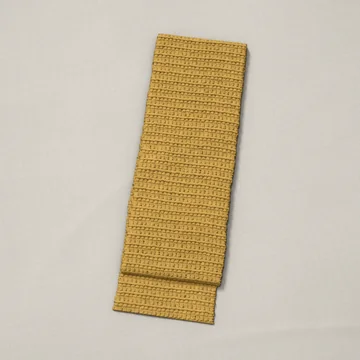
Camel stitch is a half double crochet (UK half treble) worked into the third loop: the strand that lies just behind the two top loops of the stitch. Working there pushes the two top loops forward, so each round leaves a line of sideways Vs on the front of the fabric that looks like knitting. It is worked round and round, with the right side always facing you.
How to work it
Find the third loop

Look at the top of a half double crochet. Two loops make the V you would normally work under: the front loop, nearer to you, and the back loop. Now tip the top edge of the work toward you and look behind the V. Right behind the back loop lies one more strand, running the same way. That is the third loop.
Hook under the third loop only

Yarn over, as for any half double crochet. Put the hook under the third loop of the next stitch and nothing else. Both loops of the V stay in front of the hook.
The stitch pattern, row by row
- Multiple
- Chain any number (6 or more).
- Starting chain
- The rounds here are written for a chain of 26.
- Worked in a spiral with the right side facing; mark the first stitch of each round.
- Round 1 begins in the chain that holds the joining slip stitch and uses every chain of the ring once.
- The third loop of a half double crochet is the bar behind its top two loops. Working there pushes the two top loops forward.
- Foundation. Ch 26, sl st in first ch to form a ring.
- Rnd 1 (RS). Hdc in each ch around (26 hdc).
- Rnd 2. Hdc in third loop of each st around (26 hdc).
Repeat round 2 for the pattern.

What each symbol meansHow to read a chart
Abbreviations in these rows
- ch
- chain stitch
- sl st
- slip stitch
- hdc
- half double crochet (UK half treble)
- rnd
- round
- RS
- right side
- st
- stitch
At a glance
- Also called
- half double crochet in the third loop
- Used for
- hats and hat brims; cowls and infinity scarves; any tube that should look knitted on the outside
- Abbreviation
- None is standard. Patterns write it out: hdc in third loop, or hdc in 3rd loop.
- In UK terms
- camel stitch, the same name: a half treble worked into the third loop
- Loops on the hook
- 3 before the last pull, as for a plain half double crochet
- Multiple
- Any number of chains (6 or more).
- Row repeat
- Round 2.
- Sides
- Has a right side: the lines of Vs are on the outside of the tube.
- Edges
- Worked round and round with no seam; the last round ends in a small step.
The third loop is made by the yarn over that begins the stitch. Taller stitches have one as well, but it is clearest on a half double crochet, which is why camel stitch is usually taught in that stitch.
Rounds make the stitch simple. With the right side always facing you, the third loop is always at the back, every round is worked the same way, and all the Vs end up on the front. In rows the work is turned, so the loop behind the V of the last row faces you on every other row. Makers deal with that in different ways: some change between the third loop at the front and the third loop at the back from row to row, and some work the same third loop on every row, which makes a ribbing. In rows, follow what your pattern says for each row.
Patterns also differ in how they go round. Some join each round with a slip stitch (UK ss) and begin the next with a chain. Others, like the rounds on this page, go round in a spiral with no join, and a stitch marker in the first stitch of the round keeps your place.
Any number of stitches will do. The starting chain is as long as the tube is round.
When it goes wrong
- I cannot find the third loop.
- Tip the top edge toward you and look at the back of the stitch, just behind the V. The strand that runs along right under the back loop is the one. It can be hard to see on the first few stitches and gets easier.
- My fabric has ridges but no Vs on the front.
- The hook went under the back loop of the V. The third loop is a different strand, and it lies behind the back loop. Check that both loops of the V are in front of the hook before you pull up the loop.
- I worked it in rows and it looks different.
- That is how the stitch behaves. In turned rows the Vs do not all lie the same way. For the look on this page, work in rounds.
Left-handed
The pictures show the hook held in the right hand. For the left hand, read each picture as its mirror image.
Variations
- Third loop ribbing, in rows. Half double crochet worked into the third loop on every turned row is one of the ways to crochet ribbing.
Patterns that use it
Questions
- Is camel stitch the same as half double crochet in the third loop?
- Yes. Camel stitch is the name of the fabric, and a pattern writes the stitch itself as a half double crochet in the third loop.
- Does camel stitch look the same on both sides?
- No. In rounds the lines of Vs are on the right side, the outside of the tube. The inside does not have them.
- Is camel stitch the same as waistcoat stitch?
- No, though both look like knitting. Waistcoat stitch is a single crochet (UK double crochet) worked between the legs of the stitch below, and its Vs stand upright in columns. The Vs of camel stitch lie on their sides, in lines that run round the tube.
- How many stitches do I start with?
- Any number. Chain as many as the tube needs, join the chain into a ring without twisting it, and work the first round in plain half double crochet.