Changing color · Intermediate
Checkerboard pattern
A crochet checkerboard is squares of two colors set like a chessboard. Every row is worked in both colors, in single crochet (UK double crochet): a square of one, then a square of the other, with the yarn that is not in use carried inside the stitches. After a band of rows as tall as a square, the two colors change places. In the rows on this page a square is 3 stitches wide and 3 rows tall.
How to work it
Plan the squares

Decide how many stitches wide a square is, and how many squares go across. Each row is a square of the first color, a square of the second, and so on to the end. The chain is the stitches in one square times the number of squares, plus 1.
Swap the colors after each band

Work as many rows as make the squares as tall as they are wide. Then begin the next row with the other color, so that each new square stands over a square of the opposite color. In the rows on this page the swap comes after every 3 rows.
The stitch pattern, row by row
- Multiple
- Chain a multiple of 6 plus 4 (16 or more).
- Starting chain
- The rows here are written for a chain of 22, which is 3 times the multiple of 6, plus 4.
- The ch 1 at the start of a row does not count as a stitch.
- Row 1 is the right side.
- Change yarn in the last yarn over of the stitch before the new yarn begins. Lay the other yarn of the row along the top of the row below and work over it, from the first stitch of the row to the last.
- Foundation. With A, ch 22.
- Row 1 (RS). Sc in 2nd ch from hook, sc in next 2 chs, [with B, sc in next 3 chs, with A, sc in next 3 chs] 3 times (21 sc).
- Row 2. Ch 1, turn; sc in next 3 sts, [with B, sc in next 3 sts, with A, sc in next 3 sts] 3 times (21 sc).
- Row 3. Ch 1, turn; sc in next 3 sts, [with B, sc in next 3 sts, with A, sc in next 3 sts] 3 times (21 sc).
- Row 4. With B, ch 1, turn; sc in next 3 sts, [with A, sc in next 3 sts, with B, sc in next 3 sts] 3 times (21 sc).
- Row 5. Ch 1, turn; sc in next 3 sts, [with A, sc in next 3 sts, with B, sc in next 3 sts] 3 times (21 sc).
- Row 6. Ch 1, turn; sc in next 3 sts, [with A, sc in next 3 sts, with B, sc in next 3 sts] 3 times (21 sc).
- Row 7. With A, ch 1, turn; sc in next 3 sts, [with B, sc in next 3 sts, with A, sc in next 3 sts] 3 times (21 sc).
Repeat rows 2 to 7 for the pattern.
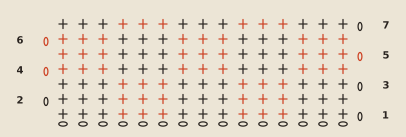
What each symbol meansHow to read a chart
Abbreviations in these rows
- ch
- chain stitch
- sc
- single crochet (UK double crochet)
- RS
- right side
- st
- stitch
At a glance
- Used for
- baby blankets and throws in two colors; a board for checkers or chess
- Colors
- Two, both worked in every row.
- A square, in the rows here
- 3 stitches wide and 3 rows tall.
- Color change
- On the last pull of the last stitch of each square.
- The other yarn
- Carried along the row inside the stitches.
- A game board
- 8 squares each way, 64 in all.
- Multiple
- The chain is a multiple of 6 plus 4 (16 or more).
- Row repeat
- Rows 2 to 7.
- Sides
- Looks much the same on both sides.
- Edges
- The side edges are straight: a row that begins with a chain that does not count begins and ends in a stitch, and that chain is not worked into.
To make the squares larger, give each one more stitches and more rows. The number of rows is whatever makes the square as tall as it is wide in your stitch and yarn, so count on a swatch. Published patterns use squares of 5 stitches and 5 rows in single crochet, and wider squares with fewer rows in taller stitches.
An odd number of squares across, as in the rows here, puts the same color at both side edges. A board for checkers or chess has 8 squares each way, so its chain is the stitches in one square times 8, plus 1, and it has 8 bands of rows.
The carried yarn stays out of sight when the stitches are worked firmly enough to close over it. Lay it flat along the top of the row, neither slack nor pulled tight. It shows most where a dark yarn is carried inside stitches of a light one.
A checkerboard is the plainer relative of gingham. Gingham uses three shades and pairs the middle one with each of the others by turns. With two colors only, worked together in every band, the result is a checkerboard.
When it goes wrong
- The carried yarn shows through the lighter squares.
- The stitches are too loose to cover it. Work them more tightly, and keep the carried strand lying flat along the top of the row.
- My squares are wider than they are tall.
- The band has too few rows. Add rows until a square measures the same both ways, and use that number for every band.
- The squares do not line up from band to band.
- A color change has slipped by a stitch. Count the stitches of each square in the row where the line goes wrong: every square has the same number, and each change is made on the last pull of its last stitch.
Left-handed
The picture of the row shows the hook held in the right hand. For the left hand, read it as its mirror image.
Questions
- How do I crochet a checkerboard pattern?
- Work each row in two colors, changing after a fixed number of stitches and carrying the color not in use inside the stitches. After a band of rows as tall as one square, start the rows with the other color.
- How many chains do I need?
- The stitches in one square, times the number of squares across, plus 1. For the rows on this page that is a multiple of 6 plus 4: 3 stitches a square and an odd number of squares.
- How many squares does a crochet checkers board have?
- Eight each way, 64 in all, in two colors by turns.
- Is a checkerboard the same as gingham?
- No. A checkerboard has two colors. Gingham has three shades, with the middle one in every row.