Changing color · Intermediate
Gingham
Crochet gingham is made of small squares in three shades: a dark one, a light one and one between the two. Every row is worked in two of the three, a square of one and then a square of the other, in single crochet (UK double crochet), with the yarn that is not in use carried inside the stitches. The middle shade is in every row. For a band of rows it is paired with the dark shade, and for the next band with the light one.
How to work it
Work two shades to a row

The squares are worked in bands of rows. In the first band every row is worked in the dark and the middle shade: a square of one, then a square of the other. In the next band every row is worked in the middle and the light shade, the middle shade over the dark squares and the light shade over the middle ones. Then the two bands repeat.
Change shade on the last yarn over

Work the last stitch of a square until two loops are left on the hook, then pull the other shade through both. The loop on the hook is now the shade of the next square, so the line between two squares comes out clean.
The stitch pattern, row by row
- Multiple
- Chain a multiple of 6 plus 4 (16 or more).
- Starting chain
- The rows here are written for a chain of 22, which is 3 times the multiple of 6, plus 4.
- The ch 1 at the start of a row does not count as a stitch.
- Row 1 is the right side.
- Change yarn in the last yarn over of the stitch before the new yarn begins. Lay the other yarn of the row along the top of the row below and work over it, from the first stitch of the row to the last.
- Do not cut a yarn that rests: it waits at the edge where its next row begins and is carried loosely up that edge, over 4 rows at most.
- A is the darkest shade, B the middle one and C the lightest. Blocks are 3 stitches wide and 4 rows tall.
- Each row is worked in two of the three yarns. The third rests at the edge for 4 rows and is there when its rows begin again.
- Foundation. With A, ch 22.
- Row 1 (RS). Sc in 2nd ch from hook, sc in next 2 chs, [with B, sc in next 3 chs, with A, sc in next 3 chs] 3 times (21 sc).
- Row 2. Ch 1, turn; sc in next 3 sts, [with B, sc in next 3 sts, with A, sc in next 3 sts] 3 times (21 sc).
- Row 3. Ch 1, turn; sc in next 3 sts, [with B, sc in next 3 sts, with A, sc in next 3 sts] 3 times (21 sc).
- Row 4. Ch 1, turn; sc in next 3 sts, [with B, sc in next 3 sts, with A, sc in next 3 sts] 3 times (21 sc).
- Row 5. With B, ch 1, turn; sc in next 3 sts, [with C, sc in next 3 sts, with B, sc in next 3 sts] 3 times (21 sc).
- Row 6. Ch 1, turn; sc in next 3 sts, [with C, sc in next 3 sts, with B, sc in next 3 sts] 3 times (21 sc).
- Row 7. Ch 1, turn; sc in next 3 sts, [with C, sc in next 3 sts, with B, sc in next 3 sts] 3 times (21 sc).
- Row 8. Ch 1, turn; sc in next 3 sts, [with C, sc in next 3 sts, with B, sc in next 3 sts] 3 times (21 sc).
- Row 9. With A, ch 1, turn; sc in next 3 sts, [with B, sc in next 3 sts, with A, sc in next 3 sts] 3 times (21 sc).
Repeat rows 2 to 9 for the pattern.
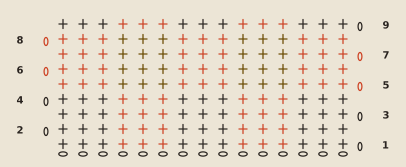
What each symbol meansHow to read a chart
Abbreviations in these rows
- ch
- chain stitch
- sc
- single crochet (UK double crochet)
- RS
- right side
- st
- stitch
At a glance
- Used for
- baby blankets and throws; scarves and hats; a red and black buffalo plaid, made the same way in other colors
- Shades
- Three: dark, middle and light.
- In each row
- Two of the three. The middle shade is in every row.
- A square, in the rows here
- 3 stitches wide and 4 rows tall.
- The other yarn of a row
- Carried along the row inside the stitches.
- Fabric
- Thick and firm.
- Multiple
- The chain is a multiple of 6 plus 4 (16 or more).
- Row repeat
- Rows 2 to 9.
- Sides
- Looks much the same on both sides.
- Edges
- The side edges are straight: a row that begins with a chain that does not count begins and ends in a stitch, and that chain is not worked into.
The middle shade stands for the places where a dark stripe and a light stripe of a woven check cross each other, so it looks like a mix of the two. That is why it is in every row, and why the pattern fails without it: a band worked in the dark and the light shade together gives a plain check of two colors, not gingham.
The fabric is thick, because every stitch has the row's other yarn inside it. With nothing lying across the back, it looks the same on both sides.
The squares can be larger than the ones here. Published blanket patterns often use squares 10 stitches wide and 10 rows tall. Whatever the size, an odd number of squares across puts the same shade at both side edges. The chain is the stitches of one square times the number of squares, plus 1: 3 times 7 plus 1 is the 22 of the rows on this page.
Buffalo plaid is the same construction in other colors: black, a bright shade and a dark shade of the same color, most often red. The dark shade takes the part of the middle one and is worked in every row.
Tips
- Two balls are in use in every row. Keep them apart, each in its own bowl or bag, so that they do not twist round each other.
When it goes wrong
- My gingham looks like a checkerboard.
- The shades are paired wrongly. The middle shade belongs in every row: with the dark shade for one band of rows, and with the light shade for the next. The dark and the light shade are never worked in the same row.
- The carried yarn shows through the stitches.
- The stitches are too loose to close over it. Work them more tightly, and keep the carried yarn just taut enough to lie straight.
- The two yarns keep twisting together.
- Stop and untwist them, and keep the two balls apart from then on.
Left-handed
The pictures show the hook held in the right hand. For the left hand, read each picture as its mirror image.
Questions
- How many colors do I need for a gingham blanket?
- Three: a dark shade, a light shade and one between them. White with two shades of one color is the usual set.
- Is buffalo plaid the same as gingham in crochet?
- It is made the same way. Buffalo plaid uses black, a bright shade and a dark shade of one color, and the dark shade is the one worked in every row.
- Why is a crochet gingham blanket so thick?
- Each row is worked over the yarn it is not using, so every stitch has a second strand inside it.
- How many chains do I start with?
- The stitches in one square, times the number of squares across, plus 1 for turning. For the rows on this page that is a multiple of 6 plus 4. Use an odd number of squares if both side edges are to be the same shade.