Changing color · Intermediate
Harlequin stitch
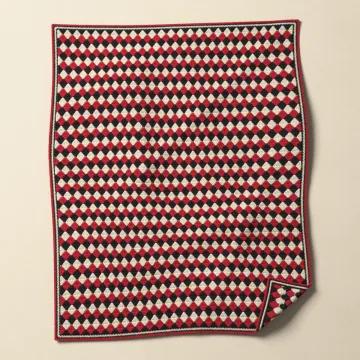
Harlequin stitch is a pattern of shells and clusters. A row of shells is followed by a row of clusters, each made of six stitches of double crochet (UK treble) worked together: the last three of one shell and the first three of the next. Seven chains run between clusters, and the next shells stand on top of the clusters. Worked in stripes of color, the rows make diamonds.
How to work it
Work a row of shells

Chain 1 and turn. Single crochet in the first stitch. Skip 3 stitches and work a shell in the next: 3 double crochets, chain 1 and 3 double crochets, all in one stitch. Skip 3 stitches and single crochet in the next. Repeat the shell and the single crochet to the end of the row.
Work a row of clusters and chains

Turn and chain 3. Work the first 3 double crochets together. Chain 7, skip the chain-1 space in the middle of the shell, and work the next 6 double crochets together, skipping the single crochet between them: the last 3 of this shell and the first 3 of the next. Chain 7 and repeat. End with the last 3 double crochets worked together and a double crochet in the last stitch.
Work the next row of shells

Turn and chain 3. Work 3 double crochets in the top of the first cluster. Then single crochet into the chain-1 space of the shell two rows below, working over the 7 chains so that they are caught inside the stitch. Work a shell in the top of the next 6-together cluster, and single crochet into the next chain-1 space two rows below, over the chains. Repeat, and end with 3 double crochets in the last cluster and a double crochet in the top of the turning chain.
At a glance
- Used for
- baby blankets and blankets; scarves; pillows and cushions
- Made of
- Shells of 3 double crochets (UK treble), chain 1 and 3 double crochets, clusters of 6 double crochets worked together, chains and single crochet
- Multiple
- A multiple of 8 stitches plus 1 for the first row of shells
- Row repeat
- Four rows after the first row of shells
- Loops on the hook
- 7 before a 6-together cluster is closed
- Colors
- Usually several, changed at the end of a row; it can be worked in one color
The name comes from the diamonds: a harlequin is a clown figure in a costume of colored diamonds. The shells and clusters of the rows sit in a staggered pattern that reads as diamonds or wheels once the rows are in different colors. Its fabric is close to Catherine wheel stitch, which is built of shells and clusters too.
The seven chains of the cluster row are not worked into. They lie loose over the middle of each shell until the next shell row, when the single crochet between two new shells is worked into the shell below and round the chains, holding them down.
To change color, work the last stitch of the row in the old color up to its last two loops, then draw the new color through them. The stitch can also be worked in one color, but the diamonds are much harder to see.
Tips
- Count the double crochets you work together: 3 at the start and end of the first cluster row, 6 in every cluster between. Six together leaves 7 loops on the hook before the last pull.
When it goes wrong
- My edges are uneven.
- End each row exactly as its step says. A cluster row that begins with a 3-together cluster ends with one, and the shell row above it begins and ends with 3 double crochets.
- The diamonds do not show.
- Check where the stitches go: each shell is worked into the top of a cluster, and each single crochet between shells into the chain-1 space two rows below. In one color the pattern shows only as texture.
Left-handed
The pictures show the hook held in the right hand. For the left hand, read each picture as its mirror image.
Patterns that use it
Questions
- What is the multiple for harlequin stitch?
- Chain a multiple of 8, plus 2, and work a row of single crochet: that gives a multiple of 8 stitches, plus 1, for the first row of shells. For three shells, chain 26: 3 times 8, plus 2.
- How many colors do I need?
- Any number. It is usually worked in several, changed at the end of a row, so that the diamonds show. In one color it is a textured fabric of shells and clusters.
- Is harlequin stitch the same as Catherine wheel stitch?
- No, but they are close relatives. Both are made of shells and clusters worked over each other, and publishers of this stitch name it as a close relative of Catherine wheel stitch.