Texture · Easy
Herringbone double crochet
The herringbone version of a double crochet (UK treble) differs in one move. Yarn over and put the hook into the stitch as usual. Then yarn over, pull up a loop and draw that loop straight on through the next loop on the hook. Yarn over and pull through one loop, then yarn over and pull through the last two. The stitches slant, and row on row they look like a herringbone weave.
How to work it
Pull up a loop, and straight on through one more

Yarn over and pull up a loop. Three loops are on the hook. Do not yarn over again: draw the loop you have just pulled up straight on through the next loop on the hook, as in a slip stitch. Two loops are left.
Work every stitch and every row the same

Work the same stitch into each stitch across. At the end of the row chain 2, turn, and work back in the same way, starting in the first stitch. The stitches of one row slant one way and the stitches of the next row slant the other way.
The stitch pattern, row by row
- Multiple
- Chain any number (4 or more).
- Starting chain
- The rows here are written for a chain of 22.
- The ch 2 at the start of a row does not count as a stitch.
- Row 1 is the right side.
- Foundation. Ch 22.
- Row 1 (RS). Hbdc in 3rd ch from hook and in each ch across (20 hbdc).
- Row 2. Ch 2, turn; hbdc in each st across (20 hbdc).
Repeat row 2 for the pattern.
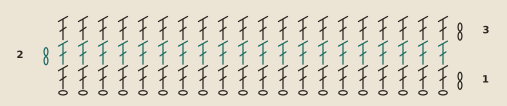
What each symbol meansHow to read a chart
Abbreviations in these rows
- ch
- chain stitch
- RS
- right side
- st
- stitch
- yo
- yarn over
- hbdc
- herringbone double crochet: yo, insert hook in the st, yo, pull up a loop and pull it straight through the first loop on hook, yo, pull through 1 loop, yo, pull through the 2 loops on hook.
At a glance
- Also called
- hbdc
- Used for
- blankets; scarves
- Abbreviation
- hbdc, as in the rows on this page. Patterns also write Hbdc or HBdc.
- In UK terms
- herringbone treble
- Loops on the hook
- 3 after the loop is pulled up, 2 after it is drawn through the next loop, 2 after the chain, 1 at the end
- Multiple
- Any number of chains (4 or more).
- Row repeat
- Row 2.
A plain double crochet pulls up a loop and then works the loops off two at a time, with a new yarn over each time. The herringbone one takes the new loop through the stitch and through the next loop on the hook in one pull, makes one chain in the loop nearest the head of the hook, and closes the last two loops together.
That first pull tilts the stitch. Worked back and forth in turned rows, the tilt changes direction from row to row, and that is what gives the herringbone look.
In the rows on this page the 2 chains at the start of a row do not count as a stitch: the first stitch of the row goes into the first stitch. Other published rows count the turning chain, of 2 or of 3 chains, as the first stitch and work the last stitch of each row into the top of it. Go by the pattern.
Herringbone half double crochet (UK half treble) is the same move one stitch shorter. It has no chain in the middle: after the pull through one loop, the two loops left are closed straight away.
When it goes wrong
- My stitches look like plain double crochet.
- A yarn over crept in after the loop was pulled up. Pull the loop through the stitch and through the next loop on the hook in one move, and yarn over only when two loops are left.
- I lose track of the loops.
- Count as you go: three loops after pulling up, two after the pull through one loop, two again after the chain, then yarn over and through both.
Left-handed
The pictures show the hook held in the right hand. For the left hand, read each picture as its mirror image.
Variations
- Herringbone half double crochet. Yarn over, hook in, pull up a loop and draw it through the next loop on the hook. Then yarn over and pull through both loops.
Questions
- What does hbdc mean?
- Herringbone double crochet.
- How is it different from a plain double crochet?
- After the loop is pulled up through the stitch, it is drawn straight on through one loop on the hook, with no yarn over between. A plain double crochet yarns over at that point and pulls through two loops.
- How many chains do I start with?
- Any number. For the rows here, chain 2 more than the number of stitches wanted: the first stitch goes into the third chain from the hook.
- Why do the stitches slant?
- The pull through one loop tilts each stitch. In turned rows the tilt goes one way on one row and the other way on the next.