Changing color · Intermediate
Larksfoot stitch
Larksfoot stitch is worked in two colors, two rows at a time. Each band is stitches of double crochet (UK treble) in threes, with a gap of one chain between the threes. When the color changes, a long double crochet is worked down through every gap into the band below. The long stitch and the stitch at each side of it make a mark with three prongs.
How to work it
Work the long stitch into the gap two rows down

Yarn over. Do not put the hook into the gap beside it. Put it into the chain space of the row below that one, two rows down, which lies straight under. Yarn over and pull up a long loop, as tall as the row you are working. Then finish like any double crochet: yarn over and pull through two loops, twice. The long stitch wraps round the chain of the row between and covers the gap.
The stitch pattern, row by row
- Multiple
- Chain a multiple of 4 plus 1 (17 or more).
- Starting chain
- The rows here are written for a chain of 21, which is 5 times the multiple of 4, plus 1.
- The ch 3 at the start of a row counts as a dc. The last stitch of the next row is worked into the top of it.
- The ch 4 at the start of a row counts as a dc and a ch-1 sp. The last stitch of the next row is worked into its 3rd ch.
- Row 1 is the right side.
- Change yarn in the last yarn over of the last stitch of the row before.
- Do not cut a yarn that rests: it waits at the edge where its next row begins and is carried loosely up that edge, over 2 rows at most.
- Foundation. With A, ch 21.
- Row 1 (RS). Dc in 4th ch from hook (skipped chs count as dc), dc in next ch, [ch 1, sk next ch, dc in next 3 chs] 4 times (15 dc, 4 ch-1 sps).
- Row 2. Ch 3 (counts as dc), turn; dc in next 2 sts, [ch 1, sk next ch-1 sp, dc in next 3 sts] 3 times, ch 1, sk next ch-1 sp, dc in next 2 sts, dc in top of turning ch (15 dc, 4 ch-1 sps).
- Row 3. With B, ch 4 (counts as dc and ch-1 sp), turn; sk next st, dc in next st, [long dc in next ch-1 sp, dc in next st, ch 1, sk next st, dc in next st] 3 times, long dc in next ch-1 sp, dc in next st, ch 1, sk next st, dc in top of turning ch (10 dc, 4 long dc, 5 ch-1 sps).
- Row 4. Ch 4 (counts as dc and ch-1 sp), turn; sk next ch-1 sp, dc in next 3 sts, [ch 1, sk next ch-1 sp, dc in next 3 sts] 3 times, ch 1, sk next ch-1 sp, dc in 3rd ch of turning ch (14 dc, 5 ch-1 sps).
- Row 5. With A, ch 3 (counts as dc), turn; [long dc in next ch-1 sp, dc in next st, ch 1, sk next st, dc in next st] 4 times, long dc in next ch-1 sp, dc in 3rd ch of turning ch (10 dc, 5 long dc, 4 ch-1 sps).
- Row 6. Ch 3 (counts as dc), turn; dc in next 2 sts, [ch 1, sk next ch-1 sp, dc in next 3 sts] 3 times, ch 1, sk next ch-1 sp, dc in next 2 sts, dc in top of turning ch (15 dc, 4 ch-1 sps).
Repeat rows 3 to 6 for the pattern.
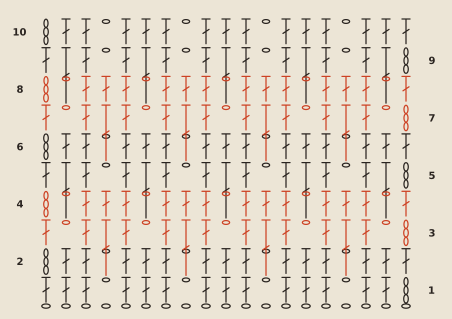
What each symbol meansHow to read a chart
Abbreviations in these rows
- ch
- chain stitch
- dc
- double crochet (UK treble)
- RS
- right side
- sk
- skip
- sp
- space
- st
- stitch
- yo
- yarn over
- long dc
- long double crochet: yo, insert hook in the ch-1 sp 2 rows below, which lies under the next ch-1 sp, yo, pull up a loop to the height of the row being worked, [yo, pull through 2 loops] 2 times; the ch-1 sp in front of it is left unworked.
At a glance
- Used for
- blankets and afghans; baby blankets; scarves
- Multiple
- The chain is a multiple of 4 plus 1 (17 or more).
- Row repeat
- Rows 3 to 6.
- Edges
- The side edges are straight: where a row begins with a chain that counts, that chain is the edge stitch and the last stitch of the next row goes into its top.
- Colors
- Two or more, changed every two rows.
- The long stitch
- A double crochet worked into the chain space two rows below. Patterns call it a long or an extended double crochet.
Four rows repeat: a row with long stitches and a plain row in one color, then the same two rows in the other color with the gaps moved along by two stitches. Because each long stitch is a different color from the band it reaches into, it shows as a spike of color in that band.
Pull the loop of the long stitch up to the full height of the row before finishing it, and leave it loose. A long loop pulled tight drags the rows together and the fabric bunches.
The color changes every two rows, so each yarn ends a band at the edge where it will be wanted again. It need not be cut: it can wait there and be carried up the side.
Tips
- On a row of long stitches, read the row as groups: a long stitch with one double crochet at each side of it, then a gap.
When it goes wrong
- My long stitches pull the fabric in.
- Draw the loop up higher before working it off, level with the top of the stitch beside it.
- I cannot find where the long stitch goes.
- Look two rows down, straight below the gap beside the hook. There are two chain spaces there, one over the other. The hook goes into the lower one.
- My gaps no longer line up.
- On the plain row, every chain goes over a chain and every double crochet into a stitch. A long stitch counts as a stitch: work a double crochet into its top.
Left-handed
The pictures show the hook held in the right hand. For the left hand, read each picture as its mirror image.
Questions
- What is the multiple for larksfoot stitch?
- Three double crochets and a gap take four chains. For the rows here the starting chain is a multiple of 4 plus 1, with the first double crochet in the fourth chain from the hook. The starting chain calculator works out the number for a width of your own.
- How many colors can I use?
- Two at the least. A blanket can have a new color for every band of two rows.