Cross stitch guide
Diamond painting and cross stitch
Diamond painting is not stitching. You press small faceted resin pieces, called drills, onto a sticky canvas that has the chart printed on it. Cross stitch makes the same kind of picture with a needle and thread on woven cloth. Names such as "diamond cross stitch" and "5D diamond painting cross stitch" borrow the words: what they name is diamond painting.
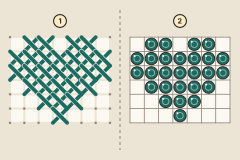
What diamond painting is
A diamond painting starts as a canvas with a grid of symbols printed on it. The printed side is covered in glue, under a clear film. For each symbol you pick up a drill of the matching color with a pen tipped in wax and press it onto its square (2). Peel the film back a little at a time, so the glue stays clean.
Drills are small pieces of resin, flat underneath and cut with facets on top so that they sparkle. They are round or square. Round drills leave tiny gaps. Square ones sit edge to edge like tiles.
What "5D" means. It is a selling word for the way the drills are cut. It has nothing to do with stitching, and it is not a kind of cross stitch.
Makers of diamond painting kits describe the craft as a cross between cross stitch and painting by numbers, because it follows a chart of symbols the way cross stitch does. No needle and no thread are involved.
How the two differ
| Cross stitch | Diamond painting | |
|---|---|---|
| What makes the picture | X-shaped stitches in thread (1) | Resin drills (2) |
| What it is made on | Woven cloth, such as Aida | A canvas coated in glue |
| Where the chart is | On paper or a screen, and you count | Printed on the canvas, under each drill |
| Tools | A needle and scissors | A pen, wax and a tray |
| Each square of the chart | One stitch | One drill |
What they share is the chart: a grid in which every square has one symbol and every symbol stands for one color.
Can you use a cross stitch chart for diamond painting?
The design carries over, square for square. A chart 100 squares wide is 100 drills wide. Three things change.
The size. Most drills are about 2.5 to 2.8 mm across. A stitch on 14 count Aida is about 1.8 mm. So a design 100 squares wide, which stitches up at 7 1/8 inches (18.1 cm) on 14 count, is about 10 to 11 inches (25 to 28 cm) wide in drills.
The colors. Many makers label their drills with DMC floss numbers, so the numbers in a cross stitch key often point straight to a drill color. Others use numbers of their own, and a conversion chart shows which thread number each one matches.
Anything that is not a whole square. A drill fills one square. Backstitch lines, quarter and three-quarter stitches and French knots have no place to go, so a chart in full crosses converts most cleanly.
There is also a practical catch. In diamond painting the chart has to be on the canvas itself, with glue over it. A paper chart cannot be worked from the way a stitcher works from one. The design has to be printed onto a sticky canvas first.
And the other way round?
A diamond painting canvas is a chart of colored squares too, so the same reasoning runs backward: one cross for each drill. Count the squares each way and divide by your fabric count to find the stitched size, as for any pattern.
Where to go next
New to stitching? What is cross stitch explains the craft, and how to read a cross stitch pattern explains the chart. To draw a design of your own as a grid of squares, open the pattern maker.